Showing posts with label shellfish. Show all posts

Sunday, October 11, 2009

Recipe: Clams and Giant White Beans with Buttery Wine Broth (Κυδώνια με Γίγαντες)

Last fall we took a quick trip to San Francisco where, unsurprisingly, the weather was cloudy and the food delicious. One Saturday we went to the Ferry Plaza Farmers Market, ogled vegetables and local cheeses, and ate at Hog Island Oyster Company. Though our table was outside on the chilly plaza, we warmed ourselves with champagne and garlicky Clams with Gigantes and Buttery Wine Broth. We walked away happy.

Gigantes, also known as
giant Greek beans or Phaseolus coccineus (multiflorus), have a starchy texture that is a perfect foil for sauces of all kinds. They're a PGI product of Greece, and always a treat to eat. (In the European Union, a PGI designation identifies foods grown in unique regions that have special qualities and characteristics.)
....

When I was working, I made steamed clams because they were quick. Now I just make them because they taste good. 


Clams with Giant White Beans and Buttery Wine Broth (Κυδώνια με Γίγαντες)
Serves 4
Inspired by Hog Island Oyster Company, San Francisco, California
If you prefer not to eat butter, this dish is delicious when made with extra-virgin olive oil. Gigantes may be cooked several days ahead (or canned beans may be used), in which case this makes a deliciously quick mid-week meal. 


Mediterranean Cooking in Alaska has moved as of March 2011. To read this post please go to


http://www.laurieconstantino.com/clams-with-gigantes/


Please click on over and visit my new site. Thank you!


Saturday, February 21, 2009

Greek Cookbooks: Varoulko: Colors, Smells, and Tastes with Recipe for Sea Urchin Risotto (Ριζότο με Αχινό)

The sun is setting over ice-rimmed Turnagain Arm, the inlet I see out my Anchorage window. The snow sparkles in the setting sun’s reflection.

My body is here, but my mind is in Greece. I’m wading the shallows of a Northern Aegean island, a plastic basin of sea urchins floating beside me. It’s mid-February and the sea urchins are in their prime. Their tongues of “
roe” are plump and full; their flavor captures the sea’s pure essence.

Four master chefs
recently discussed what they wanted for their last meal on earth. For mine, I want a pile of just-harvested sea urchins, followed by a bowl of Lefteris Lazarou’s Sea Urchin Risotto, and then a few more fresh urchins.

Lazarou is the genius chef behind
Varoulko, one of the best seafood restaurants in Athens. He flawlessly cooks sea creatures and, right when their flavors peak, sends them to his guests. One summer night we went to Varoulko and ate under the open sky in an Acropolis-view roof garden. This was our menu:

~~ Whole Wheat Toasts with Sea Urchin Roe
~~ Filo-Crusted Sardines with Silky Smooth Eggplant Sauce
~~ Grilled Calamari with Feta and Wine Sauce
~~ Angel Hair Pasta with Grouper Cheeks, Fresh Oregano, and Tomatoes
~~ Braided, Grilled Garfish Drizzled with Smoky Fava Sauce
~~ Filo Napoleon with Custard, Figs, and Rosemary & Yogurt Sorbet


Because Lazarou focuses on seafoods’ essential flavors, his dishes aren’t overly fussy. To accompany the superb food, Varoulko’s list includes many Greek wines that pair well with seafood.

Varoulko is extremely expensive and not a place for everyday eating. If I want reliably good, reasonably priced, high quality seafood in Athens, I head to fish tavernas;
Logia tis Ploris and Trata o Stelios in Kaisariani are two of my favorites. Yet, for a special occasion, or just to be inspired by Lazarou’s skill, Varoulko is well worth a visit.

In 2006, Lazarou, working with Greek food writer Diane Kochilas, published his cookbook:
Βαρούλκο Χρώματα, Αρώματα και Γέυσεις (Varoulko Colors, Smells and Tastes) (available only in Greek). This may be the most beautiful cookbook I’ve ever seen. It’s printed on high-quality paper that showcases Vassilis Stenos’ stunning food porn. Subtle background drawings of fish, akin to holographic watermarks, grace every page.

Lazarou’s recipes are straightforward and, like the food at Varoulko, emphasize flavor over showy technique. Best of all, his brilliant recipe for Sea Urchin Risotto, the one I want to eat as part of my last meal, is in the cookbook.

If you’re in Greece, head for the shore to gather sea urchins during the next few months. After eating your fill of raw urchins, including a few extra for me, gather enough to take home and make a batch of Lazarou’s Sea Urchin Risotto. )

Those who don’t live near wild urchins can make Sea Urchin Risotto with roe
sold under the Japanese name “uni.” To find it where you live, locate a sushi bar that offers uni and ask for their source of supply.

Sea Urchin Risotto (Ριζότο με Αχινό)
Serves 4
Adapted from
Βαρούλκο Χρώματα, Αρώματα και Γέυσεις (Varoulko Colors, Smells and Tastes) by Λευτέρης Λαζάρου με Νταϊάνα Κόχυλα (Lefteris Lazarou with Diane Kochilas)
Depending on the season, it can take awhile to clean sufficient sea urchins for risotto. The dish is absolutely delicious when made with 1/2 cup fresh sea urchin roe, as Lazarou specifies, and decadent if 3/4 cup roe is used, as I admit to having done. The easiest way to warm plates is to microwave them on high for 1 minute.
Here are directions, with photographs, for opening sea urchins.

1 cup diced yellow onion, 1/8” dice
1/4 cup olive oil
Salt
Freshly crushed white peppercorns
1 cup Arborio rice
4 – 5 cups chicken stock
1/2 cup white wine
1/2 – 3/4 cup fresh sea urchin roe, carefully cleaned of all spines and grit, divided

Sauté the onions, lightly seasoned with salt and freshly crushed white peppercorns, in olive oil until they soften and start to turn golden. Stir in the rice to completely coat it with oil and cook, stirring, for 1 minute. Add the wine, and stir until it’s almost absorbed. Add 1/2 cup stock and cook over moderate heat, stirring constantly, until the stock is almost absorbed. Continue adding stock, 1/2 cup at a time, and stirring while its absorbed, until the risotto is the consistency you desire; it should be moist and creamy, not dry. It takes about 18 – 20 minutes for the rice to cook.

When the rice is just done, stir in 1/4 cup sea urchin roe, and divide the risotto between 4 warmed plates. Make a shallow hollow in the center of each portion, and fill it with the remaining sea urchin roe, evenly divided.

Serve immediately.
~~~~~~~~~~~~~~~~~~~~~~~~~~~~
This is my entry for Bookmarked Recipes hosted and created by Ruth of Ruth’s Kitchen Experiments.

Saturday, February 7, 2009

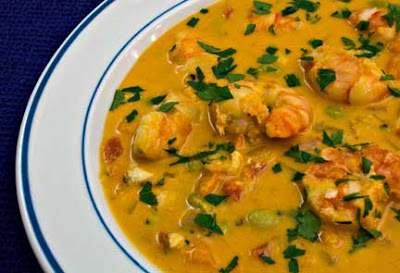
Recipe for Seafood and Vegetable Stew with Rouille (Red Pepper Sauce)

Fish Stew with Vegetables and RouilleFish and Vegetable Stew with Rouille

The discovery of a new dish does more for human happiness than the discovery of a new star.
John Anthelme Brillat-Savarin, Physiologie du Gout (Physiology of Taste) (1825)

Where do recipes come from? Family, community, tradition, and serendipitous accident are easy but incomplete answers.

The primary source of recipes has always been an individual cook’s imagination and palate. Over time, original recipes are modified by other cooks’ imaginations and adjusted by yet more cooks’ palates, to infinity and without limitation.

The food articles I enjoy most are ones that explain how a dish was developed or why a cook chose to combine certain flavors. Although its authors’ cooking styles and skills are quite different from my own, Ideas in Food is one of my favorite blogs. It focuses on the techniques and thought processes that go into creating unique flavor combinations.

I recently made Seafood and Vegetable Stew with Rouille. Here's how it came into being:

My kitchen counter was overflowing with
garnet yams, bounty from more than one Full Circle Farms CSA box. I wanted to do something other than oven-roasting the yams or making oven fries. Looking for inspiration, I randomly pulled cookbooks off the shelves.

Barbara Kafka’s book
Soup: A Way of Life had an interesting recipe for Fall Fish Stew that included sweet potatoes. I decided to try it.

My first version of the stew was similar to Kafka’s, though I substituted sautéed sweet potatoes for boiled and edamame beans for limas. After tasting the broth, I wanted more flavor.

In my next version, I added sautéed onions and red bell peppers, and used a different Rouille recipe than Kafka’s. I seasoned the Rouille with dried, ground red Moroccan pepper (poivron rouge). This version was tasty, but I thought it could be better.

In my final version, I added crushed fennel seeds and shelled shrimp. This combination was exactly what I wanted. Although inspired by Kafka, the final stew is uniquely my own.

Map of High Atlas MountainsI internet-ordered poivron rouge from World Spice Merchants in Seattle, one of my favorite herb and spice purveyors. World Spice describes poivron rouge as “sweet red pepper … produced from sweet round red niora peppers grown in the lush valleys at the foot of the High Atlas Mountains to the northeast of Marrakech.“

Poivron Rouge and PaprikaPoivron Rouge and Sweet Hungarian Paprika
Although Moroccan recipes often call for paprika, niora peppers are what Moroccans use for “paprika.” The flavor of ground niora differs significantly from sweet Hungarian paprika. Niora is spicier and has a fruitier flavor than its Hungarian counterpart, which has a slightly bitter aftertaste.

Moroccan niora peppers are likely the same as the ñora peppers used in
Romesco sauce and other Spanish and Catalonian dishes. In addition to having similar names, nioras and ñoras look the same. Most texts refer to nioras and ñoras only as members of the Capsicum annuum family; in other words, as domesticated peppers. However, in Catalan Cuisine, Colman Andrews says pepper scholar Charles Perry “thinks the nyora [ñora] pepper is the variety scientifically called Capsicum annuum grossum/provar. Pomiforme/sub-var. Conc. Humilirotundum Haz."

No matter what its scientific designation might be, poivron rouge has wonderful flavor and a permanent place in my spice cupboard. Its mildly spicy and fruity tastes make distinctively delicious Rouille and a mouth-wateringly good Seafood and Vegetable Stew.

Seafood Stew with Vegetables and RouilleSeafood and Vegetable Stew with Rouille (Red Pepper Sauce)
Serves 4
The stew may also be made with just fish or just shrimp; if so, use 1 pound of either ingredient. Although not necessary, steamed rice is a nice complement to the spicy, aromatic broth. Serve the rice on the side so eaters can stir the amount they desire into the stew.

1 cup peeled, diced garnet yams or sweet potatoes, 1/2” dice (1 garnet yam)
2 Tbsp. olive oil
Salt
Freshly ground black pepper
1 cup diced red bell pepper, 1/2” dice (1-2 peppers)
1 cup diced yellow onion, 1/2” dice
1 tsp. freshly crushed fennel seed
4 cups fish stock or clam broth (nectar)
1 recipe Rouille (see below)
1 cup shelled edamame beans (thawed) or fresh fava beans
1/2 pound skinless fillets of halibut, rockfish, cod, or other white-fleshed fish, cut in 3/4” pieces
1/2 pound shelled and cleaned shrimp,
16-20 count, halved crosswise
1/4 cup fresh lemon juice (1 lemon)

Minced parsley for garnish

Sauté the garnet yams in olive oil, lightly seasoned with salt and freshly ground black pepper, until they start to brown around the edges. Stir in the red bell peppers and onions, and continue to sauté until the onions soften. Add the crushed fennel seed and sauté for 1 minute. Stir in the fish stock, bring to a boil, turn down the heat and simmer for 15 minutes. (The recipe may be made ahead to this point.)

In a small bowl, whisk one cup of the hot broth into the Rouille. Stir this mixture into the simmering stew pot, along with the edamame beans, fish, and shrimp. Do not let boil or the Rouille may curdle. Simmer for 3-4 minutes, or until the seafood is cooked through. Stir in the lemon juice. Taste and add salt or lemon juice, as needed.

Sprinkle with minced parsley and serve immediately with steamed rice and wedges of lemon.

Rouille
Recipe adapted from
In the Hands of a Chef by Jody Adams
Rouille goes well with all fish, and is a tasty addition to fish salads. The recipe may be doubled or tripled and keeps for a week in the refrigerator.

1 egg yolk
1/2 tsp. Dijon mustard
1 Tbsp. fresh lemon juice
1/4 cup vegetable oil
1/4 cup best quality extra virgin olive oil
2 tsp. chopped garlic
1/2 tsp. salt
4 tsp.
poivron rouge or sweet Hungarian paprika
1/4 tsp. cayenne pepper

Put the egg yolk, mustard, and lemon juice in a blender and mix well. While the blender is running, add the vegetable oil drop by drop so that it emulsifies with the other ingredients. While the blender is running, pour in the olive oil in a steady stream. Add the remaining ingredients and blend until the Rouille is very smooth, scraping down the sides of the blender to ensure all ingredients are thoroughly incorporated.
~~~~~~~~~~~~~~~~~~~~~~
This is my recipe for
Weekend Herb Blogging, hosted this week by Dee from The Daily Tiffin.

Tuesday, November 25, 2008

The Humble Limpet (Petalida): A Treasure of the Sea (Η Tαπεινή Πεταλίδα)

Limpets and OuzoLimpets tightly adhere to rocks in shallow water where the sea meets the shore. They’re found throughout the Mediterranean, and on rocky coastlines around the world.


As a kid growing up on Puget Sound, I gathered limpets’ domed, pointed shells for my shell collection and marveled at their pearlescent undersides. The thought of eating them never crossed my mind.

Then I spent a year on a Greek island in the Northern Aegean Sea.

On a winter afternoon over twenty years ago, my husband returned from a seaside gathering expedition with his cousin Zafiris. Between them, they’d accumulated two giant sacks of sea urchins and a little bag of limpets.

LimpetsI recognized the limpets immediately but couldn’t fathom why two grown men would gather them. “They’re called petalides” my husband said. “Try one, they’re edible.” He pulled out two limpets the size of half-dollars and wiped algae off the undulating brown feet with a corner of his shirt.

He used the edge of one shell to scrape out the body of the other. “Here,” he said, holding up the shell with the freed limpet. I hesitated. “They’re great!” My husband applied a squeeze of lemon to the limpet, which caused it to recoil and contract. When I still hesitated, he popped the limpet in his mouth and smiled, “Mmm, so good. Better than clams. They taste of the sea.”

Both men smelled of ouzo, which did little to enhance their credibility. It was only after Froso, whose food judgment I trust without question, confirmed their edibility that I slurped its contents into my mouth. Chewing the limpet released a sweet sea flavor, more luscious and delicate than clams and more meaty than oysters, but embracing the deliciousness of both.

“Good meze,” Froso pronounced. “Perfect with ouzo,” Zafiris said, raising his glass. “Yamas!”** “Let’s go get some more,” said I.

Gathering LimpetsIt takes good balance to gather limpets. The rocks on which they live are slippery with algae; breaking waves make the rocks even more treacherous.

The top of limpets’ shells can also be covered with algae, making them tricky to find. At night, limpets graze over the rocks, returning to the same spot every morning. One trick to finding them is to look for a meandering path of cleared algae leading to a small bump that is otherwise indistinguishable from the surrounding rock.

Gathering Limpets
Hunting for Limpets, Knife at the Ready

When you spot a limpet, if you look closely, there’s a small gap between its shell and the rock. If you deftly slide a thin knife blade under the shell and along the rock’s surface, the limpet will pop right off. If you fumble and miss the gap or touch the shell, the limpet sucks its shell tightly to the rock. Limpets fit the rocks so perfectly, and with such amazing force, they're impossible to dislodge. If this happens, it’s better to forget that limpet and look for another.

My husband loves the sea and gathering. No trip to the beach is complete without bringing something back: sea urchins, fish, octopus, little crabs, or wild thyme from the shores. After one of his more successful winter forays twenty-one years ago, we ate a pile of fresh-from-the-sea raw limpets dressed only with a squeeze of lemon.

The next day we still had a bowel of live limpets residing in the refrigerator. We decided to try a variation of the Constantino family recipe for Clams Casino. The family tops raw clams on the half-shell with a small square of partially cooked smoked bacon, a dash of Tabasco, and a squeeze of lemon. The clams are then broiled until the bacon curls and slightly browns on the edges.

That winter, we were living in a stone house facing a wind-blown harbor with just an oil drip stove (soba – σόμπα in Greek) for heat. The stove heated only one room, but its hot cast-iron top made a convenient-cooking surface. Since we didn’t have a broiler, we used the stove-top to cook the limpets from below. Though the bacon wasn’t crispy, the married flavor of sea, smoke, pork fat, lemon, and Tabasco was indescribably delicious.

Limpets Casino on the GrillAll these years later, as soon as we arrive on the island and the jetlag wears off, we head straight to the beach with a loaf of bread, some olives, and a bottle of ouzo. We gather a bag of limpets and eat our fill. The next day, we feast on Limpets Casino. Even though we now have a broiler, we use the outdoor grill to cook them from below.

As Zafiris said, limpets are perfect with ouzo, raw or cooked. Yamas!

**”Yamas” is a common Greek toast, and is a contraction of the phrase “Stin ygeia mas” (Στην υγεία μας) which means “to our health.”

Monday, September 15, 2008

Sea Urchins with Tips on How to Open Them (Αχινός)

(From Greece)

Spiky sea urchins may be a bather’s bane, but their freshly gathered roe tops my list of favorite foods.

Urchin roe tastes unmistakably of the sea and has a unique sweetness that can’t be duplicated or satisfactorily described in words. If you love seafood and have access to fresh sea urchins, put aside any trepidation about their prickly spines and jump at the opportunity to enjoy their wonderful flavor.

On the island, urchins are best gathered in February, March, and April. In these months, the sea is cold by Aegean standards and the coral urchin roe, the edible part adhering to the inside of their domed shell, is plump and ripe. Urchin roe is especially prized as a superb and permissible treat during the long Lenten fast.

We’ve enjoyed several springs on the island, but we’re usually here at summer’s end. The days are still hot, gardens are abundant, and the sea is warm. We wait with the parched land for the change of seasons and the fall rains. It’s not prime sea urchin time, so it takes three times as many to make a satisfactory serving. No matter, we still gather enough urchins to remind our taste buds of their exquisite flavor.

Last night the winds were calm, the moon was full, and cousins Giorgos and Tzani invited us on a nighttime urchin expedition.


Agios ErmolaosOur destination was a small church overlooking the sea. On arrival, the men changed into wading gear. Armed with a “louks” (λουξ - a bright kerosene lantern), and “kalamis” (καλάμι – a long bamboo pole split on the end and spread to form two springy fingers that can be pressed over the sea urchins’ spines to pluck them from the water), they entered the sea.

Tzani and I spread out a picnic dinner on the church veranda: perfectly ripe cherry tomatoes, slices of homemade cheese, olives, anchovies, fried peppers, fresh bread, homemade wine, and ouzo. Tzani confided she’d brought extra food in case the men had no luck. We chatted in the moonlight, catching up on the year’s happenings.

Rocks at Agios ErmolaosWe watched the bright lantern light slowly move in the shallows along the rocky fingers that reach out to sea from the church. Men’s voices and snippets of conversation rolled over the water, “be careful, a ledge here…”, ”it's slippery there...”, “that’s a big one…”, “bah, that one’s no good…”, “Wait… Wait… don’t move! An octopus… its legal! Got it.” “Bravo Kapetanio!”

After an hour or so, the men were back, puffed with pride and their catch: two tubs full of urchins, two octopus (about which I will write later), and an incidental cuttlefish. The extra food that Tzani tucked into the picnic bags wasn’t needed last night; the men had been lucky and there were plenty of sea urchins to open.

On the still warm night, under a full moon, with a sky full of twinkling stars and lights from distant jets ferrying strangers across the world, we set upon a meal superior to any served at the finest four-star restaurants.

Opening Sea Urchins Step 1Opening Sea Urchins - Step 1

Opening Sea Urchins Step 2Opening Sea Urchins - Step 2

Opening Sea Urchins Step 3Opening Sea Urchins - Step 3 (Sping-gathered Urchin)

There are several ways to open urchins. The simplest is to plunge one tine of a dinner fork through the shell near the urchin’s mouth and work the fork around in a circle, like an army-issue can-opener. When the circle is complete, the entire bottom falls away.

The urchin’s insides, mostly partially digested seaweed, are usually shaken-out and discarded, though some like to sip the liquid inside the shell. Any remaining membranes are carefully teased away with the back of the fork.

Some people prefer to use an old knife or specially designed urchin-opening scissors to get to the roe, but a simple fork works just fine. If, like me, you have soft hands and don’t want to risk being impaled by urchin spines, wear a sturdy glove on the hand holding the urchin.

Most islanders drizzle opened urchins with few drops of olive oil and a squeeze of lemon or dash of vinegar. Then, with the spiny delight upturned in one hand, they take a square of freshly cut bread in the other and in one swift swirling motion mop up all the savory goodness and pop it into their mouth. I prefer sea urchin roe plain, so lift out each little tongue of colorful roe with a teaspoon, the better to enjoy sea urchins’ unadulterated flavor.

In Greek seafood tavernas, one can sometimes order fresh sea urchin salad (Αχινοσαλάτα), a plate of sea urchin roe dressed with a dash of oil and unobtrusive squeeze of lemon. If you close your eyes when you place a bite of sea urchin salad on your tongue, you can spirit yourself to the veranda of a tiny countryside church, with moonlight sparkling off dark waters, and savor one of the world’s most delicate and complex flavors.


Sea Urchin Salad - Achinosalata (Αχινοσαλάτα)Sea Urchin Salad (Αχινοσαλάτα) at Logia tis Ploris seafood taverna in Athens
(Photograph from Logia tis Ploris Website)

Thursday, June 26, 2008

Recipes for Mango and Feta Salad & Pan-Fried Scallops with Mango Salsa (Μάνγκο και Φέτα Σαλάτα & Χτένια με Μάνγκο Σάλτσα)

Fruit and cheese pair beautifully.

Pears and blue cheese, apple and cheddar,
watermelon and feta: all are wonderful combinations.

When I came across Mango and Feta Salad on
Feeding Maybelle, I started craving it immediately. Feeding Maybelle is my Taste and Create partner this month.

Taste and Create is an event created and organized by
For the Love of Food in which food writers are paired with a randomly assigned partner, and asked to cook and review one recipe from their partner’s blog. Although there are many wonderful recipes on Feeding Maybelle’s blog, I had to try the Mango and Feta Salad.

As is usually the case in Alaska, the grocery store mangos were rock hard. I bought them anyway, and ripened them at room temperature in a brown paper bag. Mango is ripe when it yields to a gentle squeeze (similar to testing avocados for ripeness).

Mangos have a very large, flat seed. The easiest way to remove the seed is to cut off half the mango flesh as close to the seed as possible. Cut off the second mango half as close to the other side of the seed as you can. You’ll be left with two large pieces of mango and a seed encircled by mango flesh.

How to Cut MangoWith the proper technique, cutting up mango is easy. Cut crosshatches in the flesh of each mango half, being careful not to cut through the skin, and push up from the bottom so the mango half is inside out. Cut off the mango chunks and discard the skin. Peel the flesh surrounding the seed and cut off as much mango flesh as possible (or chew it off as a chef’s treat).

The mango is now ready to eat or use in a recipe.

With my mango ripened and cleaned, I turned to the Mango and Feta Salad recipe. Sweet mango, salty feta, herby basil, and spicy pepper dressed with best quality extra virgin olive oil made a wonderful salad and a perfect lunch.

I liked the salad so much I made it again for dinner, only this time I diced the ingredients to make a salsa and added minced jalapeños and red onions. I served the Mango Salsa with Pan-Fried Scallops for a light and delicious summer supper.

Mango and Feta Salad
Mango and Feta Salad (Μάνγκο και Φέτα Σαλάτα)
Serves 1 as a meal and 2 as a side salad
Adapted from
Feeding Maybelle

1 ripe mango, peeled and cut into bite-sized chunks
1/4 cup crumbled feta
1 tsp. minced basil
1 Tbsp. best quality olive oil
Sea salt
Freshly ground black pepper

Lightly toss the mango, feta, basil, and olive oil together. Season with salt and freshly ground black pepper. Serve immediately.

Scallops with Mango Salsa
Pan-Fried Scallops with Mango Saltsa (Χτένια με Μάνγκο Σάλτσα)
Serves 2
It you don’t like spicy food, use only 1 Tbsp. jalapeño.

Mango and Feta Salsa:
1 ripe mango, peeled and cut into 1/2” dice
1/3 cup crumbled feta
2 Tbsp. minced red onion
1 – 2 Tbsp. minced jalapeño
1 Tbsp. minced fresh basil
2 Tbsp. best quality olive oil
Sea salt
Freshly ground black pepper

Scallops:
12 large scallops (about 1 pound)
Salt
Freshly ground black pepper
1 Tbsp. olive oil

Wash the scallops, removing any tough muscle clinging to the scallops' sides. Dry them well and season on both sides with salt and freshly ground black pepper.

Make the Salsa: Lightly toss all the ingredients together. Taste and add salt or freshly ground pepper, as needed.

Cook the Scallops: Heat the olive oil over high heat in a frying pan large enough to hold all the scallops. When the oil is very hot, add the seasoned scallops, and cook on the first side for 2 – 3 minutes, depending on the scallops’ size. Turn the scallops over and cook for 2 minutes more. Except for turning them over the one time, do not move the scallops or fidget with them while they cook. The scallops will brown better if they aren’t repeatedly turned.

While the scallops are cooking, warm the plates (this is easiest to do in a microwave; put the dry plates in the microwave for 1 minute on high). Place equal amounts of mango-feta salsa in the center of each warmed plate. Arrange the scallops around the salsa. Serve immediately.

Monday, June 23, 2008

How to Harvest Spruce Tips with Recipes for Using Spruce Tips (or Pine Tips or Fir Tips)

Spruce tips are one of the more unusual, least used, and tastiest wild edibles in Alaska. Over the last few weeks, I picked a bucketful and had a great time playing and experimenting with them.

(I used spruce tips because they grow in my yard. Pine tips and fir tips are also edible; my spruce tip recipes could just as easily be recipes for pine tips or recipes for fir tips.)

The key to cooking with the tips of evergreen trees is to harvest them when they first begin to emerge from their brown papery casings. At this stage, spruce tips are very tender and have a fresh flavor that tastes lightly of resin with hints of citrus.

As spruce tips mature, the resinous aspect of their flavor intensifies. When the spruce tips begin to harden, form actual needles, and lose their bright spring green color, I no longer use them for cooking.

Spruce tips are rich in Vitamin C. Spruce tip tea (just dry the spruce tips) has long been used by indigenous peoples to soothe coughs and sore throats, and to alleviate lung congestion.

To harvest spruce tips, pop the tips off the end of the bough as if you’re picking berries. When you’re done picking, remove and discard the papery casings, and discard any hard stem that may have broken off with the tip. The spruce tips are now ready to use.

As with all plants, the tips of spruce trees develop more quickly in warmer areas, locations with good sun exposures, and at lower elevations. The tips of spruce trees on the south side of my yard are past harvest time, while those on the north side are still harvestable. Further up the Anchorage hillside (where temperatures are cooler than at my house), there may be spruce trees still ready to harvest.

The first time you try spruce tips, pick only a few to make sure you enjoy their taste. (This is good advice to follow the first time you try any new-to-you wild edible.) For cookie-eaters, a good recipe to start with is Spruce Shortbread – it’s quick, easy to make, and addictively good. When baked in shortbread, spruce tips have an almost fruity flavor, reminiscent of raspberries.

As with many seasonal foods, I try to extend the spruce tip season by preserving them in various forms for later use. Spruce Tip Vinegar, Spruce Tip Salt, Spruce Tip Sugar, Spruce Tip Syrup, and Candied Spruce Tips are all now happily residing in my pantry.

NOTE: If this post is too late in the season to harvest spruce tips in your location, or to harvest pine tips, or to harvest fir tips, bookmark it for next spring and discover the wonderful flavor of evergreen trees.

Spruce Shortbread
Makes 16 1”x 3” cookies
The trick to making shortbread is processing the dough just long enough so that it can be rolled out but still appears a little crumbly in the bowl. If you process the dough until it forms a ball or sticks together in the processor, the cookies will spread out on the baking sheet and their texture will suffer.

1/4 cup fresh spruce tips
1/4 cup sugar
1 cup flour
1/2 cup butter (1 stick)

Preheat the oven to 300°F.

Process the spruce tips and sugar until the spruce tips are finely chopped. Add the flour and process in bursts to mix well, being sure to scrape out any sugar or spruce tips trapped in the corners of the food processor bowl. Cut the butter into 1/2” chunks, add to the processor bowl, and process until the butter is evenly distributed and the dough holds together when pinched.

Dump the dough onto parchment paper and form into an evenly thick rectangle. Roll out with a lightly floured rolling pin until the rectangle is 6”x 8”. Using a straight edge as a guide, cut the rectangle into 1” crosswise strips and then in half lengthwise to form 16 1”x 3” cookies. Prick each cookie 5 times with the tines of a fork. Carefully place on a parchment paper lined baking sheet.

Bake in the preheated oven for 23 – 26 minutes, or until the cookies are set and just starting to turn golden (not browned). Let cookies cool before serving. Store in an airtight container.

Spruce Tip Mayonnaise
Makes 1 cup mayonnaise
Spruce Tip Mayonnaise is a wonderful spread for Bacon-Lettuce-Tomato (BLT) Sandwiches, as a dip for Grilled (or Steamed) Artichokes or Shrimp, in Potato Salad, or in any recipe where an extra boost of flavored mayonnaise would be welcome.

1 cup mayonnaise
(homemade or store-bought)
1/4 cup minced spruce tips
2 tsp. lemon juice

Thoroughly mix all the ingredients. Let flavors blend for at least 1 hour before serving.

Grilled Artichokes with Spruce Mayonnaise: Parboil artichokes in salted water, cut in halves or quarters, clean out the choke, toss with salt and olive oil, and grill over a medium-hot fire. Serve with Spruce Mayonnaise on the side.

Shrimp with Spruce Mayonnaise: I prefer using side-stripe shrimp or spot shrimp, two kinds of cold water shrimp that remain moist and tender after cooking. Boil a large pot of salted water, dump in the shrimp, turn off the heat, and let shrimp remain in the water until cooked through, about 2 - 3 minutes. Serve with Spruce Mayonnaise on the side.

BLT with Spruce Mayonnaise: Cut bacon slices in half and cook until crispy but not over-browned. Spread Spruce Mayonnaise on toasted bread, top with slices of tomato, cooked bacon, and crispy lettuce. Top with another slice of tasted bread spread with spruce mayonnaise.


Spruce Tip Gravlax
Make
Gravlax substituting 1 cup of roughly chopped spruce tips for the dill. Although I scrape off the dill and peppercorns before serving my regular gravlax, I leave on the aromatics with Spruce Tip Gravlax. The peppercorns and cured spruce tips add wonderful flavor to the salmon. (The recipe makes 2 sides of salmon gravlax. I quarter the salmon sides and freeze all but one of the quarters for later use.)

Spruce Tip Vinegar
Makes 2 cups vinegar

Use Spruce Tip Vinegar to add an interesting twist to mixed greens salads, raw or cooked.

2 cups red wine vinegar
1 cup roughly chopped spruce tips
1 tsp. black peppercorns

Mix all the ingredients, put in a jar, and cover. Let the vinegar sit at room temperature for 10 days, shaking the jar from time to time. Strain into a sterilized bottle.

Spruce Tip Salt
Spruce tip salt is particularly good on potatoes and other root vegetables.


1/2 cup coarse salt
1/2 cup roughly chopped spruce tips

Process in bursts until the spruce tips are finely ground. Let dry at room temperature in an uncovered pie pan, stirring a couple times a day, until the flavored salt is completely dry. The salt will initially be very moist; break up any lumps as you see them forming. When the salt is dry, give it a whir in the food processor to break up any remaining lumps. Store in an airtight container.


Spruce Tip Sugar
The sugar can be used to add extra flavor to baked goods, to flavor tea, or to make winter batches of Spruce Shortbread.

1 cup granulated sugar
1 cup roughly chopped spruce tips.

Process in bursts until the spruce tips are finely ground. Let dry at room temperature in an uncovered pie pan, stirring a couple times a day, until the flavored sugar is completely dry. The sugar will initially be very moist; break up any lumps as you see them forming. When the sugar is dry, give it a whir in the food processor to break up any remaining lumps. Store in an airtight container.

Spruce Tip Syrup
Use spruce tip syrup on pancakes, waffles, or French toast, to sweeten beverages, or to make ice cream.


2 cups sugar
2 cups water
2 cups roughly chopped spruce tips.

Put all the ingredients in a saucepan and slowly bring to a boil. Simmer for 5 minutes. Turn off the heat and let the syrup cool completely. Strain, put in a sterilized container, and refrigerate until ready to use.
Candied Spruce Tips
As my final step in making Spruce Syrup, I use it to candy some spruce tips. This enhances the syrup’s flavor while making a tasty garnish.

Spruce Syrup (see above)
1 cup whole spruce tips
1/2 cup sugar

After straining the Spruce Syrup, and before refrigerating it, add 1 cup whole spruce tips and slowly bring to a boil. Simmer for 2 minutes. Turn off the heat and let the spruce tips cool in the syrup. Strain the syrup, put in a sterilized container, and refrigerate until ready to use. Thoroughly drain the syrup off the spruce tips. In small batches, toss the damp spruce tips in granulated sugar to coat and spread the candied spruce tips out on waxed paper to dry. When the candied spruce tips are dry (this may take several days), put them in an airtight container, and refrigerate until ready to use.

~~~~~~~~~~~~~~~~~~~~~~~~~~~~~~
This is my entry for Weekend Herb Blogging, hosted this week by its creator, Kalyn from Kalyn's Kitchen.


From my front window: Moose at Rest

Monday, May 19, 2008

From a Volcanic Isle with Recipe for Shrimp Santorini in Tomato and Caper Sauce (Γαρίδες Σαντορίνης)

Santorini SunsetWhite-washed houses, bright blue skies, sun sparkling on the sea, and brilliant sunsets. Some of Greece’s most iconic images are of Santorini.

Santorini is an island in the southern Aegean Sea and a regular stop for cruise ships wending their way through the Greek isles. Although it's jam-packed with tourists during the summer months, visitors to Santorini, dazzled by its dramatic beauty, write glowingly about their time on the island.

Modern Santorini was shaped by a violent volcanic eruption that occurred around 1500 BC. The volcano blew away the center of the island, forming a huge caldera. Some have theorized that Santorini is the site of mythical Atlantis, and the eruption is what caused Atlantis to be swallowed by the sea. Santorini’s volcano is still active.

Two years ago, we visited Santorini in early April. Because the season had not yet begun, we often had Santorini’s narrow village streets to ourselves. Many of the shops were closed. We had a great time.

The shopkeepers and restaurant owners were happy to see us, not yet jaded by a full season of tending tourists. Over glasses of Santorini’s crisp Assyrtiko white wine, our hotel’s owner told us about the island’s bone-dry volcanic soil and the crops that thrive in it.

“Waterless” tomatoes, capers, yellow split peas (called fava in Greece), and wine grapes are Santorini’s most important agricultural products. When we left, my bags were packed with jars of sun-dried Santorini tomatoes, dried capers, pickled caper leaves, and a kilo of fava.

One of the best things I ate on Santorini was locally-caught Shrimp in Tomato and Caper Sauce. The intense taste of Santorini’s sun-dried tomatoes boosted the sauce’s tomato flavor, and tangy capers made the dish truly special.

Shrimp Santorini in Tomato and Caper SauceShrimp Santorini in Tomato and Caper Sauce (Γαρίδες Σαντορίνης)
Serves 4
Capers are salty, so don’t add too much salt until after you’ve tasted the sauce with capers in it. Shrimp stay more tender when cooked at low temperature. No matter the temperature, shrimp cook quickly and must be watched carefully to prevent them from overcooking and getting tough. My husband likes this with a little fresh lemon juice squeezed over; I prefer it without.


Tomato Sauce:
1 1/2 cups diced onions, 1/4” dice
2 Tbsp. olive oil
Freshly ground black pepper
1/2 tsp. Aleppo pepper (optional)
1/2 cup dry white wine
1 14.5-ounce can diced tomatoes or 1 1/2 cups fresh, with juices
1 1/2 cups water
1 bay leaf
2 tsp. oregano
3 Tbsp. minced sun-dried tomatoes in oil or 1 1/2 Tbsp. tomato paste
3 Tbsp. capers, preferably salted, rinsed and soaked to remove excess salt


Shrimp:
1 1/2 pounds shrimp, shelled
Lemon wedges (optional)


Sauté the onions, lightly seasoned with salt and freshly ground black pepper, in olive oil until the onions soften and start to turn golden. Stir in the Aleppo pepper and cook for 1 minute. Add the white wine and boil until it is reduced by half. Stir in the tomatoes, water, bay leaf, and oregano. Bring to a boil, cover, turn down the heat, and simmer for 45 – 60 minutes or until the sauce thickens and its flavors meld together. If the sauce is too thick, add a little water. Turn off the heat and stir in the sun-dried tomatoes and capers. Taste and add salt or freshly ground black pepper, as needed. (This can be made well ahead.)

Wash and dry the shrimp. Season them on both sides with salt and freshly ground black pepper. Bring the sauce to a simmer and add the shrimp. Cook just until the shrimp turn pink, about 5 minutes total for medium-sized shrimp. Serve immediately with chunks of feta cheese, oil-cured black olives, a crisp green salad, and plenty of crusty bread for mopping up the sauce.
~~~~~~~~~~~~~~~~~~~~~
This is my entry for
Antioxidant Rich Foods/Five-a-Day Tuesdays hosted by Sweetnicks.

Monday, April 14, 2008

Recipes: Steamed Alaska King Crab & Spinach with Garlic and Preserved Lemon

For the last five days, I’ve been celebrating my birthday. I’ve indulged myself, and been indulged by my friends and husband. My house looks ravaged (indulgence=no cleaning). My blog’s been neglected (indulgence=no writing).

Now it’s Monday, and time to pick up the pieces. The dishwasher’s humming, and a load of clothes is in the washer. I’ve taken out the crab shell laden garbage.


The crab shells are from one of my birthday indulgences: live Alaska king crab.

I’ve only ever seen live king crab in Alaska, which is a pity because it’s the best tasting seafood I’ve ever had in a life of searching out the world’s finest foods from the sea. When fresh, Alaska king crab tastes sweet and salty, with a firm, meaty texture. Frozen king crab legs don’t do justice to the glorious flavor of fresh king crab.

When I was young, we used to buy live king crab off the dock: $5 for small crabs (5-8 pounds) and $10 for large crabs (8-12 pounds). In those days, boiling up a mess of Alaska king crab was one of my favorite company dinners. That was before over-fishing threatened king crab stocks and king crab fishing became a highly regulated industry, as it is today.

Now we’re lucky to find live king crab and rarely pay less than $50 for one small crab. In the old days I used to cook with king crab as an ingredient (and still make crab cakes out of rare leftovers). Now, it’s so expensive that I only serve unadulterated crab, perhaps with a little melted butter on the side.

Steaming crabs is a recent innovation in our house. For years, I followed my mother’s lead and boiled live crab (guts and all, for better flavor). Then I read about a lobster taste test in which steamed lobsters beat out boiled, so decided to try steaming crab. As with the lobster I’d read about, steamed crab has better, more concentrated flavor than when it’s boiled. Call me a steaming convert.

After I cooked and cleaned the crab, I put it in the refrigerator to chill. That meant making space in my woefully overcrowded refrigerator. When I jerked the bag of Full Circle Farm spinach from where it was precariously balanced on the top shelf, a jar of preserved lemons came tumbling down on me.

Inspired by the falling jar of lemons, I added some to the spinach I was serving that night as a side dish. The tart, salty lemons were a wonderful addition to the earthy taste of spinach. This easy recipe is a keeper.

Steamed Alaska King Crab
Steaming crab couldn’t be easier. Put an inch or so of water in the bottom of a large stockpot, pop in a steamer, bring the water to a boil, put the live crab on the steamer, and steam it for 15 – 25 minutes, depending on the size of the crab. When the crab is cool, clean it by discarding the gills and innards. Separate the legs and break the body in half, using paper towels if needed to protect your hands from the spiny shells. Refrigerate until ready to serve. Serve with little bowls of melted butter, and nut crackers or kitchen shears.


Spinach with Garlic and Preserved Lemon
Serves 4


2 large bunches of spinach
2 Tbsp. garlic
Salt
Freshly ground black pepper
3 Tbsp. olive oil
1 tsp.
harissa or 1 tsp. crushed red pepper
1/4 cup minced preserved lemon peel (peel from 1 preserved lemon) or 1 Tbsp. finely grated lemon peel (see NOTE)
2 Tbsp. lemon juice

Wash the spinach in two changes of water to remove all the grit. Remove and discard the stems and tear any large leaves into pieces.

Sauté the garlic, lightly seasoned with salt and freshly ground black pepper, in olive oil over medium heat until the garlic softens. Do not let the garlic brown. Stir in the harissa.

Add the spinach, and stir until it wilts (you may need to add the spinach a little at a time so it fits in the pan). When all the spinach is wilted, remove it from the heat, taste and add salt, pepper, and harissa, as needed. Stir in the minced preserved lemon peel and lemon juice and serve immediately.

NOTE: Preserved lemons are often used in Moroccan cooking. They are tart, salty, and very easy to make. If you use
my recipe for preserved lemons, you’ll have to let the lemons cure for at least a week before you can use them. If you don’t want to bother making them, you may buy preserved lemons at Middle Eastern markets, specialty stores, and online. To use preserved lemon, remove it from the brine in which it is swimming and rinse it well. Remove the flesh, and any stringy bits from the inside of the peel. The peel is now ready to use.

~~~~~~~~~~~~~~~~~~~~~~
Preserved Lemon Recipes
Preserved Lemons, Candied Lemon Peels, and Sparkling Mint-Lemonade (I make preserved lemons, candy the extra lemon peels, and use leftover syrup for sparkling lemonade.)
Moroccan Salmon, Fennel-Preserved Lemon Salad, & Sweet Potato Oven Fries (I deconstruct a Moroccan tagine, and use preserved lemons to make Preserved Lemon Aioli and in a fennel and red pepper salad.)
Moroccan Eggplant Salad with Preserved Lemon (Susan flavors eggplant salad with preserved lemons, and makes a preserved lemon martini).
To find more preserved lemon recipes, Food Blog Search is a great tool.
~~~~~~~~~~~~~~~~~~~~~~

This is my entry for
Antioxidant Rich Foods/Five-a-Day Tuesdays hosted by Sweetnicks.

Wednesday, March 12, 2008

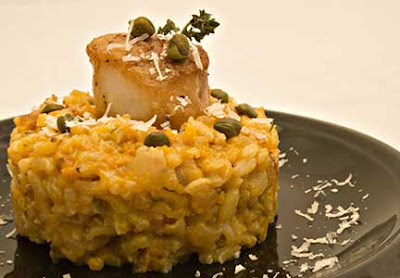
Recipes: Butternut Squash and Pancetta Risotto & Pan Fried Scallops and Capers (Κολοκύθα Ριζότο με Ιταλική Πανσέτα & Χτένια με Κάπαρης)

When I first started making risotto, Arborio rice wasn’t available in Anchorage, Alaska’s largest city. Because Arborio, a short-grain Italian rice, makes superior risotto, I imported it in my luggage or by mail-order. In those years, risotto was special occasion fare.

More recently, local stores stocked Arborio rice, but charged a premium for it. Although it became a pantry staple, ever cost-conscious, I still limited how often I made this toothsome treat.

Last month, our local Costco began selling imported Arborio rice in 3 kilo (6.6 pound) boxes for a very reasonable price. Now I guiltlessly make risotto whenever I want.

The firm, yet creamy, texture of perfectly cooked risotto is the perfect foil for vegetables of all kinds. Combined with
beets or squash, risotto is warming winter fare. In spring, I like it with peas or artichokes. In summer, I look forward to lighter risottos flavored with basil or lemons.

Yesterday, I needed to use a butternut squash that had been sitting on the counter for way too long. I also had a handful of leftover sea scallops. It was definitely time to make an old favorite: Butternut Squash Risotto with Pan-Fried Scallops.

Black-pepper pancetta from Salumi and salt-cured capers, booty from a recent trip to Seattle, rounded out my list of risotto ingredients. The result was an attractive, full-flavored dish that we enjoyed for a mid-week meal and that would be perfect for serving to company.

Butternut Squash and Pancetta RisottoButternut Squash and Pancetta Risotto (Κολοκύθα Ριζότο με Ιταλική Πανσέτα)
Serves 4 - 6
Butternut Squash and Pancetta Risotto makes a filling meal served on its own with a light salad. It pairs well with seafood; see recipe below for Pan-Fried Scallops and Capers, a lovely partner for the risotto. To make vegetarian Butternut Squash Risotto, leave out the pancetta, sauté the onions in olive oil, and use vegetable stock. To make the vegetarian version extra special, stir in a little truffle oil just before serving.

Squash:
1 1/4 pound butternut squash (1 pound cleaned; 3 cups cut in 3/4” dice)
3 Tbsp. olive oil
Salt
Freshly ground black pepper

Risotto:
1/2 cup diced pancetta, 1/4" dice
1 cup diced onion, 1/4” dice
Salt
(if the pancetta is very salty, omit the salt)
Freshly ground black pepper
1 cup Arborio rice
1 Tbsp. minced garlic
1 cup dry white wine
1 Tbsp. minced fresh thyme, sage, or rosemary
4 – 5 cups vegetable or chicken stock
3/4 cup freshly grated Parmesan cheese

Preheat oven to 450°F.

Roasting the Squash: Remove the squash skin with a knife or vegetable peeler, cut in half, remove the seeds, and cut into 3/4” dice. Put the diced squash on a rimmed baking sheet and toss it with salt, freshly ground black pepper, and 2 tbsp. olive oil. Bake for 20 – 25 minutes or until the squash is browned on at least one side. Remove from the oven and place in a strainer to drain off excess oil.
(The recipe may be made ahead to this point.)

Making the Risotto: In a sauté pan large enough to hold the finished risotto, sauté the pancetta until the fat renders and the pancetta begins to brown. Stir in the onions, lightly seasoned with salt and freshly ground black pepper, and sauté until the onions soften and begin to turn golden. Stir in the rice so it is completely coated with oil and cook, stirring, for 1 minute. Stir in the garlic and cook for one minute. Add the wine; bring to a medium boil and cook, stirring, until the wine is almost absorbed. Stir in the roasted squash.

Add 1/2 cup of stock and cook over moderate heat, stirring constantly, until the stock is almost absorbed. Keep adding stock, 1/2 cup at a time, and stirring until each addition of stock is almost absorbed. When the rice is half done, stir in the thyme.
(The recipe can be made ahead to this point, and finished right before serving. If you are going to make it ahead, after you take the rice off the burner, stir it until it cools down.)

Continue adding stock, 1/2 cup at a time, and stirring until the rice is tender, but still firm in the center (this takes 18 – 22 minutes). There may be stock left over. Stir in 1/2 cup of grated parmesan. Add stock until the risotto is the consistency you desire; it should be moist and creamy, not dry. Taste and add salt and freshly ground black pepper, as needed.

Serve immediately with the remaining grated parmesan on the side for sprinkling on top.

Scallops and Capers with Butternut Squash RisottoPan Fried Scallops and Capers with Butternut Squash Risotto (Χτένια και Κάπαρης με Κολοκύθα Ριζότο)
Serves 6

Don’t start cooking the scallops until the risotto is done.

1 recipe Roasted Butternut Squash Risotto (see above)
2 Tbsp. capers (preferably preserved in salt)
12 large scallops (about 1 pound)
Salt
Freshly ground black pepper
1 Tbsp. olive oil
3 Tbsp. fresh lemon juice

If using salt-preserved capers, rinse off the salt and let them soak in cold water for 10 – 15 minutes, and then rinse them again. If using brined capers, rinse off the brine. Dry the capers.

Wash the scallops, removing any tough muscle clinging to the scallops' sides. Dry and season them on both sides with salt and freshly ground black pepper.

Heat the olive oil over high heat in a frying pan large enough to hold all the scallops. When the oil is very hot, add the seasoned scallops, and cook for 2 – 3 minutes, depending on the scallops’ size. Turn the scallops over and cook for 2 – 3 minutes more. Except for turning them over the one time, do not move the scallops or fidget with them while they cook. The scallops will brown better if they aren’t repeatedly turned.

While the scallops are cooking, warm up 6 plates (this is easiest to do in a microwave; put the dry plates in the microwave for 1 minute on high). Place equal amounts of risotto on each of the warmed plates.

When the scallops are done, turn off the heat and top each serving of risotto with two scallops. Stir the lemon juice and capers into the still-warm pan, scraping up any browned bits on the pan’s bottom.

Top each scallop with a drizzle of pan juices and a sprinkling of capers. Serve immediately.

~~~~~~~~~~~~~~~~~~~~~~~~~

Τhis is my entry for Weekend Herb Blogging hosted this week by Kel from Green Olive Tree.

Saturday, December 29, 2007

Seven Seafoods 2007: Recipe for Scallops Piccata (Χτένια Πικάντικο)

Scallops Piccata, with its vibrant lemon sauce, is a variation of Veal Piccata, a classic Italian dish. Although purists may claim capers don’t belong in Piccata sauce, I enjoy the piquant flavors of capers and lemon together. Capers also pair particularly well with seafood, so I included them in my Scallops Piccata recipe.

Capers are sold pickled or preserved in salt. Salt helps retain the subtle floral flavor of capers, which too often is overwhelmed by the vinegar used during pickling. For this reason, I recommend using salt-cured capers whenever capers are used uncooked or cooked for only a short time, as they are in Scallops Piccata.

Many gourmet stores carry salted capers, and they are available from internet sellers. Salt-cured capers are not cheap, but because of their intense flavor, are worth buying. For more information about capers, go here.

Scallops PiccataPan Seared Scallops Piccata (Χτένια Πικάντικο)
Serves 2 as a main course or 4 as an appetizer

4 Tbsp. capers (preferably preserved in salt)
12 large scallops (about 1 pound)
Salt
Freshly ground black pepper
1 Tbsp. olive oil
1/3 cup lemon juice
1/2 cup dry white wine
4 Tbsp. butter

If using salt-preserved capers, rinse off the salt and let them soak in cold water for 10 – 15 minutes, and rinse them again. If using brined capers, rinse off the brine. Dry the capers and roughly chop them if they are large.

Wash the scallops, removing any tough muscle clinging to the side of the scallop. Dry and season them on both sides with salt and freshly ground black pepper.

ScallopHeat the olive oil over high heat in a frying pan large enough to hold the scallops. If you are serving more than two people as a main course, you may need to use two frying pans for this task; scallops too close together in a pan will steam rather than pan-fry.

When the oil is very hot, add the seasoned scallops, and cook for 2 – 3 minutes, depending on the size of the scallops. Turn the scallops over and cook for 2 – 3 minutes more. Except for turning them over the one time, do not move the scallops or fidget with them while they cook. The scallops will brown better if they aren’t repeatedly turned.

While the scallops are cooking, warm up a plate (this is easiest to do in a microwave; put the dry plate in the microwave for 1 minute on high). When the scallops are done, put them on the warmed plate while you make the sauce.

Add the lemon juice and white wine to the frying pan, scraping up any browned bits or caramelization on the bottom of the pan. Cook until the liquid has reduced to 1/3 cup. Turn off the heat and whisk in the butter, 1 Tbsp. at a time. Stir in 3 Tbsp. of the capers.

Spoon a pool of sauce onto each of 2 (or 4) plates, top with the browned scallops, and sprinkle with the remaining capers.

Seven Seafoods 2007: Recipe for Fennel Steamed Clams with Italian Sausage (Αχηβάδες με Μάραθο και Ιταλικό Λουκάνικο)

My parents faithfully read my blog.

After I wrote my first post about this year’s Seven Seafoods Feast, my mother found the menu she had saved and annotated from our 1998 Christmas Eve dinner. It was a great time. My sister and I spent the day cooking, and my seafood-loving parents were able to attend. My father e-mailed me the menu today.

1998 Seven Seafoods MenuThe menu shows we ate well in 1998: gravlax, oysters, clams, calamari, shrimp, king crab, and scallops were all part of the meal. Although the food was just as good, this year’s Christmas Eve dinner was no match for 1998, when much of my family was happily together and the food was joyously cooked with my sister. I’ll remember the 1998 meal for the rest of my life.

This year we only made it through four courses. We started slowly with Oysters and Mignonette Sauce. We gorged on Tuna Tartare with Mint, Sesame Oil, and Hot Peppers, and finished off the Spicy Pesto Grilled Shrimp. By the time we started in on the Periwinkles in Dill-Onion Wine Broth, we were whipped.

We couldn’t eat the clams, crab, or scallops.

For Christmas Eve, I’d planned to simply steam the clams with fennel. But for lunch on Christmas Day, when clams were the only thing on the menu, I enhanced the broth with sweet Italian sausage. The result was a rich, warming stew, perfect for a snowy winter day.

Fennel-Steamed Clams with Italian SausageFennel Steamed Clams with Italian Sausage (Αχηβάδες με Μάραθο και Ιταλικό Λουκάνικο)
Serves 2 as a main course or 4 as an appetizer
The Italian sausage is optional. If you leave it out, sauté the onions and fennel in 3 Tbsp. of olive oil.

3 pounds clams
1/4 lb. Italian sausage (optional)
1 1/2 cups diced yellow onion, 1/2” dice
1 cup diced fennel bulb, 1/2” dice (1 fennel bulb)
1 tsp. Aleppo pepper or 1/2 tsp. crushed red pepper
1 tsp. fennel seed, ground
1 1/2 cups dry white wine
Freshly ground black pepper
1/4 cup minced fresh parsley

Wash the clams to remove any sand or dirt; discard any that will not close or have broken shells.

If the sausage is in a casing, remove the casing. Using a pot that has a lid and is large enough to hold all the clams, crumble the sausage into the pan and cook until all the pieces have browned. Add the yellow onion and fennel bulb and sauté them in the sausage fat until the vegetables soften and start to turn golden. Stir in the Aleppo pepper and fennel seed and cook for 1 minute.

Add the clams, white wine, and freshly ground black pepper, and stir to evenly distribute the ingredients, being careful not to break the clam shells. Bring the wine to a boil, cover, turn the heat down to medium, and cook just until the clams open. Remove the pan from the heat and stir in the parsley.

Serve the clams and sausage with the broth and plenty of crusty bread.