Showing posts with label eggs. Show all posts

Wednesday, July 14, 2010

Bhutanese Refugees in Anchorage, Alaska with Recipe for Lamb's Quarters & Tomatoes with Eggs (Χόρτα και Ντομάτες με Αυγά)

Lush baskets of greens lined the table: crumpled dark Lacinato kale, sweet golden-stalked Swiss chard, deep maroon piles of earthy red orach. The sign read, “Fresh International Gardens.”

“Good morning! Where’s your farm?” The answer to my standard market question was a surprise: “Mountain View.”

Mountain View, a densely populated neighborhood within Anchorage’s urban core, is an unlikely spot for a market garden. “How much land do you have?” “8000 square feet.”

A commercially viable garden in Alaska on less than 1/5 of an acre? I looked again at the people staffing the booth. Of diverse ages and ethnicities, they didn’t fit the typical farm family image.

“Is Fresh International Gardens a farm? Or a group?” I hesitated. “Or what?”

The answer: “Or what.” Fresh International Gardens is part of the Refugee Farmers’ Market Program. This program helps refugees, newly arrived in Anchorage, adjust to uprooted lives in a new country. In addition to gardening, the program teaches entrepreneurial and life skills essential to succeeding in Alaska.

The thriving program grew from a seed planted by Julie Riley, longtime Anchorage Cooperative Extension Service Horticulture Agent. In 2004, Riley successfully helped Hmong refugees from Southeast Asia adapt their gardening skills to Alaska’s cold climate. This success inspired Catholic Social Services to work with Riley and others to create the Refugee Farmers’ Market Program. Using municipal land next to Mountain View’s McPhee Park, the program is now in its fourth year.

Most refugees working on the 2010 garden are originally from Bhutan. Over the last 10 months, a group of nearly 100 Bhutanese refugees began the challenging process of creating lives in Alaska after many difficult homeless, stateless years.

Bhutan is a land-locked country the size of Switzerland. It lies between China and India on the Himalayas’ eastern edge; Nepal is to the west. In the late 19th century, the Lhotsampa (meaning southerner in Bhutanese) began emigrating to Bhutan from Nepal, largely to work as laborers for the Bhutanese.

The Lhotsampa settled, built homes, and grew families in Bhutan. Life continued uneventfully until the late 1980s. At that time, the ethnic majority ruling Bhutan became worried about its ethnic group being outnumbered by Lhotsampas. To prevent this, the rulers began a program of ethnic cleansing, forcibly expelling many Lhotsampas from the country.

The forcible expulsions left over 100,000 Lhotsampas, including Anchorage’s new residents, stranded for nearly two decades in Nepalese refugee camps. It wasn’t until 2008 that various countries, including the US, began admitting Bhutanese refugees for permanent resettlement.

Last Thursday I went to the Fresh International Garden site on McPhee and talked with gardener and market entrepreneur Bishnu Subedi.

Subedi said he was forced from his home by the Bhutanese government in 1992. He lived in Nepalese refugee camps until Alaska welcomed him last year. “Seventeen years. Seventeen years, no home. Now, in Alaska, apartment. A home.” Subedi smiled, hesitantly.

While we talked, Subedi and a fellow refugee cleaned and turned a new garden bed, planting it with spinach seed. The men were neatly dressed; their shirts freshly ironed. They deftly and swiftly worked shovel and hoe with bare feet.

Subedi is just now learning English, and spoke it haltingly. He described his plans: work hard, feed his family, get a green card, become a citizen. He laughed, shrugged, and said, “For now, have apartment. But is home. Home.” He smiled again, this time broadly.

I walked further into the garden where three Bhutanese women were weeding beds of thickly planted greens. They heaped all but one kind of weed in piles for disposal. The women treated lamb’s quarters (Chenopodium album) differently. This plant was separated out and added to plastic grocery bags that were already full when I arrived.

Though weeds, lamb’s quarters are delicious edible greens. Since none of the women spoke English, I couldn’t ask if they planned on eating lamb’s quarters. Kelly Ingram, a Vista volunteer working for the Refugee Farmers’ Market Program, had an answer: the women used lamb’s quarters as an ingredient in curry.

Wild lamb’s quarters are gathered for food all around the globe. Uniquely, the Himalayan region, where Lhotsampas survived in Nepalese refugee camps, is the one area in the world where lamb’s quarters are domesticated. It is grown there for its leafy greens and as a grain crop. Lamb’s quarters is a quinoa relative; up to 70,000 poppy-sized seeds grow on every plant. The seeds are ground into flour, cooked as porridge, made into alcoholic beverages, and used as livestock feed.

Unlike countries with subsistence economies, wild foraging is a rarity in modern America. Lamb’s quarters and other wild greens are usually seen only as noxious weeds that pop up in home gardens and interfere with efficient commercial crop production. As a result, few Alaskans have tried tasty lamb’s quarters.

Lamb’s quarters are related to spinach and Swiss chard, and can be substituted for those greens in any recipe. Its flavor is milder, and its leaves slightly firmer, than spinach. Although young lamb’s quarters leaves may be eaten raw, I prefer them cooked. Then again, I also prefer spinach cooked.

Of the wild greens that grow in Alaska, lamb’s quarters is one of the easiest to harvest. (First time foragers may want to review my Rules for Gathering Wild Plants.) Cut off the top 6-8” of each plant, remove any damaged or diseased leaves (look carefully, lamb’s quarters are susceptible to leaf miner damage), and strip the leaves and soft seed heads from the stem. These are ready to use in your favorite greens recipe; the stem may be discarded.

Lamb’s quarters freeze well. Harvest the greens before seeds form, blanch in boiling salted water for 30-45 seconds, drain, cool, squeeze out excess water, package in freezer bags, and freeze.

Lamb’s quarters thrive on land that’s been previously cultivated, or any place they can get an easy foothold. In my yard, they're particularly fond of the topsoil pile, where loose dirt and ready nutrients attract a nice patch of lamb’s quarters every year.

Returning from my trip to the Fresh International Gardens, I had a powerful hankering for lamb’s quarters. Lacking a Bhutanese curry recipe, but being rich in farm fresh eggs, I lunched on a Greek village favorite: eggs cooked on a bed of wild greens and tomatoes.
Lamb's Quarters and Tomatoes with Eggs takes less than 30 minutes to make, including the time to harvest the lamb’s quarters (assuming you're behind on your weeding so have lamb's quarters readily available). Despite its simplicity and humble ingredients, the flavors are luxuriant: runny yolks combine with vegetable juices to form an enthrallingly rich sauce.

Lamb's Quarters and Tomatoes with Eggs (Χόρτα και Ντομάτες με Αυγά)
Serves 2
Any wild or domesticated greens may be used in this recipe. Milder greens, such as lamb’s quarters, nettles, spinach, and Swiss chard, taste best. Feta cheese, bread, and Kalamata olives typically are served with this dish.

6 cups greens, cleaned of stems and damaged leaves
1/2 cup diced onion, 1/4” dice
1 Tbsp. olive oil
Salt
Freshly ground black pepper
1 cup diced fresh tomato, 1/4” dice
2 Tbsp. minced fresh mint or basil
4 eggs

Blanch greens in boiling salted water for 30-45 seconds. Drain, rinse with cold water, and squeeze out as much water as you can from greens (do this in batches using your hands or all at once using a clean dish towel). Roughly chop the blanched greens.

Sauté onion, lightly seasoned with salt and freshly ground black pepper, in olive oil. When onions begin to turn golden, add chopped greens and tomato. Mix well. When greens are hot, taste and add salt or freshly ground black pepper as needed. Stir in mint or basil.

Spread greens evenly over bottom of the pan and make an indentation for each egg in greens. Break one egg into each hole, lightly season with salt, turn heat down to low, and cover pan. Cook until egg whites just solidify and yolks are still liquid. Serve immediately.

~~~~~~~~~~~~~~~~~~~~~~~~~~~~~~~~
Fresh International Gardens sells produce every Wednesday at the Northway Mall Farmers’ Market and alternating Saturdays at the University Center Farmers’ Market and the Spenard Farmers’ Market. Volunteers are needed to help with the Refugee Farmers’ Market Program; for more information about volunteer opportunities, contact Kelly Ingram at 786-6331.
~~~~~~~~~~~~~~~~~~~~~~~~~~~~~~~
This post is included in Weekend Herb Blogging compiled by Susan at The Well-Seasoned Cook.

Saturday, July 10, 2010

Recipe for Squash Blossom Frittata (Κολοκυθοανθοί με Αυγά)


Haul from Wednesday's Farmers' Market: parsley, dill, Swiss chard, beets, spinach, broccoli, orach, zucchini, squash blossoms, cucumbers, tomatoes

Farmers’ market season is upon us. Stalls are bursting with fresh greens and herbs. Early broccoli and zucchini are spottily available. The first bunches of baby carrots appeared today. 


Making Tostadas

Surprises abound at the markets: scarlet vine-ripened tomatoes from Delta Junction, Matanuska Creamery's Caramel Cashew ice cream made using only milk from Alaska, steaming pots of homemade pozole and elote, blowsy ‘Flemish Antique’ peony poppies, freshly gathered duck and chicken eggs from Future Farmers of America.

Among the abundance, golden squash blossoms stand out as a rare treat. Never in stores, they're available only during their short season to home gardeners and farmers’ market shoppers. So far this year, only Rempel Family Farm is selling squash blossoms in Anchorage (50 cents each on Wednesday at Northway Mall Farmers’ Market and Saturday at South Anchorage Farmers’ Market).


Delicate squash blossoms don't like plastic bags. If paper bags aren't available, wrap in newspaper.

All squash blossoms are edible and may be used interchangeably. Because we grow zucchini at home, I’ve gotten used to calling them zucchini flowers. The more generic term, squash blossoms, is usually more accurate when buying from farmers who grow a wider range of squash.

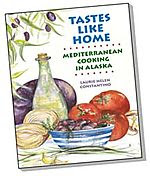
I love stuffing squash blossoms with cheese and cooking them until they’re crispy and oozing with hot, melted cheese. (Tastes Like Home: Mediterranean Cooking in Alaska has recipes for 2 different cheese fillings for zucchini flowers.) Herby essence of basil brightens the flavor of Cheesy Potato-Basil Stuffing for zucchini flowers, and pairs well with a side of fresh greens. Squash blossoms are also tasty dipped in a tempura batter and simply fried.


Blue and brown eggs from Future Farmers of America; both had deep golden yolks.

On days when I want the flavor of squash blossoms, and don’t want to fiddle around or mess with hot oil, I make Squash Blossom Frittata.  Today we had farm-fresh, golden-yolked eggs, fresh herbs, and creamy fresh goat cheese to pair with the squash blossoms. Sighs of satisfaction replaced conversation as we ate; I finished by licking my fingers, wanting more.


Squash Blossom Frittata (Κολοκυθοανθοί με Αυγά)
Serves 2-4
Food writers often advise to remove pistils and stamens from inside squash blossoms, as well as the green bases (calyxes/calyces) and stems. Don’t do it. These parts are all edible and add wonderful flavor and texture. I remove the stems in this recipe purely for decorative reasons; without stems, the blossoms form a perfect pinwheel in the frittata. Use enough flowers to complete a pinwheel; about 8 large, 10 medium, or 12 small.  Accompany Squash Blossom Frittata with a crisp garden lettuce salad and dry white wine.

8-12 squash blossoms
5 eggs
2 Tbsp. minced fresh dill
1/2 cup diced shallots, 1/4” dice (may substitute green onions, see Note below)
1 Tbsp. butter, plus 1 tsp. (divided)
Salt
Freshly ground black pepper
3-4 Tbsp. fresh goat cheese
Dill sprigs for garnish (optional)

Prepare the Squash Blossoms:  If necessary, gently brush off dirt or debris from flowers; don’t wash or get them wet. Carefully open flowers and shake out any insect hitchhikers. Cut off stems, but leave green bases attached. 

Prepare Eggs:  Whisk together eggs and dill with a light seasoning of salt and freshly ground black pepper.  Using a heavy 9-10” oven-proof frying pan (cast iron works best), sauté shallots, lightly seasoned with salt and freshly ground black pepper, in 1 Tbsp. butter until they soften and start to turn golden.  Add sautéed shallots to eggs and whisk to blend (reserve excess butter in pan for cooking frittata).

Cook Frittata:  Preheat broiler to high.

Melt remaining 1 tsp. butter in pan used to cook shallots, arrange squash blossoms in pinwheel around bottom, and cook over medium heat for 30 seconds. Turn blossoms, and evenly pour whisked egg mixture over them. Break goat cheese into pieces and scatter over eggs. Turn heat down to low, cover pan, and cook until eggs are almost set, but still runny on top, about 4-5 minutes.  Put under broiler to finish cooking eggs. Flip out onto platter, garnish with dill sprigs, and serve.

Note: Green onions may, but don’t need to, be sautéed. If you use green onions and don’t sauté them, reduce butter to 2 tsp. and whisk green onions into eggs with dill.

~~~~~~~~~~~~~~~~~~~~~~~~~~~~~
This post is included in Weekend Herb Blogging compiled by Cinzia from Cindystar.


Peony Poppy 'Flemish Antique', Papavar somniferum paeoniflorum

Friday, November 6, 2009

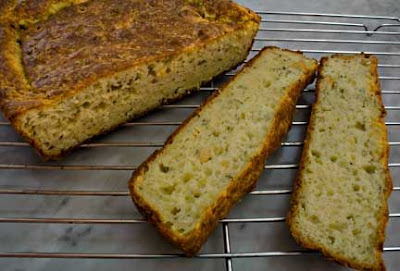
Salty Cake (Easy Cheese Bread) (Kέικ Αλμυρό)

Greeks are famously hospitable.  Visitors to Greek homes are warmly welcomed and showered with treats of all kinds.  Coffee with sweet pastries, ouzo with savory delicacies, water with preserved fruits; no matter your beverage, a Greek hostess quickly puts together a tasty accompaniment.

For some of us, enjoying Greek hospitality comes with a cost: overeating.  Before I spoke Greek, this was more of a problem. Because we couldn’t converse, people communicated love and affection by giving me double portions. Since everything was delicious, and I didn’t know how to decline, I ate it all.  Unfortunately, I was gaining 5-10 pounds for every month we spent in Greece, and dieting for 2 months afterwards so my clothes would fit again.

I finally learned how to say no. This is more difficult than it sounds.  It’s nearly impossible for a Greek hostess to accept “no” for an answer. The more you decline, the more you’re offered.  It’s also slightly rude on my part; if I were a more polite guest, I’d graciously accept some of the tasty tidbits.

After ten years of declining all snacks (and apologizing for being such a difficult guest), our friends and family have grudgingly accepted this peculiarity of mine – at least when it comes to sweets. Diabetes is rampant in the village and, in the last few years, turning down sweets has become a medical necessity for many.  Since so many can’t eat sweets, village hostesses now keep a supply of “salty” (almyro-αλμυρό) snacks on hand.

In the village, salty snacks aren’t things like potato chips, pretzels, and peanuts. Salty, in this context, just means not sweet.  Salty cookies (koulourakia) look identical to sweet cookies but, without the sugar, taste like thick crackers. Salty cakes include ingredients like cheese, olives, or ham; in the US, they’re called quick breads.

Lately, when I decline something sweet, a hostess may triumphantly declare that she has something salty instead.  Surely, I can try a few bites of a salty treat, something with absolutely no sugar? No, I sadly say, I can’t manage anything salty either, even though I’m sure it’s absolutely delicious.

Although I’m a difficult guest, I happily fulfill my duties as a hostess. In our village house, where visitors constantly stop by, the refrigerator is stocked with beverages, pastries are in the cupboard, and there’s even a salty little something for those who don’t eat sweets.

Treasured Recipes: A Collection of Personal Recipes from the Women Members of the Hellenic Athletic Club of Khartoum and Their Friends (Khartoum 1983), the Sudanese-Greek cookbook I recently wrote about, has an interesting recipe for Salty Cake.  This recipe is quite simple, but produces a rich, cheesy quick bread with wonderful flavor and a hint of mint. It’s tasty served to visitors as a snack or for brunch, but it also makes a nice accompaniment to soup or chili.


Salty Cake (Easy Cheese Bread) (Kέικ Αλμυρό)
Makes 1 9”x9” square bread or 1 9”x5” loaf
Adapted from Lefko Tsanakas and Lucy Vassiliou’s recipe for “Cake Almiro” in Treasured Recipes: A Collection of Personal Recipes from the Women Members of the Hellenic Athletic Club of Khartoum and Their Friends (Khartoum 1983)
Lefko and Lucy call for either feta or a combination of various cheeses, but emphasize using some “feta cheese is essential.” The recipe may be doubled and baked in a Bundt pan for an attractive brunch offering (when doubling the recipe, use 7 whole eggs and no egg yolks). This bread is best served warm. If you bake it ahead, wrap it in foil and refrigerate; to serve, warm in a 350°F oven for 20 minutes.

3/4 cup softened butter
3 large eggs
1 egg yolk
2 cups crumbled feta or 1 cup crumbled feta and 1 cup grated graviera, asiago, or other cheese
2 Tbsp. dried mint, crushed
1 3/4 cup flour
1 1/2 Tbsp. baking powder
3/4 cup milk

Preheat the oven to 350°F.

Butter a 9” square pan or 9”x5” loaf pan, dust bottom and sides with flour, tap out and discard any excess flour.

Beat the butter until creamy. Beat in the eggs and yolk, one at a time.  Add the cheese and mint and mix to combine.  Stir together the flour and baking powder.  Add flour to the cheese mixture one third at a time, alternating with additions of milk (one third at a time), until all is combined. Pour batter into the prepared pan. Smooth out the top to evenly distribute the batter.

Bake for 45-60 minutes, or until the bread has a nice brown crust on top.  Let cool for 30 minutes and remove from pan. Serve warm or at room temperature.

Saturday, September 20, 2008

Recipe for Eggplant Clafoutis (Κλαφουτί με Μελιτζάνες)

Eggplant Clafoutis(From Greece)

Eggplant Clafoutis: I saw the reference in my blog reader and quickly went to find the recipe. Alas, while TS and JS at
Eating Club Vancouver came up with the idea, they deemed their recipe “A. Weird. Failure.”

Though Eating Club hated their recipe, the more I thought about Eggplant Clafoutis, the more I wanted it. My craving was timely; I had an embarrassment of eggplant riches. A sack of eggplant sat in a cool corner of the kitchen (
eggplant shouldn't be refrigerated) and the plants in our garden remain productive.

After two nights of falling asleep to thoughts of Eggplant Clafoutis, I broke down and made it.

Clafoutis (klah-foo-TEE) is a simple-to-make, country dessert from France, in which fruit is baked in a custardy batter. There are a million and one different clafoutis recipes. I’ve tried many of them, some wonderfully delicious and others only pretty darn good. The best clafoutis is light-textured and not too sweet, allowing the flavor of the fruit to shine.

I’ve never made or tasted savory clafoutis before, and couldn’t find an actual Eggplant Clafoutis recipe. Instead of a recipe, I used basic principles of sweet clafoutis-making for my savory version. The first step was deciding how best to pre-cook the eggplant (Eating Club used uncooked eggplant, which they deemed a mistake). Because I planned on serving this dish as a light lunch, I didn’t want it to be oily.

EggplantAs eggplant cooks know all too well, it soaks up oil like a sponge. This is because eggplant flesh has many tiny air pockets just waiting to fill up with oil. According to Harold McGee, America’s preeminent food scientist, “the absorptiveness of eggplant can be reduced by collapsing its spongy structure before frying. This is accomplished by precooking it – microwave works well – or by salting slices to draw out moisture from the cells and into the air pockets.” On Food and Cooking: The Science and Lore of the Kitchen (2nd Rev. Ed.), Harold McGee, 2004. Based on personal experience, I agree with McGee that salting reduces, but doesn’t eliminate, eggplant’s sponge-like qualities.

While we’re on the subject of salting, some people recommend pre-salting eggplant to draw out its juices before cooking to remove alleged bitterness. Over the years, I’ve done repeated side-by-side tastings of salted and unsalted eggplant and have never detected bitterness in either version. It may be the bitterness meme is a holdover from days when eggplant was more bitter than it is today (McGee: “Farmers and plant breeders have worked for thousands of years to reduce the bitterness of … eggplants…”).


McGee says modern eggplants can turn bitter when they’re grown in dry conditions, which North American supermarket eggplants are not. Interestingly, McGee says salting doesn’t actually eliminate bitterness, but may reduce “our perception of the alkaloids” thus “suppress[ing] the sensation of bitterness.”

In any case, I rarely bother with pre-salting eggplant. The best ways to avoid oily eggplant are to “steam-fry,” oven-roast, or grill it. I use steam-frying for eggplant chunks, oven-roasting at high temperature for slices, and grilling whenever we have a fire going. To steam-fry, eggplant is briefly sautéed, which helps develop its flavor, and then steamed in a covered pan until the eggplant is fully cooked. I like letting steam-fried eggplant char a little as it cooks, the smokiness adds wonderful flavor to the finished dish.

Since I wanted chunked eggplant in the clafoutis, I steam-fried it. This worked well; it brought out eggplant’s subtle flavors that are sometimes masked by too much oil or tomato sauce. After spreading the cooked eggplant over the bottom of a springform pan, I topped it with cheese, sautéed onions, and a batter flavored with basil and garlic.

The finished dish was full of flavor, and slices of it, paired with a tomato and onion salad, made a delicious, warm from the oven, lunch. The next day I served Eggplant Clafoutis cold, cut into diamonds, as part of an appetizer table (mezedes – μεζέδες) and it disappeared quickly. Like its sweet siblings, savory clafoutis is equally good served warm or at room temperature.

This recipe for Eggplant Clafoutis was “A. Great. Success.” Many thanks to
Eating Club Vancouver for the inspiration.

Eggplant ClafoutisEggplant Clafoutis (Κλαφουτί με Μελιτζάνες)
Serves 4 – 6 as a main course or 12 – 16 as an appetizer

Eggplant:
1 pound eggplant, peel left on and cut into 1” chunks
2 Tbsp. olive oil
Salt
Freshly ground black pepper
Water

Clafoutis:
1 cup grated graviera, kasseri, or asiago cheese
2 cups diced onion, 1/2” dice
2 Tbsp. olive oil
1/2 tsp. crushed red pepper flakes (optional)
3/4 cup all purpose flour
1/4 tsp. salt
1 3/4 cup milk
1/4 cup strained yogurt
3 tbsp. minced fresh basil or mint
1 Tbsp. minced garlic
Salt
Freshly ground black pepper
3 eggs

Preheat the oven to 450°F.

Steam-Fry the Eggplant: Heat the oil in a large sauté pan over high heat. Add the eggplant chunks, lightly season with salt and freshly ground black pepper, and quickly stir the eggplant to brown it. When the eggplant starts sticking to the pan add 1/4 cup of water, stir to distribute, cover the pan, and reduce the heat to medium high. Let the eggplant steam until you can hear it sizzling (which means all the water has cooked off). Add 2 Tbsp. of water, stir to distribute, and cover the pan. Repeat until the eggplant is just cooked through. If the eggplant chars a little in between doses of water, all the better; the char adds good flavor to the finished dish.

Make the Clafoutis: Grease the bottom and sides of a 9” round springform pan or 9”x9” square pan (if you want to serve the clafoutis upside down, in addition to greasing the pan, line the bottom with greased waxed or parchment paper. Arrange the cooked eggplant on the bottom. Sprinkle the grated cheese evenly over the eggplant.

Sauté the onion, lightly seasoned with salt and freshly ground black pepper, in olive oil until the onions soften and start to turn golden. Stir in the red pepper flakes, if using, and cook for one minute. Evenly distribute the onion over the grated cheese.

Sift the flour and whisk in 1/4 tsp. salt. Whisk in 1 cup milk, yogurt, basil, garlic, and freshly ground black pepper. Taste and add salt or freshly ground black pepper, as needed. Whisk in the eggs and remaining milk, and continue to whisk until the batter is smooth. Pour the batter over the ingredients in the pan.

Put the clafoutis on the preheated oven’s center rack. Bake 20 – 25 minutes, or until the clafoutis is puffed up and golden on top. Let cool for at least 15 minutes before cutting. Serve warm or at room temperature.

~~~~~~~~~~~~~~~~~~~
This is my entry for
Weekend Herb Blogging, hosted this week by Zorra from Kochtopf.

Tuesday, September 9, 2008

Greek Cookbooks: Summer Tomatoes in Greece with Historical Information and Recipe for Strapatsada (Greek Scrambled Eggs and Tomatoes) (Στραπατσάδα)

(From Greece)

Summer tomatoes are a glory of Greece. Red and juicy, warmed by the sun and simply seasoned with salt, Greek tomatoes explode with flavor, bathing taste buds in their sweet-yet-tart goodness.

We arrived in Greece this (and every) year during tomato season. Our relatives, friends, and neighbors greet us with food, which always includes lots of luscious fresh tomatoes. Right now, there are at least ten pounds of gorgeous tomatoes sitting on the counter, and the refrigerator is packed with grapes, okra, peppers, and other seasonal vegetables. It’s the best possible welcome home gift. We happily use the bounty.


Horiatiki Salata and KebabOne of the best ways to eat summer tomatoes is in Horiatiki Salata (Village Salad), a mix of tomatoes, cucumbers, onions, green pepper, and feta cheese, dressed only with olive oil and salt. This most beloved of Greek salads appears on taverna menus throughout the country. During tomato season in Greece, we eat a variation of Horiatiki Salata every day.

Many Greeks like salad tomatoes when they’re still slightly green. I prefer them at their peak of ripeness. When I’m eating salad with Greek relatives, this balances out perfectly. I snag the reddest tomato bits. They go for the greener parts.

It’s hot on the island during tomato days. I’m not a hot weather aficionado, but appreciate that heat helps give Greek tomatoes their superior flavor.

At this time of year, light, flavorful, quick-cooked foods are welcome. They help avoid spending too much time in hot kitchens. One favorite such Greek dish is Scrambled Eggs and Tomatoes. In some places it’s called Strapatsada, in others Kayianas, Menemeni or Sfoungato Politiko, and in many it’s simply Eggs and Tomatoes (Avga me Domates/Αυγά με Ντομάτες).

Sliced TomatoesThe Greek name “Strapatsada” derives from the Italian for “scrambled eggs” (“uova strapazzate”).
Some say the dish was originally brought to Greece by Sephardic Jews. If true, given the Italian name, a plausible route is via the Venetian Jews to the Jews in Corfu and the significant Jewish population that used to exist in Thessaloniki. (Most Greek Jews died in German concentration camps during World War II; today the entire Jewish population of Greece is about 5000.) Certainly, Strapatsada is consistent with Jewish dietary restrictions.

Although
some debate the Jewish connection, it’s commonly accepted that Strapatsada as a Greek name for Scrambled Eggs and Tomatoes originated in the Ionian Islands (including Corfu) during their years of Venetian rule (1401 – 1797). See also Voice of Corfu: “… tomatoes … were brought to Corfu by the Venetians.” It’s documented that after the Venetian conquest, Corfiot Jews developed close relations with the Venetian Jewish community and its many international merchants and traders. Cookbook of the Jews of Greece, Nicholas Stavroulakis (Lycabettus Press 1986).

According to food historian
Claudia Roden, the 16th and 17th century Jewish merchants of Venice “traded with their relatives and co-religionists around the Mediterranean … [and others] in South America.” Roden says the Jewish merchants “introduced New World food products such as tomatoes…” throughout the entire Mediterranean Jewish community.

Roden points out “a tomato sauce in Venice is called ‘alia giudia’” (Jewish Style). In her history of Italian Jewish cooking, The Classic Cuisine of the Italian Jews: Traditional Recipes and Menus and a Memoir of a Vanished Way of Life (Giro Press 1993), Edda Servi Machlin says: “In the 18th century, the first people who used tomatoes in their cooking were Jews.”

See also, “[S]ome of the [Sephardim] … traveled as merchants to the New World, bringing back a whole new range of vegetables which were quickly adopted into the Sephardic kitchen. These were adopted, in turn, by the others among whom they lived, especially as the Sephardim were dispersed through the Mediterranean basin, into the Balkans, and parts of Western Europe.”

The Jews were also among the first to bring tomatoes to England and America. In his 1753 supplement to A History of Plantes (Thomas Osborne 1751), John Hill documented the use of tomatoes “eaten stewed or raw” by Jewish families in England. The tomato-eating 18th century English Jews “were of Portuguese or Spanish descent and … maintained contact with Jewish communities in the New World who consumed tomatoes.” The Tomato in America, Andrew F. Smith (University of South Carolina Press 1994). Smith says “at least one English-born Jewish physician introduced tomatoes into Virginia during the mid-18th century.”

If the conventional wisdom is correct that Strapatsada came to Corfu during the Venetian years, and we accept the historical record that Jews adopted tomatoes into their diets by at least the mid-18th century (and probably earlier), it isn’t too far-fetched to believe that Strapatsada was originally a Jewish creation. Indeed,
Cookbook of the Jews of Greece and Γεύση από Σεφαραδιτική Θεσσαλονίκη: Συνταγές των Εβραίων της Θεσσαλονίκης (Tastes of Sephardic Thessaloniki: Recipes of the Jews of Thessaloniki), Νίνα Μπενρουμπή (Φυτράκη 2002), which document the traditional foods of Greek Jews, both have recipes for Strapatsada.

It could be that tomatoes weren’t used anywhere in Greece
until the 19th century. And, as with all simple food combinations, it’s entirely possible that each version of Scrambled Eggs and Tomatoes was created independently and spontaneously by creative cooks making use of seasonally fresh foods.

No matter its origin or name, Scrambled Eggs and Tomatoes is easy to make and very flavorful. It’s especially good when made with sun-ripened summer tomatoes.

StrapatsadaScrambled Eggs and Tomatoes (Strapatsada – Στραπατσάδα)
Serves 2
When I make Strapatsada with fresh sweet summer tomatoes, I use mint to season it. Mint’s flavor enhances the tomatoes’ sweetness and goes well with eggs. Made with canned tomatoes, dried oregano makes a better seasoning for Strapatsada. In our house, three eggs are plenty for two people, but eaters with hearty appetites may prefer four eggs. I like the finished egg curds to be smooth-textured so skin the tomatoes. Skinning is not necessary; the Strapatsada will taste great if you leave on the skins. To make the simplest version of Strapatsada, cook tomatoes in olive oil until their water evaporates, then scramble in the eggs, seasoning only with salt and pepper.

2 cups diced tomatoes (1 pound tomatoes) or 14.5-ounce can diced tomatoes
1/2 cup diced yellow onion, 1/8” dice (optional)
1/4 cup olive oil
Salt
Freshly ground black pepper
2 cloves garlic, grated or minced (optional)
1 tsp. sugar (use only if needed)
3 - 4 eggs
1/2 cup crumbled feta (optional)
1 Tbsp. minced fresh mint (or oregano, dill, basil, or parsley) (optional)

If starting with fresh tomatoes and you want to skin them, cut a shallow “X” on the bottom of the tomato. Drop the tomatoes in boiling water for 20 seconds. Remove the tomatoes and drop them in cold water. Drain and slip off the peels. Cut the tomatoes in 1/2” dice.

Peeling TomatoesSauté the onions, lightly seasoned with salt and freshly ground black pepper, in olive oil until they soften and start to turn golden. Stir in the diced tomatoes, bring to a boil, turn down the heat to medium, and cook for 15 minutes or until most of the water in the tomatoes has evaporated, stirring regularly to prevent scorching and to break up the tomatoes. Stir in the garlic and cook for 5 minutes. Taste; if the tomatoes are too acidic, add 1 teaspoon sugar.

Whisk together the eggs. Stir eggs, cheese, and mint into the cooked tomatoes, and continue to cook over medium-low heat, stirring regularly, until the eggs are cooked and form small curds; the eggs should be served when they’re still a little juicy. Eggs cook faster at a higher temperature, but taste better if cooked over lower heat for a longer time.

Variations:
- Use grated kefalotyri, kasseri, or parmesan instead of feta.
- Add chopped sausage, smoked pork, or ham.
- Add diced green peppers.
- Substitute puréed roasted red peppers for half the tomatoes.
- Substitute green onions for the yellow onion.
- Add Aleppo or crushed red pepper flakes.
- Add cinnamon stick to the sauce and omit the herbs.
- Add cumin or allspice to the sauce and omit the herbs.
- After mixing in the eggs and tomatoes, quit stirring and let the eggs set, then flip and cook on the second side (as for a frittata).
- When the tomatoes are cooked and saucy, turn the heat to low, make indentations in the sauce, crack an egg into each indentation, cover, and cook just until the egg whites set and the yolks are still juicy.
~~~~~~~~~~~~~~~~~~~~~~~~~
This is my entry for
Weekend Herb Blogging, hosted this week by Gretchen from Canela & Comino.

Monday, August 18, 2008

Greek Wild Thyme Honey with Recipe for Cinnamon-Honey Tart (Melopita – Μελόπιτα)

Thyme Covered Hillsides at Tigani BaySandy beaches and rocky promontories alternate along the island’s irregular coastline. Mounds of wild thyme cover the hills sloping down to the sea, and scent the sea air with their heady aroma.

Harvesting Wild Thyme

Harvesting Wild Thyme

By the start of summer, the wild thyme is in bloom. Yiannis, our beekeeper friend, has already moved his hives to fields near the shore and the abundantly blooming thyme. The bees spend their summer making thyme-flavored honey that Yiannis harvests and sells to locals and tourists alike.

I fell in love with thyme honey years ago at a galakatopoleio, a type of Greek store that sells milk, yogurt, and desserts like rice pudding (rizogalo) and custard pies (galaktoboureko). We’d stopped for a late breakfast and I ordered yogurt.

Used to American yogurt, which has a much thinner consistency than its Greek counterpart, I was surprised to see the galaktopoleio’s proprietor slice off a thick slab from a long yogurt loaf. He served the yogurt slice with liberal drizzlings of thyme honey. Despite its simplicity, the combination was utter perfection. Thyme honey, unlike the bland clover honey I grew up with, has a robust flavor.

When we return from Greece each year, we always have a supply of wild thyme honey in our baggage. However, in Alaska, Greek yogurt is difficult, and usually impossible, to find. When available, it’s too expensive for my budget.

Greek Yogurt and Honey
If I crave Greek yogurt and honey in Alaska, I buy plain, whole-milk yogurt (Pavel’s Original Russian Yogurt, available at Natural Pantry in Anchorage, is my favorite brand), and strain it for at least an hour through a paper towel set in a colander. Strained American yogurt mimics the texture of the yogurt we buy in Greece. I like straining yogurt right when I bring it home from the market; that way, it’s ready to eat at my convenience. All I need do is drizzle a scoop of strained yogurt with Yiannis’ honey, and my favorite breakfast is ready to serve.

Honey isn’t a newcomer to the Greek table. It’s been an important ingredient in Greek cooking throughout recorded history and continuing to the present day. In
The Deipnosophistae of Athenaeus, which includes excerpts from the earliest Greek writings about food and cooking, honey appears regularly. Among other uses, the ancient Greeks combined honey with wine, added it to savory sauces, and drizzled it over all kinds of sweets.

Athenaeus (circa 200 AD) catalogs “cheesecakes of every sort and every name,” including many that contain honey. In a recent post, Mariana of History of Greek Food wrote about her version of one cheesecake described by Athenaeus.

Cinnamon-Honey Tart (Melopita), a dessert using many of the same ingredients as the cheesecakes documented by Athenaeus, is still popular in Greece today. There’s also a Greek honey cake called Melopita; for clarity, I’ve translated the cheesecake-style Melopita as Cinnamon-Honey Tart.

On some Greek islands, and notably on
Sifnos, Cinnamon-Honey Tart is traditionally made for Easter feasts. It’s worthy of a place at any special occasion table.

Cinnamon Honey Tart(Melopita)Cinnamon-Honey Tart (Melopita – Μελόπιτα)
Serves 10 - 12
The texture of Cinnamon-Honey Tart filling is similar to pumpkin pie filling, and is better when made with whole-milk ricotta. In Greece, fresh, unsalted myzithra is used instead of ricotta, but this product isn’t available in Alaska. The myzithra sold in most US supermarkets is dried, salted, and not suitable for a sweet tart filling.

I like making Cinnamon-Honey Tart in an 11” tart pan with a removable bottom to increase the crust to filling ratio. Use a 9” springform cake pan if you prefer cheesecake to tarts (more filling, less crust), a 9”x13” pan if you want to serve the dessert as bar cookies (great for potlucks), or pastry-lined cupcake tins or tartlet pans to make individual-size servings. In developing the recipe, I baked various versions of the filling as custards (without the crust) in a water bath at 325°F for 30 minutes. The custards are tasty, dead simple to make, and may be made ahead (the flavor develops over time).

Crust:
1 1/2 cups all-purpose flour
1/2 cup powdered sugar
1 Tbsp. finely grated lemon peel (peel from 1 lemon)
1/8 tsp. salt
1/2 cup cold butter (1 stick) cut in chunks
2 Tbsp. lemon juice


Filling:
15 – 16 ounces ricotta, preferably whole milk, or fresh, unsalted myzithra
2/3 cup thyme honey or other full-flavored honey
3 large eggs
1 Tbsp. cinnamon, preferably true Ceylon cinnamon (see About Cinnamon below)
1/8 tsp. salt

Make and Bake the Crust: Put the flour, sugar, lemon peel, and salt in the bowl of a food processor and pulse to mix the ingredients. Add butter chunks to the processor bowl, and process until the butter and flour are evenly mixed. Sprinkle in the lemon juice and process until the dough just holds together. If the dough is too dry, add 1 – 2 Tbsp. ice-cold water.

Dump the dough onto a sheet of plastic wrap, and knead lightly to form a flat disk. Wrap and let rest for at least 30 minutes before using.

Preheat the oven to 450°F.

Roll out the dough into a round with a diameter 3” wider than the tart pan (or enough to cover the bottom and 1” of a 9” springform pan’s sides). Use the rolling pin to lift the dough and place it in the pan; press the dough firmly into pan’s sides and bottom. Trim the dough’s edges so there is just enough to fold under and cover the sides of the tart pan with a double layer of dough (if using a springform pan, trim the dough so it goes 1” up the sides. Prick tiny holes all over the crust with a fork.

Press a double layer of aluminum foil directly onto the dough-covered bottom and sides. Bake the crust for 15 minutes. Remove the foil and bake for 5 minutes or until the crust is set and lightly golden. Remove from oven and place on a cooling rack. Reduce the oven heat to 375°F.

Make and Bake the Filling: Mix all the ingredients together to form a smooth batter. Pour the batter into the pre-baked pie crust. Bake for 20 – 25 minutes, or until the sides of the tart are set and the middle is still a little jiggly; residual heat will finish cooking the filling (because the springform pan is deeper, the filling in it will take a little longer to cook). Overcooking Cinnamon-Honey tart causes the filling to crack.

About Cinnamon:

I tested the filling recipe multiple times, using a different kind of cinnamon each time (Ceylon “True” Cinnamon, Korintje (Indonesian) Cassia Cinnamon, China Tung Hing Cassia Cinnamon, and Vietnamese “Saigon” Cassia Cinnamon), as well as a mixture of “True” Cinnamon and allspice. My favorite was the version made with “True” Cinnamon; the citrus notes in this variety blended perfectly with the lemon-flavored crust. Although Vietnamese “Saigon” Cassia Cinnamon is the cinnamon I prefer in most dishes, its flavor was too overpowering for this dish. I order my cinnamon online from The Spice House, Penzeys, or World Spice Merchants. Supermarket cinnamon is just fine for this recipe.

Tuesday, July 29, 2008

Garden Treasure with 4 Recipes for Arugula: with Eggs, in Salads, and in Pasta Sauce (4 Συνταγές για Ρόκα)

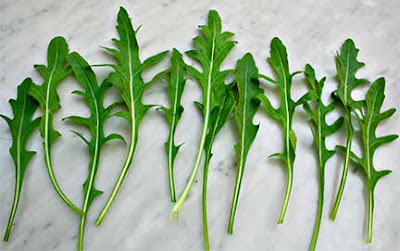
Arugula SelveticaArugula (also known as Roka, Roquette, and Rocket) wins my garden’s miracle plant of the year award.

We’ve grown arugula often over the years. We usually get a salad or two before it bolts; a common problem in Alaska. With our long days, nearly 20 hours of daylight at the solstice, many herbs and green vegetables go to seed prematurely.

Despite its tendency to bolt, we grow arugula because we enjoy its bite in salads. Last year, the arugula followed its typical pattern: two salads at the beginning of summer and it bolted. I assumed that was it. I was wrong.

This spring, after the snow melted, we noticed radicchio we’d harvested last year, but hadn’t pulled up, coming back. In the same bed, mystery plants were emerging; they had tiny green leaves growing around slender dead stalks.

We had no idea what they were (I guessed domesticated Italian dandelions we grew last year in the same bed), but let them grow so we could find out. As the plants grew larger, I realized last year’s arugula had wintered over.

I was initially confused, as I’d thought arugula was an annual (Eruca vesicaria subspecies sativa). Although I'd only grown annual arugula, it turns out “arugula,” actually refers to three separate plants: E. vesicaria ssp. sativa, Diplotaxis tenuifolia, and Diplotaxis muralis.

Last year we planted arugula seeds brought back from Greece. When I dug out the seed packet, I discovered it was Diplotaxis tenuifola, also known as wild arugula or Selvetica, an extremely cold hardy perennial (as plants must be to survive Alaskan winters). I’m thrilled to have stumbled upon it, and will give it a permanent place in my garden.

Arugula in the GardenMost commonly I use arugula in mixed green salads, or on its own with blue cheese and best quality balsamic vinegar. This year the arugula was so prolific I branched out. Arugula, briefly sautéed with shallots, adds a nice bite to omelets and frittatas. Mixed with tomatoes and anchovies, it makes a delicious pasta sauce.
My mother, upon hearing of my arugula glut, recommended the wonderful Arugula and Tomato Salad from Carol Field’s
In Nonna’s Kitchen: Recipes and Traditions from Italy’s Grandmothers. Mother was right; arugula goes really well with tomatoes.

Anchovies are the secret ingredient that makes both the salad and pasta sauce special. When minced and incorporated into other ingredients, anchovies add flavor without overwhelming the taste buds.

More Arugula Recipes:
Grilled Radicchio and Arugula Salad with Parmesan Shavings
Watermelon, Feta, and Arugula Salad

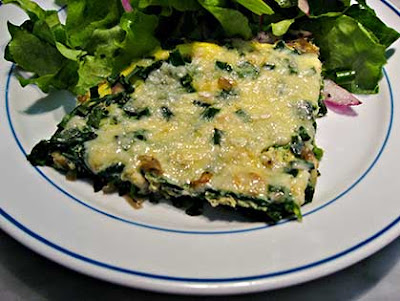
Arugula and Eggs
Arugula and Eggs
Serves 2 – 4


4 large eggs
1 cup diced shallots, 1/4” dice
Salt
Freshly ground black pepper
1 Tbsp. olive oil
4 packed cups cleaned arugula
3/4 grated kasseri or fontina cheese
1/4 cup minced chives

Crack the eggs in a bowl, season lightly with salt and freshly ground black pepper, and whisk to combine.

Sauté the shallots, lightly seasoned with salt and freshly ground black pepper, in olive oil until they soften and start to turn golden. Add the arugula, in batches if necessary, and cook just until all the arugula has wilted.

Evenly distribute the arugula in the pan and pour the eggs over. Cover and turn the heat down to low. Keep checking the eggs and when they’re almost-but-not-quite set, sprinkle the cheese and minced chives over, cover, and cook until the cheese melts.

Sprinkle with freshly ground black pepper, cut into wedges, and serve.

Arugula and Tomato Salad
Serves 4

Adapted from In Nonna’s Kitchen: Recipes and Traditions from Italy’s Grandmothers by Carol Field (HarperCollins 1997)
Lightly salting the tomatoes helps bring out their flavor, but be careful not to overdo as anchovies can be quite salty. I made this with the smaller amount of anchovies, but we both thought it would benefit from more; next time I’ll use the larger amount. I originally made this with whole anchovies, as shown in the picture, but we prefer the salad when the anchovies are minced in the dressing. Either way, it's tasty.

8 medium tomatoes, sliced 1/2” thick
Salt
1/4 cup olive oil
2 Tbsp. red wine vinegar
Freshly ground black pepper
8 - 16 anchovy fillets (1 - 2 ounces)
2 cups thinly cut shreds of arugula

Divide the tomato slices between 4 salad plates and salt lightly. Whisk the olive oil into the red wine vinegar and season with freshly ground black pepper. Mince the anchovy fillets and mix them into the dressing. Taste and add freshly ground black pepper or salt as needed. Toss the dressing and arugula (there may be leftover dressing), and mound on the tomatoes. Serve immediately.

Arugula, Blue Cheese, and Balsamic Salad
Serves 4

I never tire of this tasty salad. Because there are so few ingredients, it’s important to use best quality balsamic vinegar.

4 packed cups arugula
1/2 cup thinly sliced red onion
1/4 crumbled Roquefort or other blue cheese
2 Tbsp. extra virgin olive oil
1 Tbsp. best quality balsamic vinegar
Salt
Freshly ground black pepper

Wash and dry the arugula and tear large leaves into pieces. Add the arugula, red onion, and half the blue cheese to a salad bowl. Whisk together the olive oil, balsamic vinegar, salt, and freshly ground black pepper. Toss the dressing with the salad ingredients. Taste and add more balsamic vinegar, if needed. Sprinkle with the remaining blue cheese, grate freshly ground black pepper over the salad, and serve.

Arugula, Anchovy, and Tomato with OrecchietteArugula, Anchovy, and Tomato Sauce with Orecchiette
Serves 4
This recipe calls for a large quantity of arugula, which I measured after it had been cleaned and roughly chopped. If you don’t have arugula, dandelions or other wild greens are the best substitute; the dish may also be made with radicchio, Swiss chard or spinach. Toast the pine nuts in a 350°F oven or dry frying pan. In either case, pine nuts burn easily and must be watched carefully as they cook. Onions cook more evenly when lightly salted before sautéing, however, anchovies are salty so be sure not to over-salt the onions.

1/2 pound dried
orecchiette or any other pasta
2 cups diced onion, 1/2” dice
2 Tbsp. extra virgin olive oil
Salt
Freshly ground black pepper
16 anchovy fillets (2 ounces)
1 Tbsp. minced garlic
1 tsp. Aleppo pepper or 1/2 tsp. red pepper flakes
1/2 pound cleaned and roughly chopped arugula or other strong-flavored greens
2 cups diced fresh tomato, 3/4” dice
1/3 cup water
1 cup chopped green onions
3/4 - 1 cup freshly grated parmesan cheese
1/4 cup toasted pine nuts

Cook the pasta in boiling, salted water and cook until it is al dente. Drain the pasta and toss with a little olive oil.

Sauté the onions, lightly seasoned with salt and freshly ground black pepper, in olive oil until they soften and start to turn golden. Add the anchovies, garlic, and Aleppo pepper and cook for one minute. Stir in the arugula, tomatoes, and water, and cook for 3 minutes. Add the cooked pasta and green onions, and cook just until the pasta is warmed through. Toss with 1/2 cup cheese and half the pine nuts. Sprinkle with the remaining cheese and pine nuts and serve immediately.

~~~~~~~~~~~~~~~~~~~~~~~~~~~~~~
This is my entry for Weekend Herb Blogging, hosted this week by Kelly from Sounding My Barbaric Gulp.

Wednesday, July 23, 2008

Recipe for Red Pepper and Tapenade Tart (Πιπερόπιτα με Πάστα Ελιάς)

Workmen have been at the house for a week replacing our ancient furnaces with a new boiler. For the last five hours they’ve been struggling to run long lengths of pipe through a narrow opening in the basement ceiling's sheetrock. The sound made by repeatedly pounding and banging on metal ductwork is impressively loud.

It’s odd to have so much racket during the day; I’m used to a silent house. Mind you, I’m not complaining and am glad we’re having the work done. It’s just interesting how sustained noise interferes with my ability to hold a coherent thought.

When the men left for lunch, blissful silence briefly returned. I took the opportunity to eat in peace, and enjoyed the last of the Red Pepper and Tapenade Tart for lunch. Three days in the refrigerator and it still tasted terrific; this recipe’s a keeper.

Red Pepper and Tapenade TartRed Pepper and Tapenade Tart (Πιπερόπιτα με Πάστα Ελιάς)
Serves 4-6 (one 9” tart)


Mediterranean Cooking in Alaska has moved as of March 2011. To read this post please go to


http://www.laurieconstantino.com/red-pepper-and-tapenade-tart/


Please click on over and visit my new site. Thank you!


Wednesday, May 21, 2008

How to Harvest Fireweed Shoots with Recipe for Fireweed Shoot Omelet


Fireweed After the FireAfter the Fire: Destruction Bay, Yukon Territories, Canada
Photograph by Teeny Metcalfe

Fireweed shoot season is upon Southcentral Alaska.Fireweed (Epilobium angustifolium) grows along Alaska’s roadways and waste areas (and throughout North America as far south as California in the west and the Carolinas in the east). Spreading rapidly on underground runners, fireweed is one of the first plants to reestablish itself after forest fires.

Fireweed’s brilliant magenta flowers brighten Alaska’s summer landscape and, in the kitchen, are an attractive salad garnish. The flowers are also the source of fireweed honey, a popular Alaskan sweetener.


Fireweed Shoots


Mediterranean Cooking in Alaska has moved as of March 2011. To read this post please go to


http://www.laurieconstantino.com/how-to-use-and-harvest-fireweed-shoots/


Please click on over and visit my new site. Thank you!


(Coming Soon: I just checked the woods and, as of today, the Devil’s Club is ripe for picking.) UPDATE: My post on harvesting and preparing Devil's Club is here.


Fireweed Shoot OmeletFireweed Shoot OmeletServes 2
For 2 people, I prefer making 1 omelet in a large pan and cutting it in half, but you can also make 2 individual omelets in a smaller pan. To clean fireweed shoots, trim off any browned or damaged bits, and cut into 1” lengths. Taste, and if the fireweed shoots are bitter, blanch them in boiling, salted water before starting the recipe.


Mediterranean Cooking in Alaska has moved as of March 2011. To read this post please go to


http://www.laurieconstantino.com/how-to-use-and-harvest-fireweed-shoots/


Please click on over and visit my new site. Thank you!

Sunday, May 18, 2008

Recipe: Eggs Rockefeller with Dandelion Greens and Hollandaise

Living so far from our families, we’re nostalgic on Mother’s Day. We call and send flowers, but always wish we could be together in one place. To feel closer to our mothers, we do something special on Mother’s Day.

Last Sunday, we celebrated by making Eggs Rockefeller with Dandelion Greens and Hollandaise. To toast our mothers, we had
Bloody Marys (one of them virgin, one not), the perfect drink for eggs served with buttery hollandaise.

If you’ve never tried
dandelion greens, they have wonderful flavor when picked before the flower buds form. For information about gathering dandelions and other wild greens, go to my How to Harvest Wild Greens post.

For those who don’t have the time or inclination for dandelions, use spinach instead, the green used in many “Rockefeller” preparations. If you don’t like spinach, use Swiss chard. Or nettles. Or whatever leafy greens strike your fancy.

Hollandaise sauce is a breeze to make in a blender. For as long as I’ve been cooking, I’ve used the blender hollandaise recipe in The Joy of Cooking (a classic American cookbook) that was given me when I first moved out on my own. This recipe has never failed; it makes perfect hollandaise every time.

Eggs Rockefeller with Dandelion Greens and Hollandaise
Serves 2

Well-flavored greens, flavored with a hint of fennel, are a terrific counterpoint to runny egg-yolks and rich hollandaise. Any tender greens, wild or domesticated, may be used instead of dandelions.For special occasions, serve with a Bloody Mary or Mimosa.

1 pound dandelion greens (uncleaned) or 1 bunch spinach
1 cup diced onions, 1/4” dice
Salt
Freshly ground black pepper
2 Tbsp. olive oil
2 tsp. minced garlic
1/2 tsp. freshly crushed fennel seed
4 slices artisan-style bread or 2 English muffins
4 eggs
Blender Hollandaise Sauce (see recipe below)
Pinch of cayenne pepper

Wash the dandelions very carefully. Discard any tough or damaged leaves, stems, roots, and the tiny flower bud often found in the very center of even young dandelions.

Bring a pot of salted water to a boil. Stir in the cleaned dandelions and cook for 1 minute. Using a slotted spoon, remove the greens into a bowl of cold water. (Reserve the hot cooking water for poaching the eggs.) Drain the greens. Pick up a handful of drained greens and, using your hands, squeeze as much water out of them as you can. Continue with the remaining greens. Chop the greens.

Sauté the onions, lightly seasoned with salt and freshly ground black pepper, in olive oil until they soften and start to turn golden. Stir in the garlic and crushed fennel; cook for 1 minute. Stir in the chopped greens and toss to thoroughly combine. Cook for 5 minutes, stirring occasionally, until the liquid in the greens has evaporated. Keep warm while you make the eggs.

[For the hollandaise, put the egg yolks etc. in the blender container, and start melting the butter.] Toast the bread or English muffins.

Bring the greens cooking water to a simmer. Crack the eggs into 4 separate small bowls. Slip the eggs into the simmering water. [While the eggs are cooking, finish the hollandaise by blending hot bubbling butter into the egg yolks.]

When the simmering eggs are just set (be sure not to cook the yolks hard), remove them from the water with a slotted spoon. Drain the eggs briefly on paper towels.

Assemble: Place two slices of toast on a plate. Top each piece of toast with the cooked dandelion greens. Put a poached egg on top of the dandelions and pour a ribbon of hollandaise on top of the eggs. Sprinkle with a pinch of cayenne and serve immediately.

Blender Hollandaise Sauce
Makes 1 cup
Adapted from
The Joy of Cooking by Irma S. Rombauer and Marion Rombauer Becker (1964 edition)
The sauce must be hot when served; either make it at the very end or keep it warm by putting the blender container in warm (not hot) water. This makes enough for 3 servings of Eggs Benedict or Rockefeller and I usually only make it for 2. I’ve tried making a smaller amount and it doesn’t work; without the full amount of bubbling hot butter, there isn’t enough heat to cook the eggs. Leftover hollandaise makes a terrific sauce for asparagus or other green vegetables. To use leftover hollandaise, slowly reheat the sauce in a water bath.

3 egg yolks
2 Tbsp. lemon juice
Pinch of cayenne pepper
1/4 tsp. salt
1/2 cup butter (1 stick)

Put the egg yolks, lemon juice, cayenne, and salt in a blender. Melt the butter until it is hot and bubbling (this is easiest to do in a microwave). Blend the egg yolks on high for a few seconds, and then pour in a steady stream of hot bubbling butter. The hollandaise should now be done; if it isn’t thick enough, continue to blend for a few more seconds. If the sauce is too thick add a tiny amount of lemon juice or water. Taste and add salt, cayenne, or lemon juice as needed.

~~~~~~~~~~~~~~~~~~~
This is my entry for Weekend Herb Blogging, hosted this week by Gay from A Scientist in the Kitchen.