Yesterday the sun was shining and the temperature a balmy 15°F (-9°C).
I came in from my walk invigorated, but wanting something that would warm me from the inside out. Luckily, I had some leftover Oxtail Ravioli in Leek-Mushroom Broth, a remarkably delicious dish I’d made with leftover Oxtail Braised in Sherry.
As I’ve mentioned before, using leftovers as an ingredient is one of the easiest ways to create full-flavored food. Instead of eating the same dish twice in a row, try using all the flavors you worked hard to put in the original dish to create something new and exciting.
Although no longer the bargain it used to be, oxtail (actually, beef tail) is ideal for braising in sherry or other wine. The cartilage, marrow, and tendons in the tail dissolve into the braising liquid when oxtails are cooked long and slow. The meat becomes meltingly tender and the sauce rich and unctuous.
On a recent evening, we feasted on Oxtail Braised in Sherry. There were only two pieces of oxtail left over. That night, I lay in bed scheming and planning how best to use the luscious leftovers. I decided to stuff the meat into Oxtail Ravioli and to enrich the already wonderful braising liquid with earthy mushrooms and sweet leeks.
The next day, I hesitated. Making homemade ravioli seemed like too much of a hassle. But I didn’t have any other ideas, so I persevered and discovered, as I do anew each time I make ravioli, they are easy to make and way less trouble than I always anticipate.
The key to making ravioli is having the right equipment. The dough takes 2 minutes to make in a food processor. A pasta machine quickly rolls out perfect sheets of pasta. Because the machine can roll pasta so thinly, the resulting ravioli are light and tender. If you don’t have the equipment to make your own pasta, store-bought wonton or gyoza wrappers make tasty ravioli.
For another take on ravioli making with leftovers, check out Maria's recipe for Ravioli with Parsley-Pesto.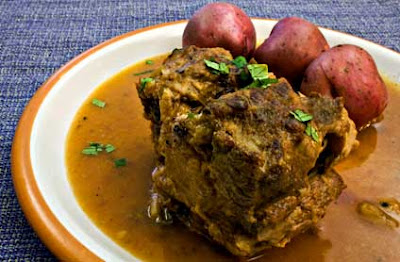 Oxtail Braised in Sherry
Serves 6 - 8
Oxtail is sold cut into 1” thick slices; buy the meatiest pieces you can find. You will inevitably have a few slices from the tail’s end that have no meat on them. Be sure and add these pieces to the stew; their cartilage adds richness to the broth. Oxtail is delicious braised in any kind of dry wine; I use sherry because I enjoy its subtle flavor. I like the soupy sauce this recipe makes, in part because it leaves me more sauce for playing with leftovers. However, if you want thicker sauce, remove the lid when the meat is done and cook the stew at a medium boil until the sauce is the thickness you prefer.
Braised Oxtail is a good recipe to make ahead. Refrigerating the cooked oxtail hardens any excess fat and makes it easier to remove. As with most braised meats, Oxtail Braised in Sherry freezes well. I make the full recipe, even though I’m cooking for 2, and freeze the leftovers in serving size containers. Other ways of using the leftovers are in Oxtail Ravioli (see recipe below) or for soup (cut up the meat, add it, diced leftover potatoes, and beef stock to the oxtail broth and vegetables, and simmer for 15 minutes).
6 pounds oxtail slices
1 Tbsp. olive oil
Salt
Freshly ground black pepper
1/4 pound diced thick-cut pancetta, 1/4” dice
4 cups diced onions, 1/2” dice
1 cup diced carrots, 1/2” dice
1 cup diced celery, 1/2” dice
1 Tbsp. minced fresh garlic
1 750ml. bottle dry Sherry
2 cups beef stock
1 14.5 ounce can diced tomatoes, preferably fire-roasted, juices included
3 bay leaves
Fresh parsley, minced, for garnish
Wash and dry the oxtails. Cut off as much fat as you can. Season the oxtails with salt and freshly ground black pepper on both sides. Heat the olive oil in a Dutch oven and, cooking the oxtails in batches, thoroughly brown them on all sides. Remove the browned oxtails from the pot and set them aside.
Add the pancetta to the same pot and cook until it is nicely browned. Add the onions, carrots, and celery, seasoned lightly with freshly ground black pepper, and cook until the onions are translucent, being sure to scrape up any browned bits from the bottom of the pot as you cook the vegetables. Add the garlic and cook for 1 minute.
Stir the Sherry, beef stock, tomatoes, and bay leaves into the vegetables. Return the browned oxtails to the pot. Bring the liquid to a boil, cover, turn down the heat to low, and simmer for 2 1/2 – 3 1/2 hours, or until the meat is very tender and falling off the bone. (The recipe may be made ahead to this point.)
Remove as much fat as possible from the sauce (a fat separator works well for this task or, if you have time, separate the meat and sauce and refrigerate to harden the fat, which makes it easier to remove from the liquid). If the oxtails have been refrigerated, cook over low heat until the sauce is liquid and the oxtails warmed through. Taste and add salt or freshly ground black pepper, as needed.
Sprinkle with minced fresh parsley and serve with boiled or roasted potatoes. Oxtail Ravioli in Leek-Mushroom Broth
Serves 4 – 6 as a main course (makes 12 ravioli, 3 - 4” diameter)
I make this with leftover oxtail because its unctuousness is well-suited for ravioli. However, any leftover braised beef, such as pot roast or stew, may be used instead. Oxtail broth gels when cold, so you need to warm the leftovers to separate the liquids and solids. Use the oxtail liquids, supplemented with rich beef or chicken stock as needed, to make 4 cups of stock for the Leek-Mushroom Broth. Bone enough oxtails to make 1 cup of chopped meat; one large oxtail slice makes about this amount. You can substitute the vegetable-pancetta mix from the oxtails for up to half the meat. Ravioli freezes well uncooked, so if I’m making ravioli, I usually double the pasta and filling recipes so I can freeze some for another day. As for the truffle cheese and truffle oil, they add satisfying umami to the dish, but neither is necessary; the dish will be very tasty even without them. If you have access to wild mushrooms, by all means use them. Be sure to carefully rinse off any dirt that is trapped between the leeks' many layers.
Pasta:
3/4 cup plus 2 Tbsp. all purpose flour
1 large egg
1/8 tsp. salt
1/2 - 1 Tbsp. water, if needed
Ravioli Filling:
1 cup chopped oxtail meat
3/4 cup grated sottocenere al tartufo (truffle cheese) or Italian fontina (about 4 ounces)
Leek-Mushroom Broth:
4 cups sliced cremini or wild mushrooms (about 1/2 pound), 3/8” slices
1 Tbsp. olive oil
3 Tbsp. butter, divided
1 Tbsp. minced garlic
1 Tbsp. minced rosemary
4 cups sliced leeks, white and light green parts only, 3/8” slices (2-3 leeks)
4 cups beef stock (or oxtail broth and beef stock to make 4 cups)
1 tsp. white truffle oil
1/2 cup freshly grated parmesan cheese
Make the Pasta: Put the flour, eggs, and salt in a food processor. Process until the ingredients are thoroughly mixed and the dough starts forming clumps. If the dough is too dry, add water in 1 Tbsp. increments and process again. Dump the dough out onto plastic wrap and knead for 1 minute, adding a small amount of flour if the dough is sticky. When you’re done, the dough should be smooth and firm. Divide the dough into two portions, wrap with plastic wrap, and let sit at room temperature for at least 30 minutes. (The dough can be made ahead to this point.)
Run each portion of dough through the rollers of a pasta machine, starting with the thickest setting. Fold the dough in thirds as if folding a letter, turn it 45 degrees, and again run it through the thickest setting. Repeat the folding, turning, and rolling at least three more times, or until the dough is smooth and shiny. Lay the sheets of dough out on dish cloths while they're waiting their turn to be rolled.
Set the pasta machine at the next thinnest setting. Run the sheets of pasta through, dusting with flour as necessary. Continue reducing the setting of the pasta machine and running the pasta through until you reach the machine’s lowest setting. When the sheets of pasta become too long to comfortably handle, cut them into manageable lengths.
 Form the Ravioli: Put 2 tsp. chopped meat on a sheet of pasta in clumps far enough apart so you can cut out 3”- 4” round ravioli. Top each clump with 1 tsp. truffle cheese or fontina. Brush water all around the pasta sheet where there isn’t stuffing (use a pastry brush for this task). Top with a second sheet of pasta. Press down to seal the top pasta sheet onto the bottom sheet, being careful to squeeze all the air out from around the stuffing. Cut out the ravioli and place them on a dishcloth while you boil water.
Cook the Ravioli: Bring a large pot of salted water to a rapid boil, then adjust the burner so the water boils slowly. Gently slide in the ravioli and cook until the pasta is tender, about 4 minutes. Remove the ravioli from the water with a slotted spoon and spread out on parchment paper while you make the Leek-Mushroom Broth.
Make the Leek-Mushroom Broth: Sauté the mushrooms, lightly seasoned with salt and freshly ground black pepper, in the olive oil and 2 Tbsp. butter until they’re well browned on all sides. Add the garlic and rosemary and cook, stirring regularly, for 2 minutes. Remove the mushrooms and seasonings from the pan with a slotted spoon and set aside.
Stir the leeks into the same pan, scraping up any browned bits on the pan’s bottom; add oil or butter, as needed. Sauté the leeks until they’re soft and tender. Stir in the stock, bring to a boil, turn down the heat and simmer for 10 minutes. Stir in the mushrooms and simmer for 10 minutes. Taste and add salt or freshly ground black pepper, as needed.
Stir in the truffle oil, and gently add the cooked ravioli to the broth. Spoon some broth over the ravioli (I use a turkey baster for this task) and simmer until the ravioli are warmed through.
Serve: Divide the ravioli between 4 – 6 warmed pasta bowls. Divide the broth and vegetables between the bowls, sprinkle with freshly grated parmesan cheese, and serve immediately.
~~~~~~~~~~~~~~~~~~~~~~~~~~~
This is my entry for the 100th post celebration of Presto Pasta Nights, created and hosted by Ruth of Once Upon a Feast.
 Bob in a Blanket

 The dandelions are coming! The dandelions are coming!
 Carpaccio with Dandelion Greens Salad and Truffle Oil (Καρπάτσιο με Ραδίκια και Λάδι Τρούφας)
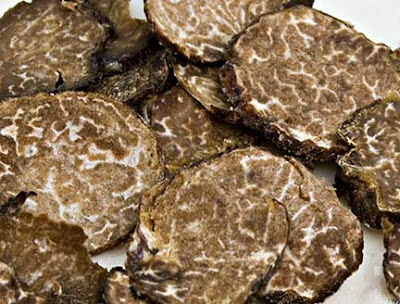 Thinly sliced Oregon white truffles
  I laughed at myself for owning a truffle shaver, but it was the precise tool needed. The truffle shaver worked perfectly on its inaugural appearance; I hope to put it to good use many times in the future.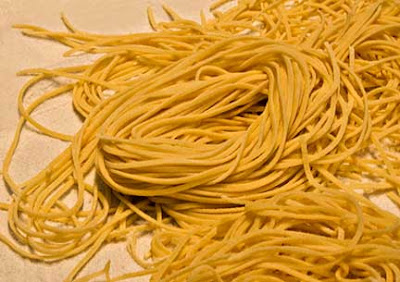
 Tajarin with White Truffles, Olive Oil, and Parmesan