Showing posts with label lamb. Show all posts

Monday, November 2, 2009

Greek Cookbooks: Hellenic Athletic Club of Khartoum with Recipe for Spiced Gazelle Pilaf (Πικάντικο Πιλάφι με Κρέας)

Modern Greeks have been in Sudan since the early 20th century.  In 1910, a Greek Orthodox church opened in Khartoum.  By 1956, there were 6000 Greeks and 1000 Cypriots in the country.  The Greek presence was particularly strong in the capital, Khartoum, where all the restaurants, cafes, hotels, cinemas, and most shops were Greek-owned.” 

In 1983, the Sudanese president imposed Islamic Sharia law, which fanned the flames of civil war between the Muslim north and Christian-Animist south.  From then to now, civil war and famine have killed millions of Sudanese. Many Europeans fled to their homelands. By 1992, only 500 Greeks remained in Sudan.  Today, there are only about 300.


Dancers at the Greek School in Khartoum, Sudan
Photograph courtesy of Apouro

Although the way of life for Sudanese Greeks has changed since 1983, there is still a Greek Orthodox church and Greek school in Khartoum.  The Hellenic Athletic Club is a hangout for Khartoum expats.  The Greek school’s students celebrate Greek Independence Day, Greek Easter, Oxi Day (when Greece stood up to Mussolini), and the 1973 Athens Polytechnic Uprising against the then-ruling Fascist junta.

Greek readers should check out this compelling description of a scalding hot Greek Easter in Khartoum, written by the Greek Ambassador to Sudan. For English speakers, the poetry of the original Greek is so powerful, it seeps through the vagaries of Google translator. Anyone interested in more about Khartoum can read this fascinating blog written by a Greek teacher who lives there (in Greek, but with fun pictures).

In 1983, the year the Sudanese civil war reignited, Greeks in Khartoum published a cookbook: Treasured Recipes: A Collection of Personal Recipes from the Women Members of the Hellenic Athletic Club of Khartoum and Their Friends (148 pages, 191 recipes, 6.5” x 9”). The editors explain the recipes “reflect the nature of our community here in the Sudan, and the influences upon our cooking, resulting from our way of life, from travel, and through marriage to other nationalities.”

Just as I’ve learned to cook Mediterranean food in Alaska, Greeks in Sudan adapted traditional recipes to their new country.  Fish recipes call for Nile perch, a giant freshwater fish that grows over 6 feet long and over 500 pounds.  Sudanese limes are recommended in lieu of lemons. Egyptian Roumi (Romy) cheese stands in for traditional Greek varieties. Spicy shatta is used for seasoning.

The recipe for Stifado (Greek stew) calls for gazelle meat. Its creator says when the stew is done, “The only thing left is to sit before the camp fire with some friends and polish the whole thing off!”  Gazelle also makes an appearance in George Limnios’ recipe for “Rice and Gazelle Pilaf.”  (An internet site counsels Khartoum visitors who “fancy” a camping safari to call “Greek guide George Limnios [who] happily provides safari advice and organizes trips.”)

Other interesting recipes in Treasured Recipes include: Tomato-Bacon Soup, Eggplants with Eggs, Spaghetti with Bacon-Olive Sauce, Sheftalia, Purslane Stew, Stuffed Mortadella Rolls, Baked Eggplant Packets, Grape Leaves with Onion, Zucchini, and Carrot Stuffing, Salty Cake, and four different recipes for Olive Bread (no explanation for the abundance of Olive Bread recipes).

The idea of “gazelle pilaf” stuck in my mind; I had to make it. (I also had to buy my home when I saw it had a gazebo and have a strong attraction to gazetteers.)  Luckily, there were moose steaks in the freezer to stand in for gazelle, though deer, lamb, or beef would also work. 

The tantalizing, cinnamon aroma of tomato-meat sauce soon filled the house.  Even before adding rice, the rich and spicy sauce was amazing on its own; neither of us could keep our tasting spoons away from its deliciousness. (The sauce, thinned with a little stock, would make terrific soup.)  The tastes of the individual spices had blended into an entirely new and wonderful flavor; no single spice dominated.  The rice soaked up the sauce, ensuring we enjoyed every last bite of the pilaf.


Spiced Gazelle Pilaf (Πικάντικο Πιλάφι με Κρέας)
Serves 4-6
Adapted from George Limnios’ recipe for “Rice and Gazelle Pilaf” in Treasured Recipes: A Collection of Personal Recipes from the Women Members of the Hellenic Athletic Club of Khartoum and Their Friends (Khartoum 1983)
The cinnamon sticks and whole cloves must be removed before serving. To make this easier, wrap the spices with cheesecloth or muslin and tie the packet up with string, instead of cooking them loose in the liquid.

1 lb. boned and trimmed gazelle (or moose, deer, lamb, or beef) meat
Salt
Freshly ground black pepper
1/4 cup olive oil
3 cups diced yellow onion, 1/4” dice
2 Tbsp. minced garlic
1 tsp. coriander seed, ground
1 tsp. cumin seed, ground
1 tsp. Aleppo pepper or 1/2 tsp. crushed red pepper flakes (optional)
1 cup red wine
1/4 cup tomato paste
4 cups water
3 cinnamon sticks
8 whole cloves
1 cup long-grain rice

Wash the meat, dry it well, and cut it into 1” cubes. Season the cubes on all sides with salt and freshly ground black pepper.  Heat the olive oil in a large pot (that has a lid) and thoroughly brown the meat.  Stir in the onions, lightly seasoned with salt and freshly ground black pepper, and sauté until they soften and begin to turn golden. Mix in the garlic, coriander, cumin, and Aleppo pepper and cook for 1 minute.  Stir in the wine, bring to a boil, and cook until it reduces by half. Stir in the tomato paste until it’s evenly distributed.

Stir in the water and packet of cinnamon sticks and cloves.  Bring to a boil, turn down the heat, and simmer for 75-90 minutes or until the meat is tender and the liquid reduced to about 2 1/2 cups.  Remove and discard the cinnamon sticks and cloves.  Stir in the rice, cover the pot, turn down the heat as low as possible, and cook for 20 minutes or until the rice is cooked and the liquid absorbed.  Serve immediately.

Thursday, October 29, 2009

Recipe: Chickpea Stew with Mint and Feta (Ρεβύθια με Φέτα και Δυόσμος)

I’m just back from Seattle, where my sister lives and my mom has resettled. After her crazy awful 2009 (husband of 65 years died, sold her home of 50 years, moved to a small apartment in a new city), my mom is positively engaged in her new life. Her motto: “Choose Happiness.” My mom, always quirky but never boring, is an inspiration.

Regular readers know nothing makes me happier than cooking with my sister. A couple days into the visit, we dished up a delicious dinner of salmon and lentils with red wine sauce. The food was beautiful; my sister suggested I take a picture and blog the meal (another day, I promise). I was too hungry for photography.

Over dinner, my sister claimed it was traditional for me to blog about one meal cooked in her kitchen each visit. Who knew? It’s funny how traditions sneak into your life without warning. And ignoring tradition, even one newly adopted, is bad juju. So that night, I found myself lying in bed dreaming up recipes.

At the store, we’d just bought chickpeas and gorgeous lamb steaks. My sister was out of coriander, so we'd bought some of that too. I decided to pair the chickpeas and coriander in a stew with plenty of fresh mint. The next day we went to Big John’s PFI, a Seattle store with a great cheese selection, and bought Greek sheep feta (and, of course, much more), the perfect finishing ingredient for chickpea stew.

Sadly, the Seattle stew pictures didn’t turn out (bad lighting, no tripod), so I “forced” myself to remake the stew when I returned to Alaska. Since I’d been craving leftover chickpeas during the foodless flight home, I was quite happy to make them again, especially because the stew goes together so quickly. It was as tasty the second time as it was in Seattle. This time, I ate the leftovers, and the flavor, already great, was even better the next day.

With generous quantities of mint, my chickpea stew goes particularly well with lamb. It also makes a deliciously filling meal on its own. The recipe has definitely been added to my permanent rotating repertoire.

Chickpea Stew with Mint and Feta (Ρεβύθια με Φέτα και Δυόσμος)
Serves 4

Serve as a side dish with grilled lamb or chicken, or as a main course with steamed rice or couscous. A crisp green salad nicely completes the meal.

3 cups diced yellow onions, 1/4” dice
Salt
Freshly ground black pepper
1/4 cup olive oil
1 cup diced carrots, 1/4” dice
1 cup diced celery, 1/4” dice
1 Tbsp. minced garlic
2 tsp. ground coriander
1 tsp. crushed red pepper flakes (optional)
2 14.5-oz. cans diced tomatoes
3 1/2 cups cooked chickpeas or 2 15-oz. cans, rinsed and drained
1/2 cup minced fresh parsley
1/2 cup minced fresh mint
1 1/2 cups crumbled feta

Sauté the onions, lightly seasoned with salt and freshly ground black pepper, in olive oil until they soften and start to turn golden. Stir in the carrots and celery and sauté for 5 minutes. Stir in the garlic, ground coriander, and crushed red pepper flakes and cook for 1 minute. Stir in the tomatoes and chickpeas and bring to a boil. Cover, turn down the heat, and simmer for 45 minutes, or until the sauce thickens and the flavors meld. Stir in the parsley and mint and cook for 5 minutes. Stir in the feta and serve immediately.
~~~~~~~~~~~~~~~~~~~~~~~~~~
This is my entry for Weekend Herb Blogging hosted this week Katie from Eat This.

Tuesday, October 13, 2009

Eggplant Recipes: Melitzanosalata & Hünkar Beğendi with Tomato-Lamb Stew (Μελιτζανοσαλάτα με Πιπεριές & Χιουνκιάρ Μπεγiεντί με Αρνί Κατσαρόλας)

Two simple and delicious ways to use eggplant are Eggplant-Red Pepper Dip (Melitzanosalata) and Hünkar Beğendi, a smoky eggplant purée that pairs perfectly with Tomato-Lamb Stew.

Even though we recently returned from Greece, I’m still craving Greek food. Luckily, when I went to Costco to restock our supplies, they had fresh eggplant and figs. Combined with the lamb, crusty bread, and cheese Costco always has on hand (and a quick trip to the farmers’ market for a pile of vegetables), we had everything necessary for a Greek feast. Or two. Or ten.

I was particularly happy about the eggplant. They were in perfect condition: firm flesh and shiny, unmarred skin. Unlike many eggplant sold in Anchorage, these were picked small, and hadn’t developed a large mass of seeds inside.

The Costco eggplant came 4 to the 1.75-pound bag. To be efficient and save energy, I oven-roasted them all at one time. (If you want to store eggplant raw,
here’s how.) Half the roasted eggplant went immediately into Melitzanosalata; the other two I refrigerated to save for Hünkar Beğendi.

Fire-grilled eggplant tastes better in recipes than oven-roasted but, the day I cooked eggplant, we were too damn tired from the trip home to start a fire. To add smokiness to my Melitzanosalata, I added a grilled-over-a-gas-burner red pepper. It’s lucky there were only two of us; the pepper-laden Melitzanosalata disappeared quickly.

I used a different technique to add smokiness to Hünkar Beğendi. I had roasted 2 eggplants whole, and stored them without breaking the skins (if you break the skins, the eggplant juices leak out). I took the eggplant directly out of the refrigerator and charred their skins over a gas burner. Because the eggplants were cold when I started charring them, they didn’t leak juices over the stove, as I 'd feared they might. This “smoking” technique was quick, easy, worked well, and added lots of flavor. I’ll do it again.

Hünkar Beğendi is a famous Turkish eggplant dish that’s also made in Greece, particularly in areas where
many people have roots in Constantinople (Istanbul), Smyrna (Izmir), or other parts of Anatolia (Asia Minor). Translations for “Hünkar Beğendi” abound: Sultan’s Delight, Sultan’s Pleasure, The Sultan Liked It, Her Majesty’s Delight, Her Majesty’s Favorite, and The Sultan Approved.

The origins of Hünkar Beğendi are murky.
Some say the dish was created in the early-17th century for Sultan Murad IV (who was half-Greek). Others say it was created for a French empress in the late 19th century. My favorite version of this story is in The Art of Turkish Cooking by Neset Eren (New York 1969):

When the Empress Eugénie, the wife of Napoleon III, was in Istanbul as the guest of Sultan Abdulaziz, the Ottoman emperor, she fell in love with eggplant purée, at that time a specialty of the Topkapi Palace. She asked her host if he would allow his chef to teach her cook how to prepare it. The sultan obliged. The next day the French chef requested an audience with the empress and begged to be excused from this impossible task. “I took my book and my scales to the Turkish chef,” he said, “and he threw them out. ‘An imperial chef,’ he told me, ‘cooks with his feelings, his eyes, his nose.’” The empress returned to France without the recipe for her favorite dish.
In
Lords of the Horizons: A History of the Ottoman Empire (London 1998), historian Jason Goodwin repeats the Empress Eugénie story. However, in Η Οθωμανική Μαγειρική: 99 Παλατιανές Συνταγές (Ottoman Cooking: 99 Recipes from the Palace) (Athens 2004), an extremely interesting and well-researched book, author Marianna Gerasimos says:

I searched hard to find how and when the famous eggplant puree, called Hünkar Beğendi, entered Ottoman cuisine. … There are many rumors and allegations about [it being made for Empress Eugénie] but, for now, there is no written historical evidence of this.
Although Empress Eugénie may not have feasted on Hünkar Beğendi, I certainly have. In the same way that mashed potatoes are exactly right with turkey and gravy, Hünkar Beğendi and Lamb Stew are wonderful together.

Eggplant-Red Pepper Dip (Melitzanosalata) (Μελιτζανοσαλάτα με Πιπεριές)
Makes 1 cup
The smoky flavor of eggplant grilled over an open fire makes the best Melitzanosalata, although it’s not absolutely necessary to success. When I don’t want to start a fire, I oven-roast the eggplant and add a grilled red pepper for smokiness. Although you can make Melitzanosalata in a food processor, I far prefer the more rustic texture that results from knife-chopping the eggplant. Serve with crusty bread and olives for a tasty appetizer, or as a flavorful accompaniment to grilled meat.


1 1-pound eggplant, or 2 1/2-pound eggplants
Olive oil
1 red bell pepper
2 cloves garlic
1/2 tsp. salt
Freshly ground black pepper
4-6 tsp. white wine vinegar
1/3 cup extra virgin olive oil

Preheat the oven to 400°F.

Rub the whole, uncut eggplant with olive oil, and place on a rimmed baking sheet. Bake for 45 – 70 minutes, depending on the size of the eggplant, or until the eggplant collapses and is cooked all the way through. (Better yet, grill the eggplant over fire until it’s cooked through.) Peel the eggplant, cut it into large chunks, and place the chunks in a colander for 15 minutes to let some of the juices drain off. When the eggplant is cool enough to handle, use your hands to squeeze out as much liquid as you can.

Roast and clean the pepper (see Note below).

Place the eggplant flesh on a cutting board, finely chop, and put in a bowl. Finely chop the roasted red pepper and add to the bowl. Purée the garlic by mashing it into the salt, and add to the bowl. Add freshly ground black pepper, 4 tsp. vinegar, and extra virgin olive oil, and mix well. Taste and add vinegar or salt, as needed.

To serve, spread the Melitzanosalata evenly over a plate and drizzle with a small amount of extra virgin olive oil.

Note on Roasting and Cleaning Peppers: The traditional method of roasting peppers is over a hot wood fire, but you can also roast them on a gas grill, directly on a gas burner (without a pan), under the broiler, or by baking in a 450° oven for 30 minutes. Unless you are baking them in the oven, turn the peppers frequently as they roast to ensure the skins char evenly and the flesh doesn’t overcook. When the skin is completely blackened, place the peppers in a paper bag and close it up for 5 minutes. Hot pepper flesh releases steam in the closed bag, loosening the charred skin and making it easier to peel.

Once the peppers are cool enough to handle, remove the burned skin from the softened flesh with your fingers or a paper towel, gently scraping away any stuck bits with a knife. Resist the temptation to rinse the peppers in water, as doing so washes away too much flavor. If necessary, dip your fingers in a bowl of water to release clinging charred pepper skins. Remove the seeds and any white pulp from the inside of the pepper.


Smoky Eggplant Purée with Tomato-Lamb Stew (Hünkar Beğendi) (Χιουνκιάρ Μπεγiεντί με Αρνί Κατσαρόλας)
Serves 4
Beef can be substituted for lamb in the stew; meatballs and grilled meats also go well with Hünkar Beğendi. In Anchorage, the best price for lamb is often on boneless leg roasts at Costco. I cut out and grill a couple “steaks” from the center of the roast, and then make stew out of each end. If you use lamb with bones, cook them in the stew for extra flavor. Unlike Melitzanosalata, smokiness is an essential flavor in Hünkar Beğendi. If you don’t have access to a grill, oven-roast the eggplant as described in the Melitzanosalata recipe, refrigerate them without puncturing the skin, and thoroughly char the skins directly over a gas burner.

Tomato-Lamb Stew:
1 1/2 – 1 3/4 lb. boneless lamb, excess fat removed
Salt
Freshly ground black pepper
2 Tbsp. olive oil
2 cups diced yellow onion, 1/4” dice
1 Tbsp. minced garlic
1 tsp. Aleppo pepper or 1/2 tsp. crushed red pepper flakes (optional)
1 14.5 ounce can (or 2 cups fresh) diced tomatoes
1 Tbsp. dried oregano, crushed
2 Tbsp. tomato paste
2 cups water

Smoky Eggplant Purée:
1 1-pound eggplant, or 2 1/2-pound eggplants
2 Tbsp. lemon juice
1 cup whole milk
2 Tbsp. butter
3 Tbsp. all-purpose flour
1/2 cup grated kasseri or Romano cheese
Pinch of nutmeg

Make the Tomato-Lamb Stew: Wash and dry the meat, cut it into 1” cubes, and season on both sides with salt and freshly ground black pepper. In a large pot, cook the lamb in olive oil until it is browned all over. Stir in the onions, lightly season with salt and freshly ground black pepper, and sauté until the onions begin to turn golden. Stir in the garlic and Aleppo pepper and cook for 1 minute. Stir in the tomatoes, oregano, tomato paste, and water, bring to a boil, cover, turn down the heat as low as possible, and simmer for 1 hour. Remove the cover and simmer for 30-60 minutes, or until the lamb is very tender and the sauce the thickness you prefer. Stir the sauce from time to time and, if it starts sticking, add a little bit more water. Taste and add salt and freshly ground black pepper, as needed. (The stew can be made ahead, refrigerated, and reheated just before serving.)

Make the Smoky Eggplant Purée: Grill the eggplant whole until it softens, collapses, and is slightly charred on all sides (or oven-roast and char as described in note above). Peel the eggplant, cut it into large chunks, and place the chunks in a colander for 15 minutes to let some of the juices drain off. When the eggplant is cool enough to handle, use your hands to squeeze out as much liquid as you can. Place the eggplant flesh on a cutting board, finely chop, and sprinkle with the lemon juice.

Warm the milk over low heat or in the microwave. Melt the butter in a saucepan, mix in the flour and cook for two minutes, stirring constantly; be careful not to brown this mixture. Slowly stir in the warm milk and cook, stirring, until the sauce is thick and smooth. Add the eggplant, cheese, and nutmeg and cook, stirring constantly, until the ingredients are thoroughly combined. Taste and add salt, as needed.

To serve, spoon some Smoky Eggplant Purée onto a plate and top with the Tomato-Lamb Stew.
~~~~~~~~~~~~~~~~~~~~~~~~~~~~~~~
This is my entry for
Weekend Herb Blogging, hosted this week by Cinzia from Cindystar.
~~~~~~~~~~~~~~~~~~~~~~~~~~~~~~~

Bob, in a rabbit stupor

Monday, February 16, 2009

The Language of Baklava by Diana Abu-Jaber with Recipe for Jordanian Kofta and Yogurt Sauce (Ιορδανικό Γιαουρτλού Kεμπάπ)
Diana Abu-Jaber grew up in the environs of Syracuse, New York during the 1960s and 1970s. She shares the dominant cultural references of all Americans her age. Her mother and influential maternal grandmother are Americans, their distant heritage “Irish, German, maybe Swiss?”

Abu-Jaber’s father is from Jordan; his heritage Bedouin and Palestinian. His large, loud, exuberant family, many of whom lived in or near Syracuse, was a constant in Abu-Jaber’s life. At home and in her lunchbox, Abu-Jaber ate Middle Eastern food. This food and her Arabic name, so unlike her pale skin and murky green eyes, set her apart from her schoolmates.

When Abu-Jaber was in grade school, her family moved to Jordan. In Jordan, it was her pale skin that set her apart. The smells and sounds and experiences of life in a crowded Middle Eastern city woke up senses Abu-Jaber hadn’t known in America. Just as her heart began to beat with the rhythm of Jordanian life, Abu-Jaber’s family moved back to America.

“America is a cold breeze that snaps us awake … We’ve left Jordan, with its lush winds, dust, and sun-stained air. When I wake in a hotel bed on the first morning back in America, I’m dazed by a blankness around me: the sleekly painted walls, the air slack without the scents of mint, olive, and jasmine, and an immobilizing silence. I close my eyes and conjure the songbirds Mrs. Haddadin kept in a gold cage hanging from a tree branch; the wobble of Munira’s singing as she dashed a broom through the courtyard. … We’ve returned to Syracuse, to a split-level house that does not have another family living in the upstairs apartment or a communal courtyard or thick hedges of mint.”

In her 2005 memoir, The Language of Baklava, Abu-Jaber describes her rootless journey to adulthood. She struggles to connect with her American and Jordanian cultures, often standing as an outsider to both.

Abu-Jaber
grew up in a family of storytellers: “To me, the truth of stories lies not in their factual precision, but in their emotional core. Most of the events in this book are honed and altered in some fashion, to give them the curve of stories. Lives don’t usually correspond to narrative arcs, but all these stories spring out of real people, memories, and joyously gathered and prepared meals.”

The essential truths and complexities of Abu-Jaber’s relationships to her family and twin cultures, as revealed through her stories
, are captivatingly real. By book's end, we understand Abu-Jaber’s American and Jordanian heritages are inseparably bound in her heart and soul.

In telling her family's stories, Abu-Jaber reveals universal truths about the immigrant experience in America. Like millions upon millions of immigrants who've given strength and diversity to their adopted homeland, Abu-Jaber’s family, many of whom are Arab and some of whom are Muslim, is inextricably woven into the fabric that makes up America. None of these immigrants, or their descendants, can be categorically ejected or rejected without leaving an irreparable hole.

In other words, there is no “us” and there is no “them.” As Abu-Jaber wrote in the Washington Post,
The world is a place of nuance, flux, hardship and complexity: We all live together in it. The real safety will come from learning how to live together better, not from trying to push others out.”

For me, Abu-Jaber’s book had special resonance.
The Language of Baklava is, in many ways, a love letter to Abu-Jaber’s father. I began reading it in a nursing home, by the bedside of my ill father who, briefly and terrifyingly, didn’t recognize me. The veil of sadness through which I read The Language of Baklava made its message of paternal love particularly poignant.

I returned home from visiting my father emotionally drained. That night, I cooked some of Abu-Jaber’s recipes for my husband. As we greedily piled our plates with Jordanian Kofta and garlicky Yogurt Sauce, I experienced anew the relationship between food and love that inspired The Language of Baklava.

Jordanian Kebab and Yogurt SauceJordanian Kofta and Yogurt Sauce (Ιορδανικό Γιαουρτλού Kεμπάπ)
Serves 4 as a meal or more as an appetizer
Adapted from The Language of Baklava by Diana Abu-Jaber
These taste best when cooked over a grill (in winter, we grill in our fireplace), but can also be made on a stovetop grill pan. To serve as an appetizer, make smaller kebabs by dividing the meat into 16 equal pieces rather than 8. Serve with Tomato, Cucumber, and Onion Salad, feta cheese, Kalamata olives, and warm pita bread.

Sausage:
1 pound ground lamb or beef
1 egg
1 cup finely diced onion, 1/8”dice
2 Tbsp. minced fresh parsley
2 tsp. ground turmeric
1 tsp. freshly crushed cumin
1 tsp. chile powder, preferably Ancho
1/2 tsp. ground cinnamon
1/2 tsp. ground allspice
Salt
Freshly ground black pepper
Bamboo skewers

Yogurt Sauce:
3 cloves garlic
1/2 tsp. salt
1 1/2 cups plain yogurt, preferably whole milk
1/4 – 1/3 cup fresh lemon juice

Make the Sausage: Put all the sausage ingredients in a bowl, and knead everything together with your hands. Divide the seasoned meat into 8 equal pieces. Roll each piece of meat around a bamboo skewer into a long sausage shape. Refrigerate until you’re ready to cook the Kofta. (The recipe may be made ahead to this point.)

Make the Yogurt Sauce: Purée the garlic and salt with the flat of a chef's knife or using a mortar and pestle. Mix the garlic purée with the yogurt and 1/4 cup lemon juice. Taste and add salt or the remaining lemon juice, as needed.

Cook the Sausages: Grill over a hot fire, turning regularly, and being careful not to overcook. Serve immediately, the hotter the better, with a generous dollop of Yogurt Sauce on the side.

To cook on the stove, heat a cast iron grill pan until it’s very hot, cook the sausages until they are well-browned on one side, turn them over, immediately turn down the heat, and cook until they are done on the other side. Serve immediately.
~~~~~~~~~~~~~~~~~~~~~~~~~~
This is my entry for Cook the Books Club, founded by Rachel at
The Crispy Cook, Ioanna from Food Junkie, Not Junk Food, and Deb from Kahakai Kitchen. Cook the Books is an online book club; this month’s selection is The Language of Baklava by Diana Abu-Jaber.

Thursday, February 12, 2009

Easy Recipe for Roast Rack of Lamb with Red Wine Sauce (Αρνίσια Παϊδάκια με Σάλτσα Κόκκινου Κρασιού)

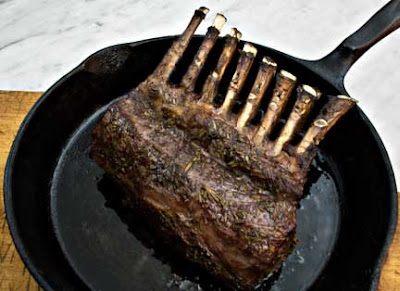
Roast Rack of Lamb with Red Wine Sauce is quick and easy to make, but it’s rich with flavor and perfect for days when you don’t want to fuss with dinner.

Roast Rack of LambThe lamb is washed, trimmed, put in a simple marinade for 30 minutes, browned on the stove, and oven-roasted. The marinade is boiled and turned into red wine sauce. That’s pretty much it. The sauce’s intense flavor is balanced by the lamb, which cooks to perfection in 15-20 minutes.

Oven-roasted potatoes go really well with Roast Rack of Lamb. They’re also easy to make: cut the potatoes in 2” chunks, brown one cut-side of each chunk in a little olive oil using an oven proof skillet, turn each chunk browned-side up, and put the pan of potatoes in the oven with the lamb for about 15 minutes to finish cooking.

Roast Rack of Lamb with Red Wine SauceRoast Rack of Lamb with Red Wine Sauce (Αρνίσια Παϊδάκια με Σάλτσα Κόκκινου Κρασιού)
Serves 3 - 4

I use cabernet sauvignon, or a cabernet-merlot mix, for the marinade. No matter the variety, use wine you’re willing to drink, otherwise the sauce won’t turn out well (don’t use anything labeled “cooking wine”). Be sure not to marinate the meat for longer than an hour. After that, dry red wine’s acidity (3.4 to 3.7 ph) begins to “cook” the meat and break down its texture, neither of which are desirable for tender lamb chops. The ribs in a
Frenched rack of lamb are completely exposed; the blade and chine bones are removed. In Anchorage, Costco sells good quality, pre-Frenched racks of lamb.

1 8-rib rack of lamb, Frenched
Salt
Freshly ground black pepper
2 cups dry red wine
2 Tbsp. minced fresh rosemary
1 Tbsp. minced fresh garlic
1/4 cup minced shallots
2 cups chicken stock
2 Tbsp. butter cut in 4 pieces
1 Tbsp. olive oil

Wash the rack of lamb and
remove the silver skin and as much fat as possible. Season the lamb on both sides with salt and freshly ground black pepper. In a gallon-size ziplock bag or bowl large enough to hold the lamb, mix the red wine, rosemary, garlic, and shallots. Put the lamb in the bag, meat side immersed, and let marinate for 30 – 60 minutes at room temperature.

Preheat the oven to 400°F.

Remove the lamb from the marinade and dry well with paper towels (don’t remove any seasoning that’s sticking to the meat).

Put the marinade in a saucepan and bring to a rapid boil. Continue to boil until the marinade is reduced by half. Strain the reduced marinade and discard the solids. Return the liquid to the saucepan, add the chicken stock, and bring to a rapid boil. Continue to boil until the sauce is reduced to 1/2 – 3/4 cup; watch carefully at the end because the sauce can go from perfect to burnt very quickly. Remove from the heat and stir in the butter, one piece at a time. Taste and add salt or freshly ground black pepper, as needed.

After you first put the marinade on to boil, heat the olive oil in an oven-proof skillet. Brown the lamb, meat side down. When the meat side is nicely browned, turn the rack over and put it in the preheated oven. Cook for 15 – 20 minutes, depending on how done you like your lamb and the size of the rack. Remove from the oven, cover with aluminum foil, and let rest for 5 minutes.

Cut the lamb into chops and plate. Drizzle with red wine sauce and serve immediately.
~~~~~~~~~~~~~~~~~~~~~~~~~~~~~~~~~~~~
This is my entry for Original Recipes, an event hosted and created by Culinarty.

Saturday, April 26, 2008

Recipe: Cannelloni with Spinach Filling (Κανελόνια με Σπανάκι)

Last week I found a bag of cookbooks in my basement that I’d never read.

I’d bought the books last year at a thrift store two days before my head exploded. By the time I was up and cooking, I’d completely forgotten about the thrift store cookbook score. My recent discovery was a lovely Easter present. A new cookbook always puts me in a good mood, and here were five of them. A bonanza!

The first book I picked up was Michael Field’s
Culinary Classics and Improvisations: Creative Leftovers Made from Main Course Masterpieces.

Michael Field was a successful concert pianist in the fifties and early sixties who had a passion for cooking. By 1964, that passion had become Field’s career. He got started by holding “
socialite cooking classes in his Manhattan apartment.” Ultimately, he started a culinary school in New York City, wrote cookbooks and magazine articles, and was a consulting editor for the Time-Life Foods of the World series.

Field
died in 1971 at age 56. Among the accomplishments cited in his Time magazine obituary are debunking “such myths as the need to wash mushrooms, devein shrimp and press garlic” and preaching the “imaginative use of leftovers.”

Field’s primary rule for using leftovers is the source of leftovers must be “of the highest quality.” To this end, Field provides classic recipes for roasted and braised meat, fish, and fowl. He uses the leftovers from these dishes for the remaining recipes.

For example, Field gives a recipe for Yankee Pot Roast, the leftovers of which can be used in his recipes for Pot Roast Pie with Braised White Onions and Mushrooms, Pirog of Beef, Bigos, Cannelloni with Beef and Spinach Filling, Pâté of Pot Roast, or Cold Braised Beef Vinaigrette.

Here’s my take on Field's Cannelloni:

Cannelloni with Spinach Filling (Κανελόνια με Σπανάκι)
Serves 4 (makes 8 cannelloni)
Adapted from
Culinary Classics and Improvisations by Michael Field (Alfred A. Knopf 1967)
Cannelloni is a very flexible dish, and is a terrific way to use up leftovers. For stuffing, combine the spinach with sautéed mushrooms or leftover chicken, beef, pork, lamb, or roasted vegetables. It’s great with homemade pasta, but can also be made with plain crêpes or store-bought manicotti tubes. The tomato sauce may be made special for Cannelloni, but the dish tastes great with leftover or jarred sauce. I made my own pasta, hand-cutting noodles with the extra dough. The noodles are terrific in homemade chicken soup. Although Cannelloni may be made in one large pan, I like using individual gratin dishes for ease of serving and because it allows me to freeze assembled but unbaked cannelloni for future use.


Pasta (or substitute crêpes or purchased manicotti shells):
2 eggs
1 1/2 cups all purpose flour
1 tsp. salt
2 Tbsp. olive oil
2 Tbsp. water

Cream Sauce:
3 Tbsp. butter
3 Tbsp. all purpose flour
1 1/2 cups half and half
1/8 tsp. cayenne pepper
Salt

Filling:
1/2 pound cleaned, fresh spinach or 10 ounces frozen spinach, thawed
1 cup diced onion, 1/8” dice
2 Tbsp. olive oil
Salt
Freshly ground black pepper
1 Tbsp. minced garlic
1 cup finely chopped leftover roast meat or leftover roast vegetables (see vegetarian variation below)
1 Tbsp. dried oregano, crushed
1/2 cup finely grated parmesan cheese
1 egg

1 cup tomato pasta sauce, puréed (use your favorite tomato sauce recipe or a good quality jarred pasta sauce)
1/4 cup freshly grated parmesan cheese

Make the Pasta: Mix all the ingredients in a food processor and process until the dough clumps together, adding water if necessary. The finished dough should be very stiff. Dump the dough out on a floured surface and knead for 2 – 3 minutes, or until the dough is smooth, shiny, and elastic. Wrap in plastic wrap and let rest for 30 minutes.

Following the manufacturer’s instructions, use a pasta machine to roll out the dough, half at a time, until the pasta has gone through the second to the last setting on the pasta machine. Let the pasta sheets dry for 10 minutes. Trim the edges and cut the pasta sheets into 5” lengths. You need 8 pasta rectangles. (NOTE: Cut the rest of the pasta into noodles, let them dry, and store in an air-tight container until ready to use.)

Cook the pasta rectangles in boiling, salted water until they are al dente. With a slotted spoon, lift out the pasta sheets and put them in a bowl of cold water. Dry the pasta rectangles by laying them out on paper towels.

Make the Cream Sauce: Melt the butter in a small saucepan. Whisk in the flour and cook, stirring, for 2 minutes. Add the cream in a slow stream, whisking rapidly and cook, stirring constantly, until the sauce thickens. Stir in the cayenne and salt, remove from the heat, and set aside until ready to use.

Make the Filling: Blanch the spinach in boiling, salted water for 1 minute. Drain and rinse with cold water. Squeeze as much liquid as possible out of the blanched (or thawed) spinach, and finely chop it. Put in a bowl.

Sauté the onion, lightly seasoned with salt and freshly ground black pepper, in olive oil until the onions soften and start to turn golden. Stir in the garlic and cook for 1 minute. Add the onion mix, meat, oregano, and parmesan to the filling and mix together thoroughly. Taste and add salt or freshly ground black pepper, as needed. Mix in the egg.

Assemble the Cannelloni: Preheat the oven to 375°F

Lay out 8 rectangles of pasta, evenly divide the filling between them, and roll them up. Spread a little white sauce in the bottom of a baking dish large enough to hold all the cannelloni or 4 individual gratin dishes. Place the cannelloni in the pan seam side down and side by side. Cover the cannelloni with tomato sauce and then cover the tomato sauce with the remaining cream sauce. Sprinkle with parmesan cheese. (The recipe may be made ahead to this point and refrigerated or frozen.)

Bake for 20 minutes, or until the sauce is bubbling. Put under the broiler until the tops are nicely browned; watch carefully, it is easy to burn the cheese.

Vegetarian Cannelloni
For meat in the filling, substitute 2 1/2 cups diced mushrooms (1/4” dice). Sauté the mushrooms, lightly seasoned with salt and freshly ground black pepper, in 1 Tbsp. butter and 1 Tbsp. olive oil until the mushrooms are nicely browned.
~~~~~~~~~~~~~~~~~~~~~~~
This is my entry for
Weekend Cookbook Challenge: Vintage Cookbooks hosted by Chocolate Moosey.

Thursday, April 17, 2008

Recipe: Lamb and Leek Meatballs with Onion Egg-Lemon Sauce (Κεφτέδες με Πράσα και Αβγολέμονο)

I redeemed myself tonight. My sad story about an unfortunate lamb tagine has a happy ending.

Two days ago, after deciding the tagine was not worth eating, I’d rinsed off the meat and threw away every bit of the nasty sauce. I was left with tender chunks of leftover lamb.

Tonight I ground the lamb in a food processor, and mixed it with soft, sweet leeks to make luscious little meatballs. Paired with an oniony egg-lemon sauce, the meatballs made a delicious mid-week meal.

The egg-lemon sauce (avgolemono) has an unusual twist. Because the meatballs weren’t cooked in liquid, I didn’t have the broth necessary for making egg-lemon sauce. Rather than using plain chicken stock, I simmered stock with onions to boost the flavor, and used this as the foundation for the sauce. The result was surprisingly good, and paired particularly well with leek meatballs.

Although the meatballs could easily be made with raw ground lamb, they are a great way to use up leftover roast (or the remnants of tragic tagine). Since Easter dinner is just 10 days away, and we’ll no doubt have leftover lamb again soon, I invented the meatballs just in time.

Lamb-Leek Meatballs with Avgolemono SauceLamb and Leek Meatballs with Onion Egg-Lemon Sauce (Κεφτέδες με Πράσα και Αβγολέμονο)
Serves 4 (makes 20 1” meatballs)
The meatballs can be served on their own as an appetizer (without the egg-lemon sauce) or with tomato sauce instead of egg-lemon. They are a wonderful way to use up leftover roast lamb.

Meatballs:
3 cups diced leeks, 1/8” dice
3 Tbsp. olive oil
Salt
Freshly ground black pepper
1 1/2 cups leftover lamb, ground (or raw ground lamb)
1 Tbsp. minced garlic
4 tsp. minced mint
2 tsp. dried oregano, crushed
1 egg
Oil for frying the meatballs

Egg-Lemon Sauce (Avgolemono):
1 cup diced yellow onion, 1/4” dice
1 Tbsp. olive oil
Salt
Freshly ground black pepper
1 cup chicken stock
2 eggs
1/4 cup fresh lemon juice

Minced mint for garnish

Make the meatballs: Sauté the leeks in olive oil, lightly seasoned with salt and freshly ground black pepper, over medium heat until the leeks are soft. Mix the leeks with the lamb, garlic, mint, oregano, and egg. Brown a sample of the meatball mix in olive oil, taste, and add salt, freshly ground black pepper, mint, or oregano to the meatball mix, as needed. Shape the mix into 1” balls, and refrigerate for at least 1 hour.

Heat the oil in a frying pan, and fry half the meatballs until they are nicely browned on all sides. If you put too many meatballs in the pan at one time, they won’t brown properly; if you’re in a hurry, cook the meatballs in two frying pans. Drain on paper towels. (You can hold the meatballs in a 250°F oven for 15 minutes, if needed, while you make the sauce.)

Make the Egg-Lemon Sauce: Start the egg-lemon sauce while the meatballs are chilling in the refrigerator. Sauté the onion in olive oil, lightly seasoned with salt and freshly ground black pepper, over medium heat until the onions are translucent. Add the chicken stock, bring to a boil and simmer for 10 minutes. Purée the onions and stock in a blender. Strain out the solids, pressing out as much liquid as possible.

Using an electric mixer, beat the eggs until they are very thick. Add the lemon juice slowly while continuing to beat the eggs. Slowly beat in the onion-stock, and put the mixture in a saucepan.

When the meatballs are nearly done, or are keeping warm in a 250°F oven, cook the sauce over low heat until it thickens (this takes 3 - 5 minutes). Don’t let the sauce boil, or it will curdle. If the sauce is too thick for your taste, thin it out with a little chicken stock.

To Serve: Spoon a pool of egg-lemon sauce onto a plate, top with five meatballs, sprinkle with minced mint, and serve immediately.
~~~~~~~~~~~~~~~~~~~~~~~~~~
This is my entry for Leftover Tuesdays #13, hosted by Project Foodie.

Tuesday, April 15, 2008

Sorry, No Recipe Today

I should’ve read the recipe more carefully before I started.

I’d cut lamb and onions, added garlic, toasted saffron, sprinkled spices, and prepped dried fruits. The ingredients were in the pot and I only needed to add oil, the last ingredient.

First, I thought I’d flipped a page and was reading the wrong recipe.

No, I was reading correctly. The recipe, which served 6, called for 3 pounds of lamb, a pound of onions, and 2 liters of vegetable oil.

I tried, unsuccessfully, to think of a way this made sense.

Maybe I had a bad printing of the book? I went to amazon.com and searched inside the book for my recipe. Yes, indeed, it called for 2 liters of oil. Just to make sure the reader understood, the recipe helpfully translated: 2 liters equals 3 1/2 pints (7 cups).

I don’t think so.

Now the dilemma was in deciding how much oil to add to a recipe I’d never made before. I settled on 2 tablespoons.

I shouldn’t have bothered. The finished dish tasted horrible. Even a gallon of oil woudn't have made a difference. I ate the couscous and forgot the tagine.

It’s enough to put me off cookbooks. When I make my own food, at least I have a clear idea of what the finished dish will taste like.

I rinsed the nasty sauce off the meat, and will try and use it for something else.

Any suggestions?

Maybe I should start an event: Cooking with Second-Hand Meat.

UPDATE 4/17/08: The rinsed-off leftovers made wonderful little Lamb and Leek Meatballs that I served with Onion Avgolemeno Sauce. A happy ending!


Bob, The Rabbit EaterBob, The Rabbit Eater

Friday, December 21, 2007

Novel Food: Corelli's Mandolin and Recipe for Cephalonian Meat Pie (Κεφαλονίτικη Κρεατόπιτα)

KreatopitaCephalonia, a Greek island in the Ionian Sea, is famous throughout the world for its meat pies.

In recent years, Cephalonia has also become known as the beautiful setting for the novel (and movie) Corelli’s Mandolin by Louis De Bernières (Pantheon Books 1994).

Corelli’s Mandolin opens in Cephalonia during the early years of World War II, shortly before the invasion of Greece. In those years, despite the hovering threat of war, life on Cephalonia continued unchanged. A procession celebrating the death of St. Gerasimos, the patron saint of Cephalonia, was held as it had been for the last hundred years:

“Outside in the beautiful meadows of the valley and amongst the plane trees that lined the road from Kastro, pilgrims and Corybants had been arriving for two days, some of them from distant parts indeed. … The pews were filled with distant acquaintances renewing their friendship by means of the animated and voluble conversation that non-Greeks mistakenly construe as irreverence. Outside, the pilgrims unloaded animals laden with feta, melons, cooked fowl, and Cephalonian meat pie, shared it with their neighbors, and composed epigrammatic couplets’ at each others’ expense. Groups of laughing girls strolled about, arm in arm, smiling sideways at potential husbands and possible sources of flirtation, and the men, pretending to ignore them, stood about in knots, gesticulating and waving bottles as they solved the outstanding problems of the world.“ Corelli’s Mandolin at p. 74 - 75.

Eight days after the celebration of St. Gerasimos described by De Bernières, the Italian dictator Mussolini demanded that Greece allow Italy to occupy certain strategic parts of the country. On October 28, 1940, the Greek prime minister refused this demand and Italy immediately invaded Greece. (Today, October 28 is a Greek national holiday honoring the 1940 refusal to submit to foreign tyranny.)

Although the Greek army held off the Italians, the country fell when Germany joined the battle. Greece was occupied by a joint force of Germans, Italians, and Bulgarians for the duration of World War II. Corelli’s Mandolin describes life in occupied Cephalonia.

Captain Antonio Corelli was a reluctant officer of the Italian garrison on Cephalonia. The fictional Captain Corelli loved music, culture, and his mandolin. Corelli tried to be a benevolent member of the occupation. He was quartered in the home of the town’s doctor and eventually fell in love with Pelagia, the doctor’s daughter.

When the doctor became aware that Pelagia was in love with Corelli, he tried to dissuade her from consummating the affair. The doctor warned Pelagia of the many dire consequences, tangible and intangible, that could result from consorting with an Italian occupier.

Leaving Cephalonia and forsaking its meat pies were some of those consequences: “Are you ready to leave this island and this people? What do you know of life over there? Do you think that Italians know how to make meat pie and have churches dedicated to St. Gerasimos? No, they do not.” Corelli’s Mandolin at p. 281

Corelli’s Mandolin is ultimately the story of Pelagia’s life and the life of Cephalonia, and how both survived the upheaval brought by war. De Bernières used Cephalonian meat pie (Kreatopita) in describing idyllic island life before the war and, when Pelagia is at a crossroads that could lead her away from the island, as a symbol of all that is good about Cephalonia.

The phrase “Cephalonian meat pie” encompasses a multitude of recipes. Most households on Cephalonia have their own version of this delicious dish. In Prospero’s Kitchen: Mediterranean Cooking of the Ionian Islands from Corfu to Kythera, Diana Farr Louis and June Marinos say, “Recipes for Kreatopita in Cephalonia are like recipes for bouillabaisse in Marseille: each one is offered as the only truly authentic version handed down by a mythical grandmother.”

Louis and Marinos describe Kreatopita recipes with prunes, raisins, almonds, and pine nuts. Some recipes use rice, others potatoes; some use marjoram, others oregano. Some Kreatopitas are made with goat, beef, pork, or lamb, and still others with a combination of two or three different meats. Some recipes add hard-boiled eggs to the filling. Louis and Marinos conclude, “It all boils down to a matter of taste.”

Here is the version of Kreatopita that suits my taste. It is based on one I had many years ago at an Athens restaurant that no longer exists. I’d forgotten this dish until recently, when I ate it in a dream and woke up with the taste of Kreatopita in my mouth. The garlic yogurt accompaniment, while not traditional, is how the Kreatopita was served in my dream. It provides a wonderful counterpoint to the meat pie.

For company, I prefer making Kreatopita in 4 - 4 1/2” tart pans (with removable bottoms) so that each person gets their own individual pie. The individual pies may also be frozen whole, to serve later for easy meals. One large meat pie is equally good for serving a crowd, and easier to make than individual pies.

A Bite of KreatopitaCephalonian Meat Pie (Κεφαλονίτικη Κρεατόπιτα)
Makes eight 4 1/2” pies or one 10” pie
Cephalonian Meat Pie may be made with pork, beef, lamb, or a combination of some or all of these meats. It may also be made with leftover roast. (If using leftovers, start by sautéing the onions, and add the cooked meat along with the tomatoes, herbs, and spices.)Traditionally, kefalotyri cheese is used for Kreatopita, but any firm cheese may be substituted. I most recently made this with P’tit Basque sheep cheese, and its earthy flavor paired well with the cinnamon-scented meat.

Using a little butter in the crust (filo) isn’t traditional, but it adds good flavor and flakiness. Olive oil can fully replace the butter, and the crust will still be tasty, but slightly tougher. More water is needed to make the crust if butter is left out. The dough may also be made by hand. If mixing by hand, make sure the olive oil is evenly distributed in the flour and use a fork or pastry cutter to add the butter.

Crust (Filo):
3 cups flour
1/2 tsp. salt
1/2 cup olive oil
1/4 cup cold butter, cut into small chunks
1/3 – 2/3 cup ice water

Filling:
2 pounds meat, cleaned of all bones, fat, and gristle
1/4 cup olive oil
Salt
Freshly ground black pepper
4 cups diced onions, 1/2” dice
2 Tbsp. minced garlic
2 tsp. Aleppo pepper or 1 tsp. crushed red pepper
3 cups ground tomatoes, fresh or canned
1 cup red wine
1 cup beef or chicken stock
1 cinnamon stick
1 tsp. allspice
1/2 tsp. nutmeg
1 Tbsp. dried oregano, crushed
3 bay leaves
1 pound peeled and diced waxy potatoes (red or Yukon gold), 1/2” dice

1 cup minced fresh parsley
2 cups grated kefalotyri, kasseri, or other firm cheese

For the crust: In a food processor, mix the flour, salt, and olive oil until the olive oil is thoroughly incorporated into the flour. Add the butter and pulse three or four times to break up and distribute the butter; when you are done, the butter pieces should be the size of small lentils. Add 1/3 cup ice water and pulse to mix. Pinch together some of the dough to see if it holds together. If it does not, add small amounts of water, pulsing to mix, until the dough holds together when pinched.

Dump the dough onto a piece of plastic wrap and knead lightly until the dough holds together. If you are making individual pies, separate the dough into sixteen pieces, shape the pieces into flat disks, wrap in plastic wrap, and refrigerate for at least 30 minutes. If you are making one large pie, separate the dough into two pieces, shape them into flat disks, wrap in plastic wrap, and refrigerate for at least 30 minutes.

For the filling: Dice the meat into 1/2” pieces, and season it with salt and freshly ground black pepper. Sauté the meat in olive oil until it is browned on all sides. Stir in the onions, and continue to sauté until the onions soften and begin to turn golden. Stir in the garlic and Aleppo pepper and sauté for 1 minute.

Stir in the tomatoes, wine, stock, cinnamon stick, allspice, nutmeg, oregano, bay leaves, salt, and freshly ground black pepper. Bring to a boil, reduce the heat, and simmer for 30 minutes. Stir in the potatoes and continue to cook until the sauce is rich and thick (it is not necessary to fully cook the potatoes). Taste, and add salt, freshly ground black pepper, or oregano, as needed. Let cool. (The filling may be made ahead to this point.) After the filling has cooled a little, stir in the parsley.

Preheat oven to 400°F.

Roll out the bottom crusts (or crust if you are making one large pie) and press into the bottoms and sides of the tart pans (the bottom crust needs to overhang the pan). Divide the filling between the pans, and top with the grated cheese. Roll out the top crusts and place over the filling. Trim the edges of dough if they are too long, roll the edge of the bottom crust over the top crust, crimp the two crusts together, and tightly seal the edges. Use a sharp knife to cut a slit in the top crust; this will allow steam to escape as the Kreatopita bakes.

Bake for 45 - 50 minutes, until the top of the pies are golden brown. (If you are making one large pie, cook for 45 minutes at 400°F, turn the heat down to 350°F, and cook for 30 minutes more. Cover the edges of the pie with foil if they get too dark.)

Serve with Garlic Yogurt on the side, a crisp green salad, dried black olives, and crusty bread.

Garlic Yogurt
2 cups whole-milk yogurt
4 cloves garlic
1 tsp. coarse-grained salt
1 Tbsp. white wine vinegar
2 Tbsp. olive oil

Line a colander with paper towels. Dump the yogurt into the lined colander and let the liquid drain out of the yogurt for 30 – 60 minutes. Puree the garlic by mashing it into the salt. Mix together the drained yogurt, mashed garlic, salt, vinegar, and olive oil. Taste and adjust the seasoning by adding garlic, salt, or vinegar, as needed.

~~~~~~~~~~~~~~~~~~~~~~~~~~~~~~~
This is my entry for Novel Food sponsored by Simona of Briciole and Lisa of Champaign Taste. Simona's half of the wonderful round-up is here and Lisa's half is here.

Wednesday, October 31, 2007

Ingredient: Dried Okra (with Recipe for Armenian Okra & Meat in Tangy Tomato Sauce)

Yesterday I hit the ingredient jackpot, and didn’t have to leave Anchorage to do it.

While sharing morning coffee with my friends Marie and Ankine, our conversation turned to the ingredients we bring home from our travels because they aren’t available in Alaska. Marie included dried okra in the list of foods that fill her luggage.

Dried okra? My ears perked up. I’d never heard of dried okra, and was full of questions. Where did the dried okra come from? How did Marie use it? How is the okra dried?


Dried OkraMarie opened the refrigerator and removed a jar of the tiniest okra I had ever seen. The 1” long baby okra were strung on cotton string like a necklace and dried until hard. The okra came from Turkey, via a California speciality market.

Mediterranean Cooking in Alaska has moved as of March 2011. To read this post please go to


http://www.laurieconstantino.com/hard-to-find-dried-okra-worth-seeking-out/


Please click on over and visit my new site. Thank you!