Sunday, April 20, 2008

Spring is Springing with Recipe for Watermelon, Feta, and Arugula Salad (Δροσερή Σαλάτα με Καρπούζι, Ρόκα και Φέτα)


I wore boots and a wool coat for my Friday shopping. After the first stop, I dumped my coat in the car and basked in being able to walk around unencumbered. I saw women in sleeveless tops and men in shorts. It may be cold according to the thermometer, but Alaskans respond to the first sunny spring weather with outbursts of irrational exuberance.

The grocery store’s produce aisle was stacked high with reasonably priced melons, reflecting South America’s seasonal bounty. I couldn’t resist a cut of juicy red watermelon, and decided to make a Watermelon, Feta, and Arugula Salad and pretend the snow was long gone.

The salad is one of my favorite dishes at Kuzina, a restaurant near the Ancient Agora archeological site in downtown Athens. Kuzina has an interesting menu, a very competent chef, and specializes in creative Greek cuisine.

Watermelon, Feta, and Arugula Salad (Δροσερή Σαλάτα με Καρπούζι, Ρόκα και Φέτα)
Adapted from Kuzina Restaurant, Adrianou 9 (Thissio), Athens, Greece


Mediterranean Cooking in Alaska has moved as of March 2011. To read this post please go to


http://www.laurieconstantino.com/spring-is-salad-time-in-alaska/


Please click on over and visit my new site. Thank you!


Saturday, April 19, 2008

Recipe: Fennel and Saffron Bread (Ψωμί με Μάραθο και Ζαφορά)

I fell in love with food writer and teacher Patricia Wells during the pre-internet, pre-satellite-TV era.

We were living in Greece, and I barely spoke the language. Virtually no one on the island spoke English. We’d find BBC or Voice of America shortwave broadcasts when we were lucky; otherwise I didn’t have daily news of the world beyond the island.

On most Fridays, we’d drive 20 kilometers to the island’s main town for shopping. Buying the
International Herald Tribune (IHT), an English-language newspaper flown in from Athens on the morning flight, was always on my list.

I preferred shopping on Fridays because that was the day IHT published Patricia Wells’ restaurant reviews. Her witty writing transported me to the best restaurants in France. She regularly inspired me to try new and interesting food combinations.

I’ve kept up with Wells ever since. She’s written numerous cookbooks, focusing primarily on the foods of France. Wells won the James Beard Award for
Patricia Wells at Home in Provence. She still writes an occasional IHT article.

My favorite of Patricia Wells’ many books is her first cookbook,
Bistro Cooking. The recipes are simple, straightforward, and unpretentious, yet are consistently full of flavor. Over the years, I’ve made many recipes from Bistro Cooking and never had a dud.

I was recently reminded of Wells’
Fennel and Saffron Bread, a Bistro Cooking recipe I used to make regularly. Years ago, I’d gone through a phase of serving several different flavored breads when I made company meals. Fennel and Saffron Bread was one of my favorites for that purpose.

When I read about a day for cooking yellow foods to support
Livestrong Foundation’s cancer awareness fight, I knew immediately I’d have to make Fennel and Saffron Bread. In addition to its wonderful flavor, this bread turns a beautiful shade of yellow from the saffron and semolina flour included in its ingredients.

A Taste of Yellow is a
Livestrong Day event (May 13, 2008) and is designed to raise cancer awareness. Winoandfoodies is the originator and host of A Taste of Yellow.

Fennel and Saffron Bread (Ψωμί με Μάραθο και Ζαφορά)
Makes 1 loaf
Adapted from
Bistro Cooking by Patricia Wells (Workman Publishing 1989)
Patricia Wells said this recipe came from Jacques Collet, an Aix-en-Provence baker. Collet designed the bread to be the perfect accompaniment for
bouillabaisse. She writes, “The addition of hard durum wheat flour, or semolina, helps give the bread a hard, crispy, buttery flavor, perfect for dipping in the rich fish soup.”

1 1/4 cups lukewarm water
1 Tbsp. dry yeast
1 Tbsp. sugar
2 tsp. salt
1 Tbsp. freshly ground fennel seed
1/8 tsp. ground saffron
1 cup semolina flour

1 3/4 - 2 1/4 cups all-purpose flour

Mix the water, dry yeast, and sugar in a large bowl. Let sit for 10 minutes, or until the yeast starts to bubble. Stir in the salt, fennel seed, and saffron. Add the semolina flour and let the dough sit for 10 minutes to fully hydrate the flour. Stir in 1 3/4 cups all-purpose flour. Place the dough on a well-floured surface and knead in as much additional flour as necessary to form a stiff dough. Knead for 10 minutes, or until the dough is smooth and satiny.

Place the dough in a well-oiled bowl. Cover and let rise at room temperature until it has doubled in size, about 1 hour. Punch down the dough, shape it into a round loaf, place on a parchment-paper-lined rimless baking sheet, and let rise until the loaf has almost doubled in size. (If you are using a baking stone, you can rise the bread directly on a wooden peel sprinkled with semolina flour or corn meal.)

Preheat the oven to 450°F.


Cut an asterisk in the center of the loaf with a razor blade or extremely sharp knife. (If you have a baking stone, slide the bread - and parchment paper if using - from the baking sheet or wooden peel onto the stone.) Turn the heat down to 375°F and bake for 40 – 45 minutes, or until the loaf sounds hollow when tapped on the bottom. Cool, cut, and serve.

NOTE: I prefer using a baking stone when I make bread as it helps my home oven maintain an even temperature and gives bread a crisper crust. I also have an old baking sheet with edges that I use when I make this bread. I preheat the baking sheet and baking stone for at least 30 minutes at 450°F (the stone on the shelf above the baking sheet. I turn the heat down to 375°F when I put the bread in to bake. Just before I close the oven, I dump a cup of water into the hot baking sheet and quickly shut the door. (Do not throw water directly on the oven floor or it will warp. Trust me, I know this from experience.) The water creates steam which prevents the bread from quickly forming a hard surface, thus allowing the bread to rise to its fullest extent. The water cooks off quickly, and leaves a hot, dry oven which, together with the baking stone, helps ensure a crispy crust.
~~~~~~~~~~~~~~~~~~~~~~
This post is dedicated to our good friend, Ron Zobel, who died way too young from esophageal cancer.

Thursday, April 17, 2008

Recipe: Lamb and Leek Meatballs with Onion Egg-Lemon Sauce (Κεφτέδες με Πράσα και Αβγολέμονο)

I redeemed myself tonight. My sad story about an unfortunate lamb tagine has a happy ending.

Two days ago, after deciding the tagine was not worth eating, I’d rinsed off the meat and threw away every bit of the nasty sauce. I was left with tender chunks of leftover lamb.

Tonight I ground the lamb in a food processor, and mixed it with soft, sweet leeks to make luscious little meatballs. Paired with an oniony egg-lemon sauce, the meatballs made a delicious mid-week meal.

The egg-lemon sauce (avgolemono) has an unusual twist. Because the meatballs weren’t cooked in liquid, I didn’t have the broth necessary for making egg-lemon sauce. Rather than using plain chicken stock, I simmered stock with onions to boost the flavor, and used this as the foundation for the sauce. The result was surprisingly good, and paired particularly well with leek meatballs.

Although the meatballs could easily be made with raw ground lamb, they are a great way to use up leftover roast (or the remnants of tragic tagine). Since Easter dinner is just 10 days away, and we’ll no doubt have leftover lamb again soon, I invented the meatballs just in time.

Lamb-Leek Meatballs with Avgolemono SauceLamb and Leek Meatballs with Onion Egg-Lemon Sauce (Κεφτέδες με Πράσα και Αβγολέμονο)
Serves 4 (makes 20 1” meatballs)
The meatballs can be served on their own as an appetizer (without the egg-lemon sauce) or with tomato sauce instead of egg-lemon. They are a wonderful way to use up leftover roast lamb.

Meatballs:
3 cups diced leeks, 1/8” dice
3 Tbsp. olive oil
Salt
Freshly ground black pepper
1 1/2 cups leftover lamb, ground (or raw ground lamb)
1 Tbsp. minced garlic
4 tsp. minced mint
2 tsp. dried oregano, crushed
1 egg
Oil for frying the meatballs

Egg-Lemon Sauce (Avgolemono):
1 cup diced yellow onion, 1/4” dice
1 Tbsp. olive oil
Salt
Freshly ground black pepper
1 cup chicken stock
2 eggs
1/4 cup fresh lemon juice

Minced mint for garnish

Make the meatballs: Sauté the leeks in olive oil, lightly seasoned with salt and freshly ground black pepper, over medium heat until the leeks are soft. Mix the leeks with the lamb, garlic, mint, oregano, and egg. Brown a sample of the meatball mix in olive oil, taste, and add salt, freshly ground black pepper, mint, or oregano to the meatball mix, as needed. Shape the mix into 1” balls, and refrigerate for at least 1 hour.

Heat the oil in a frying pan, and fry half the meatballs until they are nicely browned on all sides. If you put too many meatballs in the pan at one time, they won’t brown properly; if you’re in a hurry, cook the meatballs in two frying pans. Drain on paper towels. (You can hold the meatballs in a 250°F oven for 15 minutes, if needed, while you make the sauce.)

Make the Egg-Lemon Sauce: Start the egg-lemon sauce while the meatballs are chilling in the refrigerator. Sauté the onion in olive oil, lightly seasoned with salt and freshly ground black pepper, over medium heat until the onions are translucent. Add the chicken stock, bring to a boil and simmer for 10 minutes. Purée the onions and stock in a blender. Strain out the solids, pressing out as much liquid as possible.

Using an electric mixer, beat the eggs until they are very thick. Add the lemon juice slowly while continuing to beat the eggs. Slowly beat in the onion-stock, and put the mixture in a saucepan.

When the meatballs are nearly done, or are keeping warm in a 250°F oven, cook the sauce over low heat until it thickens (this takes 3 - 5 minutes). Don’t let the sauce boil, or it will curdle. If the sauce is too thick for your taste, thin it out with a little chicken stock.

To Serve: Spoon a pool of egg-lemon sauce onto a plate, top with five meatballs, sprinkle with minced mint, and serve immediately.
~~~~~~~~~~~~~~~~~~~~~~~~~~
This is my entry for Leftover Tuesdays #13, hosted by Project Foodie.

Tuesday, April 15, 2008

Sorry, No Recipe Today

I should’ve read the recipe more carefully before I started.

I’d cut lamb and onions, added garlic, toasted saffron, sprinkled spices, and prepped dried fruits. The ingredients were in the pot and I only needed to add oil, the last ingredient.

First, I thought I’d flipped a page and was reading the wrong recipe.

No, I was reading correctly. The recipe, which served 6, called for 3 pounds of lamb, a pound of onions, and 2 liters of vegetable oil.

I tried, unsuccessfully, to think of a way this made sense.

Maybe I had a bad printing of the book? I went to amazon.com and searched inside the book for my recipe. Yes, indeed, it called for 2 liters of oil. Just to make sure the reader understood, the recipe helpfully translated: 2 liters equals 3 1/2 pints (7 cups).

I don’t think so.

Now the dilemma was in deciding how much oil to add to a recipe I’d never made before. I settled on 2 tablespoons.

I shouldn’t have bothered. The finished dish tasted horrible. Even a gallon of oil woudn't have made a difference. I ate the couscous and forgot the tagine.

It’s enough to put me off cookbooks. When I make my own food, at least I have a clear idea of what the finished dish will taste like.

I rinsed the nasty sauce off the meat, and will try and use it for something else.

Any suggestions?

Maybe I should start an event: Cooking with Second-Hand Meat.

UPDATE 4/17/08: The rinsed-off leftovers made wonderful little Lamb and Leek Meatballs that I served with Onion Avgolemeno Sauce. A happy ending!


Bob, The Rabbit EaterBob, The Rabbit Eater

Monday, April 14, 2008

Recipes: Steamed Alaska King Crab & Spinach with Garlic and Preserved Lemon

For the last five days, I’ve been celebrating my birthday. I’ve indulged myself, and been indulged by my friends and husband. My house looks ravaged (indulgence=no cleaning). My blog’s been neglected (indulgence=no writing).

Now it’s Monday, and time to pick up the pieces. The dishwasher’s humming, and a load of clothes is in the washer. I’ve taken out the crab shell laden garbage.


The crab shells are from one of my birthday indulgences: live Alaska king crab.

I’ve only ever seen live king crab in Alaska, which is a pity because it’s the best tasting seafood I’ve ever had in a life of searching out the world’s finest foods from the sea. When fresh, Alaska king crab tastes sweet and salty, with a firm, meaty texture. Frozen king crab legs don’t do justice to the glorious flavor of fresh king crab.

When I was young, we used to buy live king crab off the dock: $5 for small crabs (5-8 pounds) and $10 for large crabs (8-12 pounds). In those days, boiling up a mess of Alaska king crab was one of my favorite company dinners. That was before over-fishing threatened king crab stocks and king crab fishing became a highly regulated industry, as it is today.

Now we’re lucky to find live king crab and rarely pay less than $50 for one small crab. In the old days I used to cook with king crab as an ingredient (and still make crab cakes out of rare leftovers). Now, it’s so expensive that I only serve unadulterated crab, perhaps with a little melted butter on the side.

Steaming crabs is a recent innovation in our house. For years, I followed my mother’s lead and boiled live crab (guts and all, for better flavor). Then I read about a lobster taste test in which steamed lobsters beat out boiled, so decided to try steaming crab. As with the lobster I’d read about, steamed crab has better, more concentrated flavor than when it’s boiled. Call me a steaming convert.

After I cooked and cleaned the crab, I put it in the refrigerator to chill. That meant making space in my woefully overcrowded refrigerator. When I jerked the bag of Full Circle Farm spinach from where it was precariously balanced on the top shelf, a jar of preserved lemons came tumbling down on me.

Inspired by the falling jar of lemons, I added some to the spinach I was serving that night as a side dish. The tart, salty lemons were a wonderful addition to the earthy taste of spinach. This easy recipe is a keeper.

Steamed Alaska King Crab
Steaming crab couldn’t be easier. Put an inch or so of water in the bottom of a large stockpot, pop in a steamer, bring the water to a boil, put the live crab on the steamer, and steam it for 15 – 25 minutes, depending on the size of the crab. When the crab is cool, clean it by discarding the gills and innards. Separate the legs and break the body in half, using paper towels if needed to protect your hands from the spiny shells. Refrigerate until ready to serve. Serve with little bowls of melted butter, and nut crackers or kitchen shears.


Spinach with Garlic and Preserved Lemon
Serves 4


2 large bunches of spinach
2 Tbsp. garlic
Salt
Freshly ground black pepper
3 Tbsp. olive oil
1 tsp.
harissa or 1 tsp. crushed red pepper
1/4 cup minced preserved lemon peel (peel from 1 preserved lemon) or 1 Tbsp. finely grated lemon peel (see NOTE)
2 Tbsp. lemon juice

Wash the spinach in two changes of water to remove all the grit. Remove and discard the stems and tear any large leaves into pieces.

Sauté the garlic, lightly seasoned with salt and freshly ground black pepper, in olive oil over medium heat until the garlic softens. Do not let the garlic brown. Stir in the harissa.

Add the spinach, and stir until it wilts (you may need to add the spinach a little at a time so it fits in the pan). When all the spinach is wilted, remove it from the heat, taste and add salt, pepper, and harissa, as needed. Stir in the minced preserved lemon peel and lemon juice and serve immediately.

NOTE: Preserved lemons are often used in Moroccan cooking. They are tart, salty, and very easy to make. If you use
my recipe for preserved lemons, you’ll have to let the lemons cure for at least a week before you can use them. If you don’t want to bother making them, you may buy preserved lemons at Middle Eastern markets, specialty stores, and online. To use preserved lemon, remove it from the brine in which it is swimming and rinse it well. Remove the flesh, and any stringy bits from the inside of the peel. The peel is now ready to use.

~~~~~~~~~~~~~~~~~~~~~~
Preserved Lemon Recipes
Preserved Lemons, Candied Lemon Peels, and Sparkling Mint-Lemonade (I make preserved lemons, candy the extra lemon peels, and use leftover syrup for sparkling lemonade.)
Moroccan Salmon, Fennel-Preserved Lemon Salad, & Sweet Potato Oven Fries (I deconstruct a Moroccan tagine, and use preserved lemons to make Preserved Lemon Aioli and in a fennel and red pepper salad.)
Moroccan Eggplant Salad with Preserved Lemon (Susan flavors eggplant salad with preserved lemons, and makes a preserved lemon martini).
To find more preserved lemon recipes, Food Blog Search is a great tool.
~~~~~~~~~~~~~~~~~~~~~~

This is my entry for
Antioxidant Rich Foods/Five-a-Day Tuesdays hosted by Sweetnicks.

Monday, April 7, 2008

Recipe: Smoky Tunisian Oven-Roasted Vegetables with Tabil (Τυνησιακό Μπριάμ)

It’s no secret to my regular readers that I favor oven-roasted vegetables.

Roasting vegetables in a hot oven concentrates and develops subtle vegetable flavors that are lost when the same vegetables are boiled, stewed, or fried. Briam (Μπριάμ), a classic Greek medley of roasted vegetables, is one of my favorite ways to serve an abundance of vegetables. (My Briam recipe is in
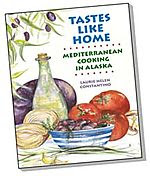
Tastes Like Home: Mediterranean Cooking in Alaska.)

While Briam is what I make most often, grilled and roasted vegetable combinations are popular throughout the Mediterranean region; I like them all. For example, in Tunisia, tomatoes, onions, and peppers are grilled and mixed with Tabil (pronounced “table”), a spice mix containing coriander seeds, caraway seeds, garlic, and dried red peppers, to make a refreshing cold salad called Mechouia.

This weekend I needed a main course, not a salad, but really had a taste for Mechouia. Inspired by a Paul Gayler recipe in
A Passion for Vegetables, I decided to combine Tunisian Mechouia with Greek Briam. I used a vegetable combination typical of Briam and, as for Briam, oven-roasted the vegetables. However, instead of the herbs used in Briam, I seasoned the vegetables with Tabil and quickly charred them, two essential elements of Mechouia.

The vegetables can be completely cooked on a grill, in which case, the oven-roasting step is unnecessary. However, when I’m cooking on a stovetop grill pan (as I was yesterday due to the snow), it’s much easier to quickly char the vegetables on the grill pan and then finish cooking them in the oven.

A benefit to pre-cooking the vegetables on the grill is this step can be done well ahead. Although you can skip charring them and completely cook the vegetables in the oven, I don’t recommend it because you lose the smokiness, an important flavor element in this dish.


Oven-Roasted Vegetables with TabilSmoky Tunisian Oven-Roasted Vegetables with Tabil (Τυνησιακό Μπριάμ)
Serves 4 as a main course or 6 as a side dish
Adapted from
A Passion for Vegetables by Paul Gayler (Lyons Press 2000)
This dish is a combination of Briam and Mechouia; it has Briam’s oven-roasted vegetable medley, with Mechouia’s smokiness and spicing. We like spicy food, so I use the larger amounts shown in the ingredient list for Tabil. If you prefer less highly seasoned food, use the smaller amounts. If you’re unsure, mix up the dry spices and add half to the vegetables along with all of the garlic; when the vegetables are done, taste and add more dry spice mix, as needed. Tabil tastes great with any kind of vegetable (or fish, meat, or poultry), so consider the list of vegetables as only a suggestion. Leftovers may be roughly chopped and added to vegetable or chicken stock for an easy mid-week soup.


Tabil:
1 – 2 Tbsp. coriander seeds
1 – 2 tsp. caraway seeds
1” – 2” piece of dried red pepper or 1/4 – 1/2 tsp. crushed red pepper
2 tsp. finely minced fresh garlic

Vegetables:
4 medium Yukon Gold or red potatoes
2 medium zucchini
2 red bell peppers
1 large fennel bulb
1 extra large onion
Olive oil
Salt
Freshly ground black pepper

For the Tabil spice mix: Mix all the ingredients together.

For the Vegetables: Preheat the oven to 400°F.

Wash all the vegetables. Peel the potatoes, and cut into large chunks. Parboil the potatoes in salted water for 7 minutes, drain, and put them in a large roasting pan.

Cut the zucchini on the diagonal into 3/4” slices. Discard the peppers’ seeds and stems, and cut each into six lengthwise slices. Cut off the stalks and leaves of the fennel, and cut the bulb in lengthwise quarters. Remove most of the core, leaving enough so the layers of fennel stay together. Cut each quarter in half lengthwise. Peel the onion, leaving the stem end intact so the layers of onion stay together, and cut into 3/4” wide lengthwise sections. Put all the vegetables in the roasting pan, sprinkle with salt and freshly ground black pepper, liberally drizzle with olive oil, and toss the vegetables to coat them with oil.

Heat a grill pan until it's white hot (or fire up the grill). Quickly char the vegetables on both sides, but don’t cook the vegetables through. Char the vegetables in batches; for me, it's easiest to lay them out on the grill pan one at a time. As each vegetable is done, return it to the roasting pan. (I set the peppers aside, and peel them before adding them to the pan; this step is optional.)


When all the vegetables are done, sprinkle the Tabil over, and toss the vegetables to evenly distribute the spices. If the vegetables seem dry, drizzle with a little more olive oil. Spread the vegetables out into a single layer.

Roast the vegetables for 30 minutes. Serve immediately with couscous, green salad, olives, and plenty of bread for soaking up the splendidly spicy oil and vegetable juices.

Variation: For a saucier version, stir in one 14.5 ounce can of diced tomatoes (or 2 cups freshly diced tomatoes) just before putting the roasting pan in the oven.

~~~~~~~~~~~~~~~~~~~~~~~
Oven-Roasted Vegetable Recipes

Roast Cauliflower with Dukkah (Dukkah, a Middle Eastern spice mix, enhances roasted cauliflower).
Oven-Roasted Vegetables (Λαχανικά στο Φούρνο) (How to bring out the flavor of vegetables by oven-roasting them).
Rosemary and Garlic Roasted Sweet Potatoes (Oven roasted vegetables are an ideal accompaniment to holiday meals.)
Roasted Beets with Celery Root Skordalia (Roasted celery root is a low-calorie, high-flavor alternative to bread or potatoes in the wonderful Greek garlic spread called skordalia.)

To find more oven-roasted vegetable recipes, Food Blog Search is a great tool.
~~~~~~~~~~~~~~~~~~~
This is my entry for
Antioxidant Rich Foods/Five-a-Day Tuesdays hosted by Sweetnicks.

Sunday, April 6, 2008

Recipes: Grilled Radicchio & Grilled Radicchio and Arugula Salad with Parmesan Shavings (Ψητό Ραδίκιο & Σαλάτα με Ψητό Ραδίκιο, Ρόκα, και Παρμεζάνα)

Treviso Radicchio and Knife
Treviso Radicchio and Knife (Click entry)

Radicchio drizzled with olive oil and grilled has lots of flavor and takes very little work. Grilling tames radicchio’s natural bitterness, and changes it into an ingredient that enhances everything with which it is paired.

Radicchio PastaThe outer leaves of grilled radicchio are charred, soft, and slightly smoky; the inner leaves warm yet crunchy. Mixed with garlic, olive oil, parmesan cheese, and sometimes a little good quality balsamic vinegar, grilled radicchio makes a wonderful topping for egg-yolk rich, Piemontese tajarin (or any other pasta).

The form of radicchio most commonly found in US supermarkets looks like a small red cabbage. Occasionally, the market has
Treviso Radicchio, which is elongated and, when the outer leaves are stripped away, looks like a large red Belgian endive. For most purposes, the two radicchios can be used interchangeably.

Backyard Shed 4-6-08Friday night we had no snow near the back shed; this is Sunday morning (April 6, 2008).

We planted radicchio in our Alaskan garden last summer and harvested it on our return from Greece in October. Today we ignored the 12” of snow that fell yesterday and started this year’s radicchio seeds in the garage.

Radicchio Ready to GrillGrilled Radicchio (Ψητό Ραδίκιο)
Serves 4
If you don’t have the time, weather, or inclination to start a fire, it’s easy to grill radicchio on a cast iron grill pan.

2 heads radicchio, round or elongated (Treviso)
Olive oil
Salt

Rinse off the radicchio and discard any damaged portions. Cut round radicchio in quarters, and elongated radicchio in lengthwise halves. Drizzle with olive oil and season with salt.

Preheat a cast iron grill pan until it is very hot (if you're grilling over fire, you need
moderately hot coals), and grill the radicchio on all sides until the outer leaves are nicely browned. Remove from the grill.

Serve immediately drizzled with a little best quality balsamic vinegar. For use in another recipe, cut out any tough center core, and roughly slice or chop into pieces.


Grilled Radicchio and Arugula Salad with Parmesan ShavingsGrilled Radicchio and Arugula Salad with Parmesan Shavings (Σαλάτα με Ψητό Ραδίκιο, Ρόκα, και Παρμεζάνα)
Serves 4
Save leftover salad
and wrap it, with a few parmesan shavings, in a warm flour tortilla for one of the most delicious vegetarian sandwiches you’ll ever eat. To make parmesan shavings, you need to start with a chunk of fresh parmesan cheese, preferably Parmigiano-Reggiano.

Dressing:
2 Tbsp. sherry vinegar
1/2 tsp. Dijon mustard
Salt
Freshly ground black pepper
4 Tbsp. extra virgin olive oil

Salad:
4 cups roughly chopped grilled radicchio
4 cups loosely packed torn pieces of arugula
1/4 cup chopped parsley
1/4 cup thinly sliced red onion or shallot
Parmesan shavings

Whisk together the sherry vinegar, mustard, salt, and freshly ground black pepper. Slowly whisk in the extra virgin olive oil. Taste the dressing and add salt or pepper as needed. Mix all the remaining ingredients together in a bowl. Toss with the appropriate amount of dressing just before serving (there may be dressing left over).

Using a vegetable peeler, or very sharp knife, shave off very thin pieces of parmesan and arrange over each serving of salad.

Serve immediately.

~~~~~~~~~~~~~~~~~~~~~~~
Radicchio Recipes

Lentil Salad with Radicchio, Celery, and Capers (Ilva makes an easy salad with marinated lentils and fresh radicchio and celery.)
Radicchio Stuffed with Cheese and Sun-Dried Tomato Vinaigrette (Cris gives directions for a beautifully composed fresh radicchio salad.)
Roasted Radicchio di Treviso (Susan tells how to simply roast radicchio with grated cheese.)
Bruschetta with Burrata and Radicchio Marmalade (Luisa tests Russ Parsons’ recipe for Radicchio Marmalade and finds it “delicious beyond words.”)
Radicchio Soup – Minestra di Radicchio (Susan makes radicchio soup, flavored with vegetables, pancetta, and ham.)

To find more radicchio recipes,
Food Blog Search is a great tool.

~~~~~~~~~~~~~~~~~~~
This is my entry for
Weekend Herb Blogging, hosted this week by Jai and Bee from Jugalbandi.

The first picture, of the Treviso Radicchio and Knife, is my entry for Click, a food photography event hosted and created by Jai and Bee from Jugalbandi. This month’s theme is Au Naturel: food photographed in its natural state.