Wednesday, November 7, 2007

Ingredient: Leaf Celery

Leaf CeleryTwo readers asked for information about leaf celery, also known as cutting celery, the celery I often recommend using in Mediterranean recipes: “What is the difference between leaf celery and the celery at the grocery store? Can I substitute one for the other?” “Where can I buy leaf celery?”


Mediterranean Cooking in Alaska has moved as of March 2011. To read this post please go to

http://www.laurieconstantino.com/all-about-leaf-celery/

Please click on over and visit my new site. Thank you!

Tuesday, November 6, 2007

Leftovers: I Love Them, You Should Too; or Don't Throw Away Your Pie Dough

Some time ago we went to a friend’s house for a wonderful, well-cooked meal. I helped her clean up afterwards, and asked where she kept her storage containers so I could stick the leftovers in the refrigerator. She laughed, and said, “Just throw it in the garbage; I don’t bother saving leftovers.”

Throw it in the garbage? Throw away perfectly good food, all of which has excellent flavor, that she had spent hours preparing? I asked her why she was throwing it away. She said no one in her house liked eating the same thing over again, and they all wanted freshly prepared food each day.

I didn’t argue, but I also didn’t understand. Wasting perfectly good food bothers me. I can still hear my mother admonishing me about “starving Armenians” whenever I take my eye off the ball and let food turn green in the refrigerator.

A moment’s digression: As far as I know, there were no Armenians in the small Pacific Northwest town where I grew up. The Armenian genocide occurred between 1915 and 1918. Why, then, is the phrase “starving Armenians” so firmly fixed in my mind? I called my parents to ask. The answer is their parents chided them regularly to not waste food because the “poor starving Armenians” would really appreciate it. When raising us, a reminder about “starving Armenians” was the talismanic way my parents ensured we would remain members in good standing of the “clean plate club.”

But where did the phrase come from? In the decade after World War I, the American people raised millions of dollars to assist Armenian genocide survivors. Relief organizations used the image of “starving Armenians” to help raise money (at that time, many Armenians were, indeed, starving). Adults reminded schoolchildren across the country, including my father in the Northwest and my mother in the Midwest, of the Armenians’ plight, particularly around mealtimes.
My Dad said it wasn’t until he was an adult that he knew who the Armenians were; as a child he just knew they were starving and really liked spinach. (As in, “Boy, eat your spinach. The ‘starving Armenians’ would feel lucky to have it.")

Back to my leftover-tossing friend: She had worked hard to develop delectable flavors in the dishes she served us. Putting these flavors in the garbage along with the leftovers meant she couldn’t use them to heighten and improve the food she would be making over the coming week.

When we have leftovers, I think of them as complex ingredients that can be used to create new dishes, rather than as reheated dinners we have to slog through because people somewhere in the world are starving. By using leftovers as ingredients, I often hit on flavor combinations so desirable they become dishes I make for their own sake.

For example, there is a recipe in Tastes Like Home: Mediterranean Cooking in Alaska for a Palestinian Chicken and Onion dish called Masakhan. I used its leftovers to make chicken soup bursting with Middle Eastern flavors. It is now a favorite winter meal I make starting from scratch. Had I not saved and used the leftovers from Masakhan, I never would have discovered this complex and exotic soup.

Last night I decided to use two stuffed eggplants left over from the Imam Baildi we had last week. The flavors I had to work with were well-cooked eggplant with onions, parsley, and tomatoes. I thought about using the mixture as a filling for filo pastry, or for soup, or as the basis for a sauce, but decided I was in the mood for Melitzanosalata, the eggplant spread Greeks call Eggplant Salad.

Putting tomatoes and onions in Eggplant Salad may not be the most traditional way Greeks make the dish, but this combination of ingredients is commonly used in spreads and salads throughout the Balkans and Middle East. With a few minor adjustments, my leftover Imam became a new plate of Eggplant Salad that in turn became part of a lovely pre-dinner appetizer spread.

Once you start regularly using leftovers as an ingredient, it becomes easier and easier. Soup is always a good destination for leftovers, but be sure only to use ingredients with complimentary flavors. My grandmother would dump all the leftovers she had into the same soup pot whether or not their flavors went together. This is not a good idea.

Leftover meat works well in salads, or combined with rice, or incorporated into a pasta sauce. It can be used in fillings for stuffed vegetables or added to braised vegetables as flavoring. Hot sandwiches are another choice way to use leftover meat.

My mother is fond of making pot pies with her leftovers. She buys little aluminum pie pans, lines them with the dough she has leftover from making pies, and freezes the pie crusts for future use. When she has leftover meat and vegetables, my mother grabs the frozen pie crusts and puts together an effortless pie for dinner.

After my mother explained her clever pot pie techniques, she asked if I ever had leftover pie dough. Yes, indeed I have, but I always just throw it away, I said. This was the wrong answer. Using her best “Mother voice” she said, “Don’t throw leftover pie dough away; that is bad, bad, bad form. Even if you don’t want to freeze pie crusts, you should roll out the extra dough, sprinkle it with cinnamon and sugar, and bake it in the oven, which is already hot. It’s really good and you can eat it when your husband’s gone.” Okay, I said, okay. “Tell your readers not to throw food away. And tell them not to waste their pie dough.”

Consider yourself told. Don’t waste your pie dough.

Meze Spread 2 with Eggplant SaladMelitzanosalata (Eggplant Salad) with Eggplant Leftovers
This can be made with leftovers of baked or stewed eggplant. The proportions are based on having 1 1/2 – 2 cups of chopped eggplant and other vegetables after they are drained.

- Leftover eggplants, together with any onions or tomatoes that were part of the original eggplant dish; peels removed from the eggplants
- 2 Tbsp. extra virgin olive oil
- 1 Tbsp. red wine vinegar
- 1 - 2 cloves garlic, grated on a small-holed grater, or very finely minced

Meze Tray with Eggplant SaladPut the peeled eggplant and other vegetables in a strainer lined with paper towels. Let the liquids drain off for about an hour. (I save and use these liquids as a seasoning in vegetable dishes.) Dump the strained vegetables onto a cutting board and roughly chop them. (The salad’s texture is better if you chop the vegetables by hand, so don’t use a food processor for this task.) Place the chopped vegetables in a bowl. Add the olive oil, red wine vinegar, and garlic to the chopped vegetables. Taste and add red wine vinegar, garlic, salt, and pepper, as needed. Serve with toasted bread, olives, pickled peppers, and cheese as part of an appetizer spread (called mezedes in Greek).

Monday, November 5, 2007

Cookbook: Pork with Celery-Lemon Sauce (Hirino me Selino kai Lemoni)

Pork with Celery-Lemon SaucePork with Celery-Lemon Sauce is a popular Greek stew with countless variations, but it’s a tricky recipe to get right. Too often the sauce overwhelms the pork, or goes in the opposite direction and vanishes into blandness. Some recipes taste good, but because the sauce is thick, gloppy, and pale, the finished dish looks very unappealing.

I’ve made versions of pork with celery more times than I care to count, and tinkered repeatedly with the balance of flavors and textures. In my version, the celery is just strong enough to balance the pork, and the eggless lemon sauce is bright and sharp.

Celery and OnionsIf I can find it, I make this dish with leaf celery, which has a concentrated herby flavor absent in supermarket (stalk) celery, and a hint of bitterness that goes well with pork, a mild and slightly sweet meat. In Anchorage, leaf celery is found in Asian or farmer’s markets, and may be sold as “Chinese celery.”

When celery is served on its own, more likely than not it will be as part of a raw vegetable tray with ranch dressing, or filled with peanut butter for hungry dieters. Pork with Celery-Lemon Sauce uses 8 cups of chopped celery, and provides a way to appreciate celery's distinctive flavor without it being overwhelmed by ranch dressing. You also won't have to cope with a wad of peanut butter sticking to the roof of your mouth.


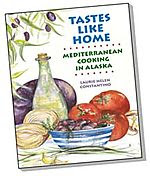
From start to finish, Pork with Celery-Lemon Sauce takes me about an hour to make. The recipe for it is in Tastes Like Home: Mediterranean Cooking in Alaska, which can be ordered here.

Saturday, November 3, 2007

Recipe: Pasta with Sardines and Fennel

After returning from language school in Taormina, Sicily, my sister continued to crave Sicilian food. She discovered a recipe for Sicilian Pasta with Sardines on Epicurious that was so good she ate the leftovers for breakfast and lunch the next day.

Pasta with Sardines is one of Sicily’s classic dishes, and there are countless recipes for it. In The Flavors of Sicily, Anna Tasca Lanza refers to it as “the national dish of Sicily.” Lanza, the owner of Sicily’s Regaleali winery and Sicilian food expert, says Pasta with Sardines and Fennel contains all the classic elements of Sicilian food: “fennel from the earth, fish from the sea, pine nuts from the trees, dried currents from the vine, … and that most Sicilian of ingredients, pasta.”

Some versions of the dish contain saffron, some use tomato sauce, and others augment the sardines with anchovies. The two constants are sardines and fennel.

This is my adaptation of Pasta with Sardines and Fennel, using the Epicurious recipe as a starting point, but modifying it significantly to enhance the primary elements of sardines and fennel. The flavors of the finished dish are so balanced that no single ingredient stands out; had I not made it myself, I wouldn’t have known it contained sardines. It’s a gloriously harmonious creation.

Pasta with Sardines and Fennel is a simple recipe, made primarily with pantry staples. I will happily make it over and over again.

Pasta with Sardines and FennelPasta with Sardines and Fennel
Serves 4

1/2 cups currants
3/4 cup white wine
1/2 cup pine nuts
2 Tbsp. olive oil
1/3 cup Panko (dried breadcrumbs)
2 cans sardines in olive oil
2 large or 4 small fennel bulbs (3 1/2 cups diced)
4 cups diced yellow onions, 1/4” dice
1/2 cup olive oil
2 Tbsp. fennel seeds, crushed
1 tsp. crushed red pepper flakes
Salt
Freshly ground black pepper
1 Tbsp. minced garlic
1 lb. penne, or any other pasta

Mix the currents and wine in a small bowl. Set aside.

Toast the pine nuts in a dry frying pan over medium heat, watching carefully to make sure they don’t burn. Put the pine nuts in a bowl large enough to hold the cooked pasta.

Add 2 Tbsp. olive oil to the frying pan, and brown the Panko in the oil, stirring frequently, until the breadcrumbs are lightly toasted. Set aside.

Open the sardines, drain off the oil, put the sardines in a small bowl, and mash them with a fork. Add half the mashed sardines to the bowl with the toasted pine nuts, and set aside the remaining half of the sardines.

Cut the stalks off the fennel bulb, cut the bulb in half, remove the hard core, and dice the fennel bulb into 1/4” dice. Remove the green fronds from the fennel stalks, chop them, and add to the bowl with the pine nuts. Discard the fennel stalks.

Sauté the onions, fennel bulb, fennel seeds, red pepper flakes, salt, and freshly ground black pepper in 1/4 cup olive oil until the fennel is tender, about 15 minutes. Stir in the wine, currents, reserved mashed sardines, and the remaining 1/4 cup olive oil, and simmer for 1-2 minutes. Taste and add salt and freshly ground black pepper, as needed.

While cooking the onions and fennel, boil the pasta in salted water until it is al dente. Drain the pasta and add it and the hot fennel-onion mixture to the bowl with the pine nuts. Toss well. Add the toasted bread crumbs and toss again. Serve with a crisp green salad and black olives.

Recipe: Greens and Beans Soup (Fasolia me Horta)

Greens and Beans Soup

Greens and Beans Soup is a particularly welcome recipe because its ingredients are not cast in stone. If I don’t have kale, I make it with Swiss chard or spinach (although I add these tender greens later in the cooking process than I do kale).


Mediterranean Cooking in Alaska has moved as of March 2011. To read this post please go to


http://www.laurieconstantino.com/the-best-kale-for-soup/


Please click on over and visit my new site. Thank you!

Friday, November 2, 2007

Recipe: Fig, Lemon, Olive, and Rosemary Cookies

Fig and Olive CookiesWhen I have insomnia, a not infrequent occurrence, I lie in bed cataloging the contents of my refrigerator. I plan and replan how I can use the available food. As a result, I am the queen of leftovers; my midnight musings often result in new creations, with the leftovers being just one among many flavorful ingredients.

Last week, my CSA box from Full Circle Farm contained lovely, organic, black Mission figs from California. I ate some fresh, and used others in an excellent grilled cheddar cheese sandwich. When insomnia next struck, my mind turned to the figs left in the refrigerator.


Mediterranean Cooking in Alaska has moved as of March 2011. To read this post please go to


http://www.laurieconstantino.com/kitchen-creativity-how-to-use-fresh-figs/


Please click on over and visit my new site. Thank you!

Thursday, November 1, 2007

Cookbook: Fasolakia (Green Bean and Tomato Stew)

Green Bean Stew My mouth began watering for Green Bean and Tomato Stew (Fasolakia) the minute I saw that Anchorage’s Costco had begun carrying two pound bags of green beans. Two pounds is the exact amount needed to make Fasolakia, a recipe in Tastes Like Home: Mediterranean Cooking in Alaska.

Fasolakia is familiar to patrons of old-style restaurants in Greece where customers are invited into the kitchen to choose from the day’s specials. My version is based on the countless bowls of Fasolakia I have enjoyed sitting under shade trees in outdoor restaurants, eating slowly to make it last, sipping wine, and watching the world go by.

The earthy bean flavor in Fasolakia, together with the sweetness of onion, the rich luxurious taste of tomatoes, and the fresh flavors of parsley, mint, and dill makes this an exceptional dish. Sometimes, when I want a heartier stew, I add chunks of peeled potatoes to the pot.

Herbs and Onions

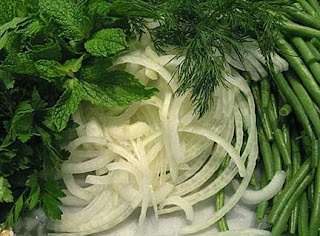
Flavors of Fasolakia: parsley, mint, dill, onions, beans

Fasolakia is a wonderful meal on its own accompanied by a slice of feta cheese and plump olives, or when served as a side dish with roasted chicken or meat. I always have plenty of crusty bread on hand to sop up the herb-filled sauce, and round out the meal with a glass of full-bodied red wine.

I’ve made myself hungry writing this. Luckily, there is leftover Fasolakia in the refrigerator.

Tastes Like Home:
Mediterranean Cooking in Alaska
can be ordered here.