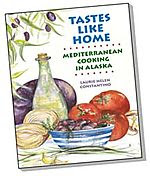
 Every cook worth her salt has many mentors who influence and inspire her in different measures. From Froso, I learned the importance of using local ingredients at their seasonal peak, and the degree to which the art and craft of cooking are inextricably entwined with the quality of the ingredients. I could not have written my cookbook, Tastes Like Home: Mediterranean Cooking in Alaska, if Froso and I had never met.
I first sat at Froso’s table 25 years ago, as her cousin’s new wife. She spoke no English. I spoke no Greek. There are no strangers at Froso's table and she welcomed me into her kitchen, the center of family life, with open-hearted hospitality.
Our shared love for food and cooking was our first common language. Beginning with our first days together, and continuing over the next two decades, I have watched, tasted, and helped Froso prepare an amazing abundance of food from what she, her family, and her friends grew or gathered, all within walking distance of her kitchen.
Froso lives in Atsiki, the small, vibrant farming village where she was born, on Limnos, a rural island in the North Aegean Sea. Once from necessity and now by choice, the foods that grace Froso’s table come almost exclusively from the bounty of her garden, fields, and pastures, the island's hunting grounds, and the rich waters of the surrounding sea.
Mediterranean Cooking in Alaska has moved as of March 2011. To read this post please go to
http://www.laurieconstantino.com/new-improved-edition-of-tastes-like-home/
Please click on over and visit my new site. Thank you!
Although it is cooked in oil, kavourma is not a fatty dish. The meat has most of the fat rendered out in the cooking process, so what is left is succulent browned pork. Here is Froso’s modern version of kavourma: When we eat it in Alaska, we feel the presence of Froso at our table, without whom our meals would be much the poorer.
 Kavourmas (Καβουρμάς)
Kavourmas and Eggs (Αυγά με καβουρμά)
~~~~~~~~~~~~~~~~~~~~~~~~~~~~~~~~~~~~~
Kavourmas and Cabbage (Καβουρμάς με Λάχανο)
Serves 4




27 comments:
Wow, what an amazingly self-sufficient woman. She sounds like she is truly inspirational. You are so lucky to have time in the kitchen with someone like Froso. Thank you so much for sharing this with us in Apples & Thyme
Froso is a true inspriation, and I do feel very lucky and blessed to know her. I'm so glad you liked the story of her table!
Wow, what phenomenal details, photos and woman! I felt transported to Greece. The recipe looks mouthwatering.
Thanks for participating in our event!
Jeni
Sounds like something I need to try at home! I loved this entry! Great photos too!
Ok, so I will just have to try it...of course at home-where else? I'm so silly. :)
Jeni, thanks for the kind words; I had fun writing this piece. And I love kavourma -- we had it again tonight, with cabbage, so I added that recipe too! Thank you and Inge for putting this event together.
Cheryl, I knew just what you meant! Of course, you could have been thinking about trying it at your m-i-l's house. Or not! Nice to see you here...
there are some women `i have met in greek remote villages who are like froso simple food yet so tasty and like her they cook whats on the season,
I have travelled in some remote places in north Greece and I tell you I still remember their xortopites
Great story Laurie I just really hope we will meet in Greece one day.... tha leme kai kali ebdomada
Επίσης, Sha, Καλή Εβδομάδα!! I'm glad you liked Froso's story. She is a wonderful woman and I love her very much. As for hortopites, I've never met one I didn't like.
I also hope we will meet one day!
wow! What a wonderful post! Thank you :)
What a great blog to find, I LOVE Mediterranean cooking and am thrilled to find some new recipes to try.
Thanks for entering this, it's a completely different take on the topic and is fun.
My years of Greek are a little behind me but you brought me back to the most wonderful days I spent in Greece visiting my bestfriend and her family. Great post Laurie! When I feel like whining because I have had a tough day, I almost always think about what my grandmothers had to function with everyday and it makes shut up! Froso is a true inspiration for all in the kitchen and I am sure you learned a lot from her.
Thank you for this lovely excursion through Greece and for your beautifully expressed memories. I will be adding your recipes to my (ever growing) list to try.
Lucky you, and lucky us for your sharing this!
It's reading things like this that make me forget that there's a sea between Greece and southern Italy where I now live...such wonderful cooking traditions.
Lovely post :)
Tartelette, you are so right -- we have it easy, especially compared to village women. Froso is my inspiration and I have learned an incredible amount from her. I'm glad you enjoyed meeting her.
Ann, thank you -- you won't be sorry if you try this -- it's delicious.
Sognatrice, when we go to Italy, I always notice its similarities with Greece, not suprising given how close the two countries are. Thank you for the kind words.
What a wonderful story and what a great Mediterranean character. It was a pleasure to read.
OK. I'm drooling.
Thank you for such a wonderful story!
Thanks Simona and Barb!
Froso is one wonder woman! makes me remember all the things i have now and to be thankful :)
Self-sufficient households amaze me! My parents harvested almost all the produce we ate in the garden they turned their suburban yards into, and it's always heartening to see that somewhere out there, people still put food they make themselves on their tables. What a great look into a Greek household! Thank you for sharing these stories and these tasty recipes! I may have to buy a hunk of pork to try it out!
Rokh, Froso is a wonder woman, and I didn't even write about one of the best things about her, and that is she is the kindest, most loving person I have ever met. I have never heard a single person say a bad word about her - quite an accomplishment.
Julie, go buy that hunk o'pork and think of Froso as you eat it! I agree with you that self-sufficient households are amazing.
Wow - she sounds like quite an inspirational and amazing lady! Thank you for sharing about her and her lovely recipes!
You're welcome childlife! Thanks for stopping by.
Hi Laurie, I've been browsing around your site and reading some of these very interesting stories. It's like reading "Loxandra" in English. Well done.
Ivy, that is a true compliment. Thank you very much.
Hi - I linked over to your site from Mel's Diner...just checking out some of your posts and began reading about "Froso". I was wondering which island in Northern Aegean she is from as my mother's side of the family is from a small island in the Northern Aegean. Is it Aghios Efstratios or Lemnos?
Hi Joanne: Thanks for stopping by! Why don't you email me at tasteslikehome(at)hotmail(dot)com?
Laurie, thanks for this posting! The kavourma with eggs is truly classic!
Post a Comment