Thursday, May 22, 2008

How to Harvest Devil’s Club Shoots and Recipes for Sautéed Devil’s Club Shoots with Onions & Crispy Chicken with Roasted Garlic

Devil's Club Towering over TeenyDevil's Club Towering Over Teeny Metcalfe
Treadwell Mine, Douglas, Alaska
Photograph by Ray Brudie

Devil’s club leaf shoots are the ultimate seasonal treat – they’re edible for only a few days a year and taste wonderful. They have a resiny, almost piney, odor when first picked that is tamed, but doesn’t dissipate entirely, when heated. Cooked devil's club shoots have a uniquely energizing and complex flavor that tastes like nothing else I’ve ever eaten.

In spring, I check the devil’s club on our property daily, anxious lest I miss the narrow harvesting window. Once they’re ready, we immediately head out with bags and baskets in hand to pick our fill of this unusual spring green.

When I mention how good devil’s club shoots taste, I often get looks of disbelief from those who have fallen victim to the spines that cover its stalks and leaves.

Devil’s club (Echinopanax horridum, also known as Oplopanax horridus) is the bane of hikers and bushwhackers in coastal forests from southcentral Alaska to northern California and east to Montana. It's also found on a few islands in Lake Superior.

Devil's club's sharp spines painfully puncture skin and can be difficult to dislodge. Because it’s such a large plant and grows in wide swaths, devil’s club renders impassable the areas where it’s found in abundance.

Close-up of Devil's Club SpinesClose up of Devil's Club leaf spines before they harden

In spring, before it has leaves, patches of devil’s club look like dried brown sticks, covered from top to bottom with nasty spines. When the leaf buds first appear, they’re cloaked in a thin brown sheath.

Once the leaf buds break through their inedible sheaths, and are 1” – 2” long, they are edible. At this stage, their leaf spines are soft and pliable. When the spines harden, the leaf shoots can no longer be eaten.

Harvesting devil’s club shoots can be tricky because it requires you to carefully pick your way through large patches of prickly stalks, which hurt if you grab them. The ground where devil’s club grows is uneven and often moist, so great care must be taken not to fall among the painful spines.

It’s also important to wear sturdy clothes when harvesting devil’s club. If you brush against a stalk of devil’s club, the spines can embed themselves in your clothing and try to work their way through to your skin.

When you’re done harvesting, check your clothes over carefully and remove any lurking spines, or they’ll stab you the next time you wear the clothes.

Devil's Club ShootsHow to Harvest Devil’s Club Shoots
Carefully grasp the green leaf bud, bend it down, and it will snap off. Be careful how you do this, as you can easily drive the surrounding spines into your hand as you’re breaking off the bud. I learned this lesson the hard way; and more than once.

Blanched Devil's Club ShootsBlanched Devil's Club Shoots

How to Prepare Devil’s Club Shoots for Use in Recipes
Carefully pick through the devil’s club shoots and discard any twigs, leaves, spines, damaged shoots, or leaf sheaths. Wash twice in cold water to remove all extraneous debris. Fill a clean sink or large bowl with cold water. Blanch the cleaned shoots in a large pot of boiling salted water for 2 minutes. Drain the shoots and immediately plunge them into the cold water. Drain well. The devil’s club shoots are now ready to use in recipes, and may be frozen for later use.

Unless I’m finely chopping or puréeing the greens, I separate the multiple leaf shoots that make up a single devil’s club leaf bud. There are both male and female leaf buds; the females have a tiny green cone in the center that eventually will flower. Both types of leaf buds are edible.

Sauteed Devil's Club with OnionsSautéed Devil’s Club Shoots with Onions
Serves 4

Sautéed Devil’s Club Shoots go well with Crispy Chicken with Roasted Garlic, any seafood or poultry dish, with pasta, or on their own.

1 cup thinly sliced yellow onions
Salt
Freshly ground black pepper
3 Tbsp. olive oil (use the oil from browning chicken if you are making it)
2 cups cleaned blanched and separated devil’s club shoots (see above)
1/2 tsp. Aleppo pepper (optional)

Sauté the onions, lightly seasoned with salt and freshly ground black pepper, in olive oil until the onions soften and start to brown. Stir in the blanched devil’s club shoots and Aleppo pepper and cook for 5 minutes, stirring regularly, or until the moisture from the blanched devil’s club has evaporated and the shoots are cooked through. Taste and add salt or freshly ground black pepper, as needed. Serve immediately.

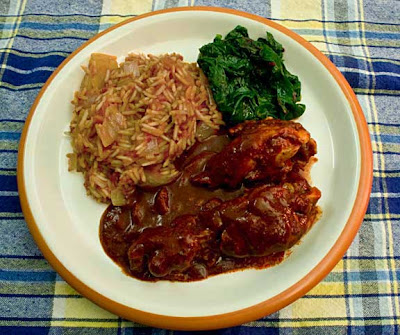
Crispy Chicken with Roasted GarlicCrispy Chicken with Roasted Garlic
Serves 4 – 6
This recipe is quick and easy; the chicken is crispy without being oily. The soft and sweet roasted garlic goes particularly well with green vegetables, including Sautéed Devil’s Club Shoots with Onions. Be sure and brown the chicken pieces in two batches; if you crowd all the chicken into the pan at one time, the chicken will steam rather than brown.

3 heads garlic
1 4-pound whole chicken, cut up, or 4 pounds chicken thighs
Salt
Freshly ground black pepper
1/3 cup olive oil

Preheat the oven to 400°F.

Separate the heads of garlic into cloves. Peel the cloves and cut off the hard bits at the root end of the cloves.

Wash the chicken pieces and dry them well. Sprinkle both sides of the chicken pieces with salt and freshly ground black pepper (don’t stint on the seasoning).

Heat the olive oil in a cast iron (or other) skillet until it’s very hot, but not smoking (if the oil is very hot, the chicken skin is less likely to stick to the pan). Place half the chicken pieces in the pan, skin side down, and let cook until the skin is well browned; this takes about 5 minutes on each side. Don’t turn the chicken or fidget with it until the skin is fully browned, or the chicken won’t cook properly. Turn over and brown the other side of the chicken. Put the browned chicken in a roasting pan skin side up. Repeat with the remaining chicken pieces.

When all the chicken is in the roasting pan, add the peeled garlic to the skillet and sauté for 1-2 minutes until the garlic is lightly browned. Evenly distribute the browned garlic among the chicken in the roasting pan.

Bake for 20 – 25 minutes, or until the chicken is cooked through. Separate the pan juices from the fat. Serve with a few cloves of roasted garlic and drizzle with the defatted pan juices.
~~~~~~~~~~~~~~~~~~~
This is my entry for Weekend Herb Blogging, hosted this week by Cate of Sweetnicks.

Wednesday, May 21, 2008

How to Harvest Fireweed Shoots with Recipe for Fireweed Shoot Omelet


Fireweed After the FireAfter the Fire: Destruction Bay, Yukon Territories, Canada
Photograph by Teeny Metcalfe


Fireweed shoot season is upon Southcentral Alaska.

Fireweed (Epilobium angustifolium) grows along Alaska’s roadways and waste areas (and throughout North America as far south as California in the west and the Carolinas in the east). Spreading rapidly on underground runners, fireweed is one of the first plants to reestablish itself after forest fires.

Fireweed’s brilliant magenta flowers brighten Alaska’s summer landscape and, in the kitchen, are an attractive salad garnish. The flowers are also the source of fireweed honey, a popular Alaskan sweetener.

Fireweed ShootsIn spring, when fireweed first emerges from the ground, its shoots are edible and similar to wild asparagus. As they grow, fireweed stalks remain edible in the sense they aren’t harmful to humans but, for me, become unacceptably bitter. The larger the shoots and the more developed the leaves, the more bitter they taste.

Fireweed grows rapidly during Alaska’s long summer days; today, from sunrise to sunset, we had 18 hours of daylight. As a result, the season for harvesting fireweed shoots is very short (only a few more days now).

Fireweed RunnerThe sweetest fireweed shoots are those cut when the leaves are still reddish. The blanched, underground portion is the sweetest part of the shoots, so I slip the knife several inches underground to harvest fireweed.

The amount of bitterness in fireweed shoots varies unpredictably. In Discovering Wild Plants: Alaska, Western Canada, the Northwest (Alaska Northwest Books 2003), the best available book on wild Northern edibles, Janice Schofield says, “Soil conditions affect flavor; I’ve found spring shoots rang[ing] from mild to quite bitter.”

After harvesting, I taste the shoots to determine their degree of bitterness. If they are very sweet, the shoots may be eaten raw. If they are bitterer than I like, I blanch them in boiling salted water before using them in recipes.

Fireweed shoots can be used in lieu of asparagus in most recipes, on their own or mixed with other vegetables in a salad, added to soups, and in any dish that calls for cooked greens. If you’re lucky enough to harvest an abundance of fireweed shoots, blanch and freeze them for winter use.

UPDATE: In a comment, Mariana from History of Greek Food pointed out that Fireweed (Epilobium angustifolium) is “found in the higher elevations of the Rhodope Mountains” where the shoots and leaves are eaten boiled. Mariana noted its Latin name is from the Greek words epi (on) and lovos (pod) and “refers to the way the flower sits on top of a long ovary, which later becomes a thin seed pod.” She says the adjective angustifolium means “with narrow leaves.”

In Greek, Fireweed is called kafsokxyla (
καυσόξυλα) and, in Bulgarian, Tesnolistna varbovka (Теснолистна върбовка).

(Coming Soon: I just checked the woods and, as of today, the Devil’s Club is ripe for picking.) UPDATE: My post on harvesting and preparing Devil's Club is here.

Fireweed Shoot OmeletFireweed Shoot Omelet
Serves 2

For 2 people, I prefer making 1 omelet in a large pan and cutting it in half, but you can also make 2 individual omelets in a smaller pan. To clean fireweed shoots, trim off any browned or damaged bits, and cut into 1” lengths. Taste, and if the fireweed shoots are bitter, blanch them in boiling, salted water before starting the recipe.

For the Fireweed Shoot Filling:
2 cups (1/4 pound) cleaned fireweed shoots (raw or blanched) or asparagus, cut in 1” lengths
2 cups thinly sliced yellow onions
Salt
Pepper
2 Tbsp. olive oil
1/2 cup water

For the Omelet:
4 eggs
1/4 cup cream
1 tsp. hot sauce (optional)
Salt
Freshly ground black pepper
1 Tbsp. butter
1 cup grated fontina or other mild cheese
1/4 cup freshly grated parmesan cheese

Make the Filling: Sauté the onions, lightly seasoned with salt and freshly ground black pepper, in olive oil until they soften and start to turn golden. Add the fireweed shoots and stir until they are thoroughly coated with oil. Add 1/2 cup water, bring to a boil, and cook until all the water has evaporated. Keep warm while you make the omelet.

Make the Omelet: Whisk together the eggs, cream, hot sauce, salt, and freshly ground black pepper. Melt the butter in a cast iron skillet (or other pan suitable for cooking omelets). Pour in the egg mixture, cover the pan, turn the heat down to low, and cook until the eggs are nearly, but not quite, set; the top of the omelet should still be moist. Sprinkle the fontina over half the omelet. Cover and cook until the eggs are set, about 1 minute.

Put the cooked fireweed shoots on top of the omelet’s cheese half and sprinkle with grated parmesan. Flip the plain half of the omelet over the fireweed shoots. Cut the omelet in half and serve immediately with a simple salad of salted tomatoes.
~~~~~~~~~~~~~~~~~~~~~~~
This is my entry for In the Bag hosted this month by Scott at Real Epicurean.

Monday, May 19, 2008

From a Volcanic Isle with Recipe for Shrimp Santorini in Tomato and Caper Sauce (Γαρίδες Σαντορίνης)

Santorini SunsetWhite-washed houses, bright blue skies, sun sparkling on the sea, and brilliant sunsets. Some of Greece’s most iconic images are of Santorini.

Santorini is an island in the southern Aegean Sea and a regular stop for cruise ships wending their way through the Greek isles. Although it's jam-packed with tourists during the summer months, visitors to Santorini, dazzled by its dramatic beauty, write glowingly about their time on the island.

Modern Santorini was shaped by a violent volcanic eruption that occurred around 1500 BC. The volcano blew away the center of the island, forming a huge caldera. Some have theorized that Santorini is the site of mythical Atlantis, and the eruption is what caused Atlantis to be swallowed by the sea. Santorini’s volcano is still active.

Two years ago, we visited Santorini in early April. Because the season had not yet begun, we often had Santorini’s narrow village streets to ourselves. Many of the shops were closed. We had a great time.

The shopkeepers and restaurant owners were happy to see us, not yet jaded by a full season of tending tourists. Over glasses of Santorini’s crisp Assyrtiko white wine, our hotel’s owner told us about the island’s bone-dry volcanic soil and the crops that thrive in it.

“Waterless” tomatoes, capers, yellow split peas (called fava in Greece), and wine grapes are Santorini’s most important agricultural products. When we left, my bags were packed with jars of sun-dried Santorini tomatoes, dried capers, pickled caper leaves, and a kilo of fava.

One of the best things I ate on Santorini was locally-caught Shrimp in Tomato and Caper Sauce. The intense taste of Santorini’s sun-dried tomatoes boosted the sauce’s tomato flavor, and tangy capers made the dish truly special.

Shrimp Santorini in Tomato and Caper SauceShrimp Santorini in Tomato and Caper Sauce (Γαρίδες Σαντορίνης)
Serves 4
Capers are salty, so don’t add too much salt until after you’ve tasted the sauce with capers in it. Shrimp stay more tender when cooked at low temperature. No matter the temperature, shrimp cook quickly and must be watched carefully to prevent them from overcooking and getting tough. My husband likes this with a little fresh lemon juice squeezed over; I prefer it without.


Tomato Sauce:
1 1/2 cups diced onions, 1/4” dice
2 Tbsp. olive oil
Freshly ground black pepper
1/2 tsp. Aleppo pepper (optional)
1/2 cup dry white wine
1 14.5-ounce can diced tomatoes or 1 1/2 cups fresh, with juices
1 1/2 cups water
1 bay leaf
2 tsp. oregano
3 Tbsp. minced sun-dried tomatoes in oil or 1 1/2 Tbsp. tomato paste
3 Tbsp. capers, preferably salted, rinsed and soaked to remove excess salt


Shrimp:
1 1/2 pounds shrimp, shelled
Lemon wedges (optional)


Sauté the onions, lightly seasoned with salt and freshly ground black pepper, in olive oil until the onions soften and start to turn golden. Stir in the Aleppo pepper and cook for 1 minute. Add the white wine and boil until it is reduced by half. Stir in the tomatoes, water, bay leaf, and oregano. Bring to a boil, cover, turn down the heat, and simmer for 45 – 60 minutes or until the sauce thickens and its flavors meld together. If the sauce is too thick, add a little water. Turn off the heat and stir in the sun-dried tomatoes and capers. Taste and add salt or freshly ground black pepper, as needed. (This can be made well ahead.)

Wash and dry the shrimp. Season them on both sides with salt and freshly ground black pepper. Bring the sauce to a simmer and add the shrimp. Cook just until the shrimp turn pink, about 5 minutes total for medium-sized shrimp. Serve immediately with chunks of feta cheese, oil-cured black olives, a crisp green salad, and plenty of crusty bread for mopping up the sauce.
~~~~~~~~~~~~~~~~~~~~~
This is my entry for
Antioxidant Rich Foods/Five-a-Day Tuesdays hosted by Sweetnicks.

Sunday, May 18, 2008

Recipe: Eggs Rockefeller with Dandelion Greens and Hollandaise

Living so far from our families, we’re nostalgic on Mother’s Day. We call and send flowers, but always wish we could be together in one place. To feel closer to our mothers, we do something special on Mother’s Day.

Last Sunday, we celebrated by making Eggs Rockefeller with Dandelion Greens and Hollandaise. To toast our mothers, we had
Bloody Marys (one of them virgin, one not), the perfect drink for eggs served with buttery hollandaise.

If you’ve never tried
dandelion greens, they have wonderful flavor when picked before the flower buds form. For information about gathering dandelions and other wild greens, go to my How to Harvest Wild Greens post.

For those who don’t have the time or inclination for dandelions, use spinach instead, the green used in many “Rockefeller” preparations. If you don’t like spinach, use Swiss chard. Or nettles. Or whatever leafy greens strike your fancy.

Hollandaise sauce is a breeze to make in a blender. For as long as I’ve been cooking, I’ve used the blender hollandaise recipe in The Joy of Cooking (a classic American cookbook) that was given me when I first moved out on my own. This recipe has never failed; it makes perfect hollandaise every time.

Eggs Rockefeller with Dandelion Greens and Hollandaise
Serves 2

Well-flavored greens, flavored with a hint of fennel, are a terrific counterpoint to runny egg-yolks and rich hollandaise. Any tender greens, wild or domesticated, may be used instead of dandelions.For special occasions, serve with a Bloody Mary or Mimosa.

1 pound dandelion greens (uncleaned) or 1 bunch spinach
1 cup diced onions, 1/4” dice
Salt
Freshly ground black pepper
2 Tbsp. olive oil
2 tsp. minced garlic
1/2 tsp. freshly crushed fennel seed
4 slices artisan-style bread or 2 English muffins
4 eggs
Blender Hollandaise Sauce (see recipe below)
Pinch of cayenne pepper

Wash the dandelions very carefully. Discard any tough or damaged leaves, stems, roots, and the tiny flower bud often found in the very center of even young dandelions.

Bring a pot of salted water to a boil. Stir in the cleaned dandelions and cook for 1 minute. Using a slotted spoon, remove the greens into a bowl of cold water. (Reserve the hot cooking water for poaching the eggs.) Drain the greens. Pick up a handful of drained greens and, using your hands, squeeze as much water out of them as you can. Continue with the remaining greens. Chop the greens.

Sauté the onions, lightly seasoned with salt and freshly ground black pepper, in olive oil until they soften and start to turn golden. Stir in the garlic and crushed fennel; cook for 1 minute. Stir in the chopped greens and toss to thoroughly combine. Cook for 5 minutes, stirring occasionally, until the liquid in the greens has evaporated. Keep warm while you make the eggs.

[For the hollandaise, put the egg yolks etc. in the blender container, and start melting the butter.] Toast the bread or English muffins.

Bring the greens cooking water to a simmer. Crack the eggs into 4 separate small bowls. Slip the eggs into the simmering water. [While the eggs are cooking, finish the hollandaise by blending hot bubbling butter into the egg yolks.]

When the simmering eggs are just set (be sure not to cook the yolks hard), remove them from the water with a slotted spoon. Drain the eggs briefly on paper towels.

Assemble: Place two slices of toast on a plate. Top each piece of toast with the cooked dandelion greens. Put a poached egg on top of the dandelions and pour a ribbon of hollandaise on top of the eggs. Sprinkle with a pinch of cayenne and serve immediately.

Blender Hollandaise Sauce
Makes 1 cup
Adapted from
The Joy of Cooking by Irma S. Rombauer and Marion Rombauer Becker (1964 edition)
The sauce must be hot when served; either make it at the very end or keep it warm by putting the blender container in warm (not hot) water. This makes enough for 3 servings of Eggs Benedict or Rockefeller and I usually only make it for 2. I’ve tried making a smaller amount and it doesn’t work; without the full amount of bubbling hot butter, there isn’t enough heat to cook the eggs. Leftover hollandaise makes a terrific sauce for asparagus or other green vegetables. To use leftover hollandaise, slowly reheat the sauce in a water bath.

3 egg yolks
2 Tbsp. lemon juice
Pinch of cayenne pepper
1/4 tsp. salt
1/2 cup butter (1 stick)

Put the egg yolks, lemon juice, cayenne, and salt in a blender. Melt the butter until it is hot and bubbling (this is easiest to do in a microwave). Blend the egg yolks on high for a few seconds, and then pour in a steady stream of hot bubbling butter. The hollandaise should now be done; if it isn’t thick enough, continue to blend for a few more seconds. If the sauce is too thick add a tiny amount of lemon juice or water. Taste and add salt, cayenne, or lemon juice as needed.

~~~~~~~~~~~~~~~~~~~
This is my entry for Weekend Herb Blogging, hosted this week by Gay from A Scientist in the Kitchen.

Tuesday, May 13, 2008

Recipe: Braised Green Beans (Fasolakia) with Lemon (Φασολάκια Λαδερά με Λεμόνι)

“If there are three Greeks in a room, you’re bound to hear five different opinions about the correct way to cook just about anything.”

Or so goes the self-deprecating joke at Holy Transfiguration Greek Orthodox Church in Anchorage, Alaska. Although it may not be literally true, the joke helps lighten the mood at festival time.

For the annual Greek festival held in August, parishioners join together to make classics of the Greek table. The correct ways to make Moussaka, Fasolakia (braised green beans), and Dolmades (stuffed grape leaves) trigger the most vigorous debates. Everyone knows the “correct” recipe, but none of them are the same.

At Mama’s Taverna, Lulu captured the essence of these debates as she described how Zoe came up with
her wonderful Fasolakia recipe.

The truth is, Greek braised green beans taste great no matter the recipe. As I commented to Lulu, “I’ve sautéed, I’ve not sautéed, I’ve layered, I’ve stirred, I’ve added potatoes, I’ve added zucchini, I’ve cooked the beans plain, I’ve cooked them with meat, I’ve cooked them without and, shockingly, I’ve even made them sans tomatoes. In all their incarnations, I’ve NEVER had a pot of Fasolakia that tastes anything other than absolutely wonderful.”

I no sooner sent the comment than I started obsessing about Fasolakia made without tomatoes (the most common recipe includes them). I used to make tomato-less Fasolakia all the time. In recent years I’ve been stuck on versions with tomato, one of which I wrote about in February:
Greek Beef and Green Bean Stew and two of which are included in Tastes Like Home: Mediterranean Cooking in Alaska (Fasolakia and Fasolakia with Zucchini and Potatoes).

Last night I made the tomato-less version. It was everything I’d been wanting. The braised beans and onions were soft and sweet, rich with oil and herbs, and tangy from the fresh lemon juice finish. This is a dish where bread is a necessary accompaniment; it’s a shame to let the remarkably good juices go to waste.

Fasolakia belongs to a class of Greek dishes called Ladera, which means “oily” (ladi/λάδι is the Greek word for oil). The oil and vegetable juices cook together to make a wonderfully unctuous sauce. However, for many today, traditional Ladera has too much oil. Adjust the amount of oil in the recipe to suit your taste; for the traditional version, use the larger amount.

When considering the amount of oil to use, keep in mind that olive oil is a heart-healthy fat. According to the
Mayo Clinic, “Olive oil contains monounsaturated fat, which can lower your risk of heart disease by reducing the total and low-density lipoprotein (LDL, or "bad") cholesterol levels in your blood.”

The FDA says there is "limited but not conclusive evidence" that 2 tablespoons of olive oil daily can reduce the risk of heart disease. (Olive oil should be substituted for fats already in the diet, and not just added to what you’re already eating.)

This recipe’s dedicated to Lulu and Zoe.

Braised Green Beans (Fasolakia) with Lemon (Φασολάκια Λαδερά με Λεμόνι)
Serves 4 - 6 as a main course
In this easy recipe, the herbs and vegetables are layered in a Dutch oven and cooked without stirring until the beans are soft and tender. The beans shouldn’t be crunchy, and must be cooked through. Adjust the amount of olive oil as desired. Serve with slices of feta cheese, Kalamata olives, bread, and lemon wedges.

1 1/2 pounds green beans (6 cups cleaned)
4 cups thinly sliced onions
1 1/2 cups minced parsley
1/2 cup minced dill
1/2 cup minced mint
3 Tbsp. minced garlic
Salt
Freshly ground black pepper
1/2 – 1 cup olive oil
1/4 - 1/3 cup fresh lemon juice
Lemon wedges

Wash the beans, break off both ends, and break them in half. Mix the herbs and garlic together.

In a Dutch oven, layer 1 cup of onions on the bottom of the pan, top with 1/3 of the beans, then 1/3 of the herb mix, season with salt and freshly ground black pepper, and drizzle with 1/3 of the olive oil. Repeat. Repeat again but finish with the remaining cup of onions before drizzling with the last 1/3 of olive oil.

Cover and cook over medium high heat until the pan lid is hot. As soon as the lid is hot, turn the heat down to low and simmer for 1 hour, or until the beans are very soft and tender. Stir in 1/4 cup lemon juice. Taste and add lemon juice, salt, or freshly ground black pepper, as needed. Serve hot or at room temperature.
~~~~~~~~~~~~~~~~~~~~~~~~~
This is my entry for
Heart of the Matter’s May heart-healthy herb challenge hosted this month by Michelle at The Accidental Scientist.

Sunday, May 11, 2008

Recipe: Carrots with Capers (Kαρότα με Kάπαρης)

When I want an easy, reliable, colorful vegetable side, I make Carrots with Capers adapted from Marcella Hazan's More Classic Italian Cooking. It goes particularly well with roast meat or chicken.

I’ve made it for 2 and I’ve made it for 100. Over the last 30 years, I’ve made this dish hundreds of times. It’s never been anything other than wonderful.

Marcella explains why: “The tart corrective of the capers is just what the carrots need to add a little zip to their otherwise passive sweetness. And their gentleness, in turn, tempers the tonic bite of the capers.”

I've changed Marcella's original recipe by upping the parsley, garlic, and capers. Because the garlic is cooked in water, its flavor in the finished dish is quite mild.

Try it. You won’t be sorry.

Carrots with Capers (Kαρότα με Kάπαρης)
Serves 4
Adapted from More Classic Italian Cooking by Marcella Hazan (Alfred A. Knopf 1978)
Adding the water a little at a time keeps the carrots from getting waterlogged; it's the same principle as adding broth to risotto in stages. The carrots may be cooked ahead, reheated, and the capers added at the last minute, but the carrots taste better if cooked right before serving. Since capers are salted, be careful not to oversalt at the beginning.

1 pound carrots
1/4 cup capers, preferably salt-cured
1/4 cup olive oil
Salt
Freshly ground black pepper
1 Tbsp. minced garlic
1/4 cup minced parsley
1 – 1 1/2 cups water

Wash the carrots, peel them, and cut off the tops and bottoms. Cut into lengths the size and width of a woman’s little finger.

If using salt-preserved capers, rinse off the salt and let them soak in cold water for 10 – 15 minutes, and rinse them again. If using brined capers, rinse off the brine. Dry the capers and reserve.

Sauté the carrots, lightly seasoned with salt and freshly ground black pepper, in olive oil for 2 minutes. Stir in the garlic and parsley and cook for 1 minute. Stir in 1/4 cup water and cook until the water completely evaporates. Continue adding 1/4 cups of water and evaporating it until the carrots are done. This takes 10 – 20 minutes; cook until the carrots are tender but firm.


When the carrots are done, brown them lightly in the oil remaining in the pan after the water is gone. Stir in the capers and cook for 1 minute. Taste and add salt or freshly ground black pepper, as needed. Serve immediately.
~~~~~~~~~~~~~~~~~~~~~
This is my entry for Antioxidant Rich Foods/Five-a-Day Tuesdays hosted by Sweetnicks.

Weekend Herb Blogging Roundup for May 5 - 11, 2008

Weekend Herb Blogging is a weekly event created by Kalyn of Kalyn’s Kitchen and features interesting recipes made with herbs, plants, vegetables, or flowers. For those who want to take part in Weekend Herb Blogging, here are the rules.

The responsibility for summing up each week’s submissions jumps from blogger to blogger; this week it’s my turn. Fifty people from across the globe submitted an interesting and eclectic group of recipes. I enjoyed reading them all.

The entries are described in the order they were received. If anyone finds an error, please let me know and I’ll fix it right away. Next week’s host is Gay from
A Scientist in the Kitchen.

Thai-Style Red Curry with Chicken
Alexandria, Virginia, USA
While readying her garden for spring, Cheryl of
Gluten Free Goodness found a volunteer Vietnamese basil plant growing in a patio crack. Cheryl used the basil to garnish and give flavor to Thai-Style Red Curry with Chicken.

Trio of Preserved Tomatoes
Manila, Philippines

Chicha Jo, of
80 Breakfasts, bought a passel of organic red and green tomatoes that had been “grown using local community labor at fair wages.” In an epic cook-a-thon, she made Pickled Green Tomatoes to serve with fish or burgers, Red Tomato Chutney, a versatile condiment, and Oven-Roasted Tomatoes, which she’s already used in salad, pasta, and a tart.

Farro with Mushrooms, Thyme, and Balsamic Vinegar
Salt Lake City, Utah, USA

Kalyn, of
Kalyn’s Kitchen (and creator of Weekend Herb Blogging), has trouble finding time to cook out of all her accumulated cookbooks. Luckily for us, Kalyn dove into one of her books and made Farro with Mushrooms, Thyme, and Balsamic Vinegar. Kalyn also gives tips for using farro, an ancient Mediterranean high-protein grain.

Spanish Omelet with Roasted Red Pepper Sauce
Mill Valley, California, USA

Anna of
Anna’s Cool Finds shows off her shopping skills, and demonstrates why her blog is aptly named, with a wonderful Spanish Omelet and Roasted Red Pepper Sauce served with ocean friendly Canadian lobster tail. Anna says the quick and easy pepper sauce, made with pantry staples, can also be used to enliven roast meats.

Palek Paneer (Spiced Spinach and Cheese)
Toronto, Ontario, Canada
Elizabeth of
Blog from OUR Kitchen made her favorite vegetable: an Indian spinach and cheese dish called Palek Paneer. This is so good it converted Elizabeth from a spinach hater to a spinach lover. Palek Paneer can be made well ahead, and is nicely seasoned with ginger, cumin, mustard seed, and garlic.

Matar Paneer (Spiced Peas and Cheese)
London, Ontario, Canada
Lisa of
Lisa’s Kitchen made spiced peas and cheese from the Punjab region of India and Pakistan called Matar Paneer. When you eat this, Lisa says the warm paneer cheese melts in your mouth and nicely balances the spicy tomato sauce.

Fresh Cardamom and Rocket (Arugula) Salad
Athens, Greece
Ivy of
Kopiaste went to a farmer’s market and discovered fresh cardamom greens. The seller told Ivy to use it in salads, but warned her fresh cardamom is a male aphrodisiac. (The Greek verb kardamono/καρδαμώνω means “to become invigorated.”) Ivy made a delicious Fresh Cardamom and Rocket (Arugula) Salad that included cherry tomatoes, green onions, dried figs, and fresh strawberries.

Black Bean Chili-Soup
Missouri, USA

Susan of
Farmgirl Fare made an easy, healthy, and delicious Black Bean Chili-Soup packed with herbs and vegetables. The soup can be made ahead or frozen for use on days when finding time to cook is impossible. For maximum flavor, Susan advises to buy whole spices and grind them at home; I whole-heartedly agree.

Foxtail Millet with Dal and Fenugreek Leaves
India

Srivalli of
Cooking 4 All Seasons cooks foxtail millet instead of rice and serves it with Dal and Fresh Fenugreek Leaves. Her fascinating post explains the variety of ways that fenugreek is used as food: seeds, fresh greens, and dried greens. (The word fenugreek comes from the Latin for “Greek hay;” in Greece it’s called Trigoniskos – Τριγωνίσκος.)

Ricotta Cheese Spread with Herbs
Vancouver, British Columbia, Canada

KC of
Kits Chow loves Boursin cheese but hasn’t been eating it since starting the South Beach diet. To ease her longing, KC created a lovely Ricotta Cheese Spread with Herbs seasoned with cilantro, lemongrass, ginger, garlic, and lemon zest.

Minty Watermelon Shake
Philippines

Gay of
A Scientist in the Kitchen blends watermelon and fresh mint to make a wonderfully refreshing Minty Watermelon Shake: the perfect drink for a sunny day.

Red Quinoa Stuffed Peppers
Raleigh, North Carolina, USA

Natalie of
Gluten Free Mommy loves quinoa and says it’s easiest to make in a rice cooker. For Red Quinoa Stuffed Peppers, Natalie bakes peppers with red quinoa, kale, tomato, and herb stuffing, and serves them with mashed avocado and lime.

Herbed Parsnip Soup
Greenwich Village, New York, USA

The Chocolate Lady says that parsnips are at their sweetest and most intense in early spring. For the last days of Passover, she made Herbed Parsnip Soup, a comforting soup guaranteed to sooth even the most harried among us.

Split Pea Soup
Melbourne, Victoria, Australia

Johanna of
Green Gourmet Giraffe was inspired by medieval recipes for pease pudding to make vegetarian Split Pea Soup. She uses smoked paprika instead of ham to round out the soup’s flavor. For food history buffs, Johanna describes pea soup’s importance in years past.

Oregano Crusted Wavy Pork Skewers
Belgrade, Serbia

Marija of
Palachinka layers thin pork slices with zucchini and smoked cheese, skewers them, and coats them with oregano flavored bread crumbs to make Oregano Crusted Wavy Pork Skewers. Marija cooks interesting Serbian food; when you’re done reading about pork skewers, check out the rest of her wonderful blog.

Liver in Onion and White Wine Sauce
Croatia (Dalmatia) via the UK
Maninas of the wonderful
Food Matters blog shares her mother’s recipe for Liver in Onion and White Wine Sauce. Sweet carrots and onions combine with white wine, garlic, and parsley to make a typically Croatian sauce. When served over buttery soft mashed potatoes, Maninas' liver dish is heavenly.

Carpaccio with Dandelion Salad and Truffle Oil
Anchorage, Alaska, USA

Laurie of
Mediterranean Cooking in Alaska (yep, that’s me) used the first, sweet dandelions of the year to make Carpaccio with Dandelion Salad and Truffle Oil. I also give some basic rules to follow when foraging for wild greens.

Tamarind Rice
Los Angeles, California, USA
Divya Vikram of
Dil Se says Tamarind Rice is the ultimate comfort food and can be prepared in minutes. She mixes cooked rice with lots of Indian spices, chili, and garlic. Tamarind Rice can be made with pantry staples, so is a handy dish for days when you don’t have time to go shopping.

Dhokla Sandwiches
California, USA

For days when she wants something attractive, delicious, and low-calorie, Mansi of
Fun and Food makes Dhokla Sandwiches filled with cilantro chutney. The bottom layer is a steamed chickpea flour cake and the top layer a steamed chili and cilantro cake. Dhokla Sandwiches are perfect finger food that can be served with your choice of dipping sauce.

Bottle Gourd Curry (Bolu Kodhel)
India via the UK

Sia of
Monsoon Spice came home after a long flight from India and needed simple comfort food. She made her amah’s mother’s recipe for Bottle Gourd Curry which mixes silky bottle gourd with spicy sambar powder and sweet jaggery. (Use the links if you need help understanding what, for me, are exotic ingredients.)

Parsley Pesto with Walnuts
Sydney, New South Wales, Australia

Peter of
Souvlaki for the Soul makes Parsley Pesto with Walnuts and serves it on toasted pita bread and also tossed with pasta. Peter says it’s delicious and highly addictive. For anyone interested in food photography, Peter’s blog is a must; he consistently takes some of the best and most innovative photographs available in the food blogosphere.

Yellow Rice & Black Bean Salad
Lima, Peru

Last Friday, Gretchen of
Canela & Comino woke up to a wind storm; winter is arriving in Peru. Gretchen, however, is still pretending it’s summer so made a healthy Yellow Rice and Black Bean Salad.

Millet and Red Pepper Pilaf
Ontario, Canada

Ricki of
Diet, Dessert and Dogs used her knowledge of gluten free grains to whip up a 20-minute Millet and Red Pepper Pilaf. Curry and coconut milk add Asian undertones, and complement the sweet red peppers. Pretty to look at, pleasingly aromatic, and ready in a flash, Ricki’s millet pilaf is a wonderful side dish.

Mom’s Stuffed Artichokes
San Diego, California, USA

Susan of
Food Blogga first helped her mom make vegetarian stuffed artichokes when she was 6. After moving to California, the artichoke-lovers’ promised land, Susan called her mom for advice on how to make them by herself. Over the years, Susan has perfected her Mom’s Stuffed Artichokes and now shares the recipe with us.

Roasted Tomatoes with Fresh Chives
Soddy Daisy, Tennessee, USA
Pam of
Sidewalk Shoes is blessed with too many chives in her garden. One way she uses them is in quick and easy Roasted Tomatoes with Fresh Chives. Pam says roasting sweetens and deepens the flavor of even off-season tomatoes.

Lamb Shanks in Port Sauce
Victoria, Australia

Autumn has arrived in Australia, and Pam of
The Backyard Pizzeria turns to her favorite cut of meat to make the perfect fall dish: Lamb Shanks in Port Sauce. Pam cleverly uses a pressure cooker to turn this normally slow-cooked dish into one that is tender and succulent in only an hour.

Black Bean Chicken Chili
Ann Arbor, Michigan, USA

Mandira of
Ahaar had some leftover chicken and used it to make Black Bean Chicken Chili. Green peppers and carrots give substance to the chili, which is warmly spiced with cumin and chili powder.

Sourdough Rosemary Olive Oil Bread
Arcata, California, USA

Tommi of
Brown Interior makes her first WHB entry a great one with La Brea Bakery’s recipe for Sourdough Rosemary Olive Oil Bread. Tommi’s loaves have a beautiful tender crumb from the added olive oil, which also makes the crust thin and crispy.

Pineapple Sage
Australia

Linda of
Snowys grows Pineapple Sage as an ornamental perennial and provides links for Pineapple Sage Pound Cake and Pineapple Sage Tea. The gorgeous red flowers can also add a tasty accent to fruit salads.

Portuguese Chicken
Sydney, New South Wales, Australia

Australians are obsessed with
Portuguese Chicken for good reason, says Anna of Morsels & Musings. The spicy chicken is seasoned with Piri Piri (African Birdseye) Peppers which, at 175,000 Scoville units, are hotter than Thai and Pequin peppers but not as hot as Habaneros or Scotch Bonnets. To cool down your mouth, Anna throws in a bonus recipe for Coriander Soup.

Gingko Nut and Mushroom Custards
Melbourne, Victoria, Australia

Lucy of
Nourish Me searched out gingko nuts at an Asian grocery and used their pungent flesh to make Gingko Nut and Mushroom Custards. Seasoned with shiitake mushrooms and smoked tofu, Lucy says the barely set, quivering custards are a welcome restorative. Speaking of restoratives, Lucy’s lyrical writing and striking photographs make Nourish Me one of mine.

Roasted Garlic Oil
Toronto, Ontario, Canada

Kevin of
Closet Cooking claims he used to make boring meals, but you’ll never believe it if you read his prolific postings. This week, Kevin enters an easy recipe for Roasted Garlic Oil. Making the oil leaves you with a bonus bowl of roasted garlic that can be tossed with pasta, spread on toast, slipped under chicken skin, or used in a myriad of other ways; just don’t throw it away.

Asparagus Chèvre Quiche
Les Pineaux, Vendée, France

Katie of
Thyme for Cooking dreams of eating Asparagus Chèvre Quiche in the Monet-designed gardens of Giverny and takes us along to this floral paradise. Katie's spendid quiche has an interesting brown rice crust and also includes prosciutto, tomatoes, and basil.

Braised Peas with Pancetta and Onions
Melbourne, Victoria, Australia

Haalo of
Cook Almost Anything brings us her mom’s recipe for Braised Peas with Pancetta and Onion. Fresh peas are combined with slowly braised onions, garlic, and pancetta in a glorious side dish. Haalo says she never has leftovers when she makes this; it’s that good.

Spring Lamb Stew
Boston, Massachusetts, USA
Tammy of
Food on the Food braises spring lamb until it’s fork-tender and mixes it with fresh asparagus, peas, tarragon, and chervil to make Amanda Hesser’s Spring Lamb Stew from The Cook and the Gardener. If you haven’t seen WHB first-timer Tammy’s blog, I recommend it – she’s a humorist as well as an excellent cook.

Dolmadakia (Stuffed Grape Leaves and Zucchini Flowers)
Hania, Crete, Greece

Organically Cooked is one of my favorite Greek food blogs. Its author, Maria, is a born storyteller and purveyor of healthy, tasty, and traditional Cretan foods. For her first time participating in WHB, Maria makes rice-stuffed Dolmadakia (Stuffed Grape Leaves and Zucchini Flowers). Maria cleverly uses Dolmadakia as caps for oven-baked Stuffed Tomatoes.

Pasta with Pink Peppercorns
Chennai, India

Arundathi of
My Food Blog approached pink peppercorns with trepidation after learning they can be toxic if eaten in large quantities. However, when she made Pasta with Pink Peppercorns with exactly 5 peppercorns, Arundathi discovered they added a delicate and wonderful flavor to her vegetarian pasta recipe.

Chinois Pancakes
New York, USA

Siri of
Siri’s Corner continues her series of vegetarian Wolfgang Puck recipes with her post on Chinois Pancakes. Though the pancakes were originally designed to accompany Puck’s Chinese Duck with Plum Sauce, Siri says they can be served with just about anything. The savory pancakes, seasoned with garlic, ginger, and green onions look like beautiful lace.

Zoe’s Green Beans (Fasolakia tis Zoes)
California, USA

Green beans braised in tomato sauce are a classic of the Greek table, and for good reason: they taste wonderful. At
Mama’s Taverna, clever Lulu gives us a taste of the debates that rage in Greece over the correct way to make Fasolakia (and every other classic dish), as well as a recipe and step-by-step photographic instructions.

Creamy Quinoa with Banana, Cassia, and Almonds
Melbourne, Victoria, Australia

With fall’s arrival in Melbourne, Another Outspoken Female from
Confessions of a Food Nazi is drawn to hot breakfasts. Creamy Quinoa with Banana, Cassia, and Almonds hits just the right spot. Ms. Outspoken hand-grates cassia bark for seasoning, and prefers its spicier flavor to that of milder true cinnamon.

Mushroom Balls
Davis, California, USA

Sher of
What Did You Eat? loves meatballs, but decided it was time to make something that would let her vegetarian friends “experience the joy of popping a savory orb into their mouths.” She serves her delicious gluten-free Mushroom Balls with spiced red sauce and says they look meaty, but taste like concentrated mushrooms.

Cheese, Olive, and Buttermilk Herb Bread
Sydney, New South Wales, Australia

When Y of
Lemonpi was young, she made her brother hot breakfasts showcasing cheese, one of his favorite foods. In honor of those long ago days, Y recently made her brother Cheese, Olive, and Buttermilk Herb Bread. With oodles of herbs and two kinds of cheese, Y’s beautiful bread is best served warm.

Tapenade (Olive Spread)
Northern Germany
Ulrike of
Küchenlatein used thyme and rosemary from her garden to make a Provençal olive spread called Tapenade. Anchovies and capers add to Tapenade’s flavor, which is best served on freshly baked bread.

French Beans with Spicy Dried Shrimp
Singapore

For busy nights when Wiffy of
Noob Cook wants flavorful food in a hurry, she makes French Beans with Spicy Dried Shrimp. Green beans are cut in 1/2” lengths, seasoned with chili, garlic, and dried shrimp, stir-fried for 5 minutes, and served with steamed rice.

Spareribs with Bitter Gourd Soup
Philippines

Soli Deo Gloria of
Hearth and Home learned to remove the bitterness from bitter gourds by making Spareribs with Bitter Gourd Soup. Since bitter gourd is such a healthy vegetable, Ms. Gloria was happy to find a way to make it that even children like.

Picnic by the Loire
France

Ronell of
My French Kitchen kindly takes us along for a Picnic by the Loire River. She packs a hamper with beautiful herbs and vegetables (and vinaigrette on the side), and adds cheese, bread, wine, and ice cream for dessert. If wishes were horses, I’d join her on the riverbank. Since they aren’t, I’ll bask in Ronell’s lovely pictures and be inspired by her good time.

Oregano Ravioli
Ontario, Canada

Natashya of
Living in the Kitchen with Puppies shows genius by making Oregano Ravioli for her maiden voyage with WHB. She works fresh oregano directly into pasta dough and stuffs the ravioli with cheese filling. Natashya serves her ravishing ravioli with grilled chicken.

Wild Garlic Chutney
Cleveland, Ohio, USA

Maybelle’s Mom of