Falafel almost whipped me, but I prevailed in the end.
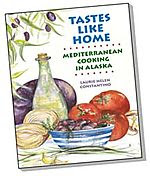
My friend Salwa, a Christian Palestinian, gave me her recipe ages ago, when I first started working on the book that became Tastes Like Home: Mediterranean Cooking in Alaska (a fundraiser for Alaska’s only Greek Orthodox Church). She made the recipe sound simple. Initially, it wasn’t.
The first few times I made falafel were miserable failures. Because I couldn’t get them right before the book went to print, Tastes Like Home doesn’t include a falafel recipe.
After re-consulting Salwa and reviewing other recipes for this wonderful Middle Eastern treat, I finally had my Eureka moment and figured out how to make great tasting falafel every time. Trust me; if you follow the directions, falafel are simple.
For those who’ve never eaten them, falafels are crispy fried chickpea or bean croquettes, seasoned with herbs, cumin, and coriander seeds. Salwa serves hers with tahini sauce and tomato-onion salad. Falafels are delicious either on their own or in a pita sandwich. Falafel (Φαλάφελ ή Ρεβυθοκεφτέδες)
Makes 25-30 small patties (serves 4 as a main course)
Adapted from Salwa Abuamsha’s recipe
To make good falafel there are four important rules: 1. Don't use canned chickpeas. 2.
Mediterranean Cooking in Alaska has moved as of March 2011. To read this post please go to
http://www.laurieconstantino.com/how-to-make-perfect-falafel/
Please click on over and visit my new site. Thank you!




23 comments:
I've only ever made these once and they disintegrated on frying! I will try your trick of soaking the chickpeas for 24 hours Laurie. Thanks for the tips. Cheers.
I heart falafel. I make a coarser version - falafel burgers, if you like - which I must post about soon. But you can't beat the real deal!
I hear ya on the debate on where falafel comes from. Here in Toronto, I would give the Lebanese community credit for bringing this delicious and healthy food to our city.
I have loved eating falafel but have never tried to make them. Thanks for a easy looking recipe. Yum!
i love falafel, but like you, my recipe never came out standard. i had some failures too, so i hope i can try this one out and be successful right from the first.
These look like they turned out perfectly. I think I may now have a new favorite recipe for falafel. Thanks for this!
these falafels look perfect. i adore falafel w(ith hummous and tabbouleh) but have never made them. i've never tried them with fava beans. do you think chickpea flour could also work?
I had the same experience as peter g. with my one and only attempt at homemade falafels -- oily disintegration. Now I'll have to dig out my falafel scoop and try out your great tips. Thanks for making it work!
Peter G, that is exactly the experience that made me give up putting falafel in the book - falling apart in the oil. I believe this is caused by inadequately grinding or processing the chickpeas. If you try again, good luck!
Flyingfork, falafel burgers sounds pretty good to me! Looking forward to your recipe.
Peter M, I'd love to visit Toronto one day; it sounds like such a vibrant city.
Gretchen, one of the best things about falafel is you can make up the mix way ahead of time.
Maria, if you make them, they'll turn out!
Lisa, you're most welcome!
Maybahay, I don't think chickpea flour would work, as the texture would be off. Although I've only tried making them with chickpeas and dried fava beans, I'd guess the recipe would work with pretty much any kind of white bean.
Manju, I'm glad to hear I'm not the only one with falafel disintegrating in oil! I hate it when recipes don't work, and so glad I finally figured this out before I got a complex.
Looks absolutely delicious, and completely nistisimi! If only I could make a good tahini sauce - I tried to make it last weekend, to horrible results (I made tahini paste, and it tasted terrible!).
I can see why you had problems with these...I would too, if not reading your post. The idea of using chickpeas that have been soaked but not 'cooked' would seem strange... and I always cut corners like not soaking long enough.
You inspire me to give them a try!
Melusina, are you saying you ground your own sesame seeds? If so, that is definitely ambitious. On the island, there are two kinds of tahini - one light and one dark. The dark kind makes awful tahini sauce, you really need to use the light. This probably wasn't your problem, but thought I'd mention it just in case.
Katie, exactly - I used cooked chickpeas the first time because I assumed I had skipped a step when I was taking notes while talking to Salwa. And who knew that soaking so long would be necessaray? I'm glad to do the experimenting for you!
I love falafels. I recently made them with a tahini sauce, but my favourite way is still with a feta cheese or tzatziki sauce...and yes soaking dried chickpeas makes all the difference:D
I adore felafel and can't tell you how much I appreciate you spelling out how to make them. Even though, as Peter M has pointed out, we can get terrific ready made felafel relatively easily here in Toronto.
It would never have occurred to me to use pre-soaked UNcooked chickpeas!
-Elizabeth
Val, tzatziki is great for anything fried and would definiely go great with falafel. As for the extra long soaking, I should have talked to you before I began my falafel odyssey!
Elizabeth, exactly. That's why I foolishly ignored the instructions - I couldn't believe they were right! I guess I'm just one of those people who have to learn the hard way!
Most enlightening. Like Elizabeth, I never imagined the chickpeas in the falafel patty were raw before frying. Makes sense though. I love falafel, great post!
Thanks for the recipe. I've always been too intimidated to try falafel, but your step by step instructions gave me confidence.
The first few were a little pasty on the inside, so I lowered the oil temp and fried them longer.
I had them with a tomato, parsley mint salad (it would have been tabbouleh, but no bulgur in the house), tahini sauce, and some lebanese hot pink pickled turnips that I canned last weekend. Thanks again!
I will get some dried chickpeas. I hope that works, because these look great. Thanks for the easy to understand instructions. This will be one of our go to meals this year!
I know you posted this a while ago, but I just have to come on and thank you for this recipe. I've tried falafel 6 times and each attempt ended with a ground chickpea/hot oil soup. I tried yours, step by step, and they turned out perfectly the first time. We've made it about 5 times since then. Thanks!
Luke, thanks so much for the note - I'm glad to hear I'm not the only one with falafel failures (and also that my method works for others). Mmmm, we haven't had falafel lately - think I'll start some chickpeas soaking right now!
Post a Comment